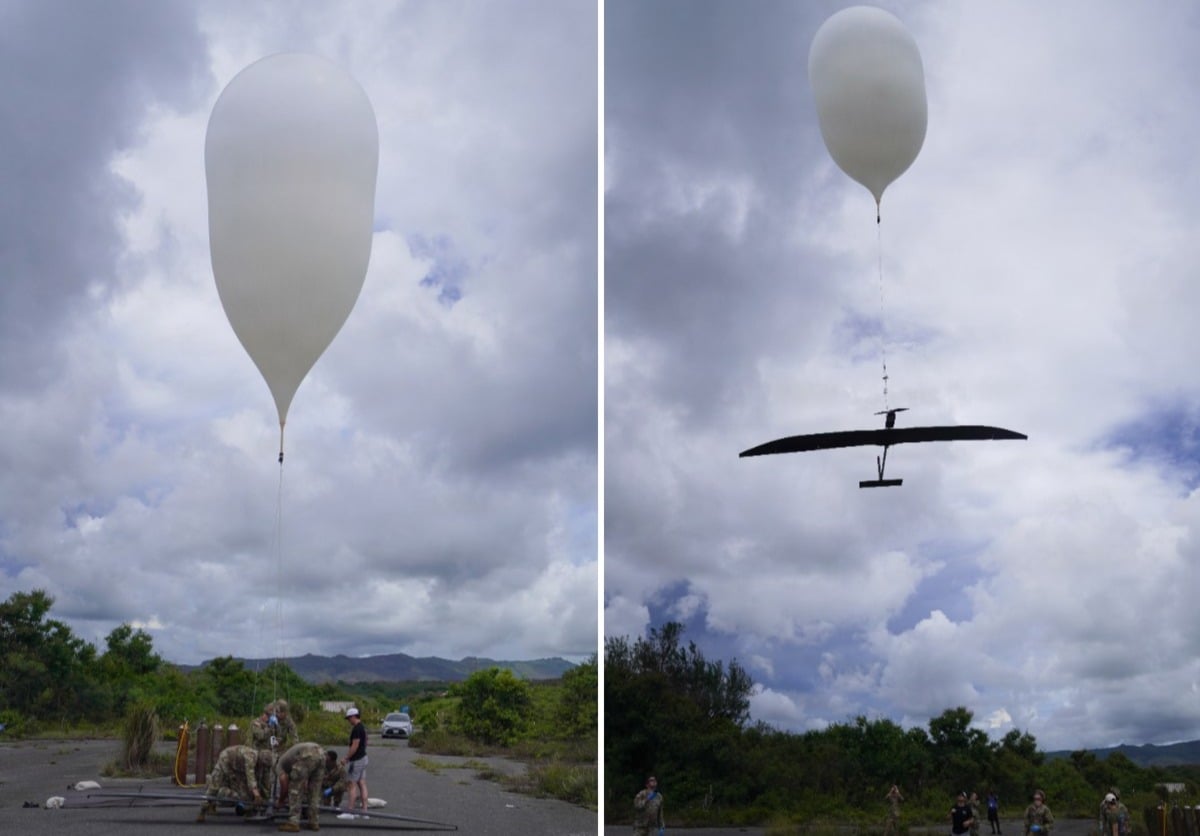
The defense tech press is losing its collective mind over the U.S. Army's latest experiments with balloon-carried, solar-powered stratospheric aircraft. The narrative circulating through Washington think tanks and tech blogs is wonderfully utopian: a lightweight, solar-winged aircraft hitching a ride on a high-altitude balloon, floating effortlessly 70,000 feet up to provide infinite, un-jammable surveillance. It sounds elegant. It sounds cheap.
It is a multi-million-dollar pipe dream.
The defense establishment has fallen into a classic trap: infatuation with theoretical endurance at the expense of basic operational physics. Over the last decade, I have watched aerospace consortia burn through staggering budgets trying to make high-altitude pseudo-satellites (HAPS) a reliable reality. The physics of the stratosphere do not care about your PowerPoint presentations. By overhyping a platform that combines the structural fragility of a solar glider with the unguided vulnerability of a weather balloon, we are building a multi-million-dollar surveillance asset that a peer adversary can neutralize with a $50,000 countermeasure.
The lazy consensus says this technology will replace expensive satellites and risky spy planes. The reality is that we are building the world’s most expensive target practice.
The Tyranny of Stratospheric Wind and Weight
To understand why this hybrid balloon-solar aircraft concept is fundamentally flawed, you have to look at the brutal engineering trade-offs required to make anything fly at 70,000 feet.
At that altitude, the air density is roughly 7% of what it is at sea level. To generate lift in an atmospheric soup that thin, a solar-powered aircraft requires an immense wingspan covered in photovoltaic cells, paired with an ultra-lightweight composite airframe. We are talking about structures with the wingspan of a commercial airliner that weigh less than a pickup truck.
The competitor's coverage lauds the balloon-launch mechanism as a brilliant way to save energy. They claim that by lifting the solar aircraft through the turbulent lower atmosphere inside a balloon envelope and releasing it only when it reaches calm stratospheric waters, you eliminate the risk of the airframe snapping during takeoff.
That solves a temporary logistics problem while ignoring the permanent operational crisis.
Once the balloon drops the aircraft, that solar-powered glider must maintain station-keeping. It has to fly in tight circles or figures-of-eight over a target area to provide continuous coverage. But "calm stratospheric waters" is a myth born of averaging out weather data over decades. The stratosphere experiences brutal, localized wind shears and seasonal jet streams that can easily exceed 60 to 80 knots.
When an ultra-lightweight aircraft with minimal thrust encounters an 80-knot headwind, one of two things happens:
- It gets blown completely off course, rendering its surveillance payload useless to troops on the ground.
- It increases motor output to fight the wind, draining its batteries faster than the sparse high-altitude sunlight can recharge them, causing a catastrophic loss of altitude.
Imagine a scenario where a commander relies on one of these platforms for real-time tracking during a geopolitical flashpoint, only for a seasonal wind shift to push the aircraft two hundred miles away into sovereign enemy airspace. It is not an alternative to a satellite; it is an unguided liability.
The Nighttime Battery Bankruptcy
The math behind solar-powered stratospheric flight is simple, unforgiving, and rarely discussed honestly by the contractors selling these systems.
A solar aircraft must generate enough energy during peak daylight hours to do three things simultaneously: power its propulsion motors, operate its high-draw radar or imaging payloads, and recharge its onboard energy storage systems completely. That storage system must then keep the aircraft aloft and operational through 10 to 14 hours of freezing stratospheric darkness.
To achieve this, the aircraft must carry high-energy-density lithium-sulfur or specialized lithium-ion battery packs. But batteries are heavy. Every ounce of battery weight added to the airframe increases the required wingspan, which increases structural drag, which demands larger motors, which requires more power. It is an engineering doom loop.
The current state of energy density means these platforms operate on a knife-edge. During winter months at higher latitudes, the angle of the sun is too low and the nights are too long. The aircraft literally runs out of juice before dawn. If the platform is forced to shed payload power to survive the night, your "always-on" eye in the sky goes blind for twelve hours out of every twenty-four. Satellites do not have this issue; they move. Traditional aircraft do not have this issue; they refuel. Solar HAPS are trapped by the calendar.
The Soft, Slow Target Problem
Let's address the elephant in the airspace: survivability.
The Pentagon is enamored with these platforms because they are supposed to fill the "capability gap" between low-Earth orbit satellites and traditional manned reconnaissance flights. They are marketed as low-cost, persistent assets. But the assumption that the stratosphere is a safe sanctuary is entirely outdated.
An aircraft that flies at 15 to 30 knots with a massive radar cross-section—caused by hundreds of square feet of flat solar arrays—is a radar operator's dream. It cannot maneuver defensively. It cannot dive to escape a threat. It cannot deploy kinetic countermeasures without tearing its fragile wings apart.
A peer adversary does not even need to waste an expensive long-range surface-to-air missile to down a balloon-carried solar glider. High-altitude interceptors or long-endurance loitering drones can disable these platforms with simple directed-energy weapons or kinetic disruption. Even worse, cyber-interdiction or electronic jamming directed at the unencrypted control uplinks of these low-cost platforms can turn them into multi-million-dollar pieces of space junk before they ever snap a single photo.
We are designing systems under the flawed assumption that our adversaries will allow them to float unmolested above the battlespace. They won't.
Dismantling the Premise: The Flawed Questions We Keep Asking
The defense tech industry loves to answer the question: "How can we keep a surveillance platform in the air for months at a time without refueling?"
That is the wrong question. The real question we should be asking is: "Is an fragile, un-survivable platform actually useful just because it can stay aloft?"
When you look at the "People Also Ask" queries surrounding high-altitude platforms, the underlying assumptions are broken. Let’s dismantle them.
Can stratospheric solar drones replace traditional spy satellites?
No. Satellites operate in the vacuum of space, completely immune to atmospheric weather, wind shear, and sovereign airspace laws. A satellite moves at orbital speeds, making it exceptionally difficult to intercept without specialized anti-satellite weaponry. A solar stratospheric glider is at the mercy of the wind and sits squarely within the reach of basic surface-to-air defense networks.
Aren't balloon-launched solar aircraft more cost-effective than satellites?
Only if you ignore the replacement rate. A single low-Earth orbit (LEO) satellite constellation might cost more upfront, but those satellites work reliably for years. A fragile solar glider that risks structural failure every time it hits a major thermal updraft, or gets shot down in the opening minutes of a near-peer conflict, has an operational lifespan measured in days. The true lifecycle cost per hour of usable data is astronomical compared to commercial satellite imagery.
Can't we just use these for domestic border security and disaster relief instead of war?
This is the standard fallback argument when military utility dries up. But even in domestic airspace, the regulatory and safety hurdles are immense. If an ultra-lightweight aircraft with a 150-foot wingspan suffers an electrical failure and drops out of the stratosphere over a populated area, it becomes a massive unguided kinetic hazard. The Federal Aviation Administration (FAA) is rightfully terrified of integrating these unpowered, unresponsive giants into domestic air traffic corridors.
The Real Path Forward: Distributed LEO Constellations
If the goal is persistent, un-jammable, high-resolution surveillance, pouring money into balloon-hoisted solar gliders is a dead end.
The actual solution is already being deployed by commercial space firms: massive, distributed constellations of low-Earth orbit small-sats utilizing synthetic aperture radar (SAR) and optical imaging.
| Attribute | Stratospheric Solar Gliders | Distributed LEO Satellites |
|---|---|---|
| Vulnerability | High (Slow, fragile, easily intercepted) | Low (Orbital speed, hard to target at scale) |
| Weather Dependence | Severe (Jet streams, cloud cover, winter nights) | Zero (SAR penetrates clouds; orbital mechanics ignore weather) |
| Payload Capacity | Minimal (Strict weight limits for lift) | Substantial (Scalable bus architectures) |
| Station-Keeping | Flawed (Fights wind, easily displaced) | Precise (Governed by orbital physics) |
I recognize the downside to this take. Distributed satellite constellations require significant rocket launch infrastructure and create long-term space debris challenges that the aerospace industry is still struggling to manage. They are also difficult to upgrade once in orbit.
But from a pure mission-readiness perspective, a satellite constellation offers graceful degradation. If an adversary knocks out three satellites, twenty more are moving into position behind them. If an adversary knocks out your single solar stratospheric glider hovering over a carrier strike group, that strike group is instantly blind.
Stop trying to revive the age of the airship with a coat of solar paint. Cut the funding to these fragile atmospheric experiments and redirect the capital toward hardended, orbital infrastructure that can actually survive a modern combat environment.