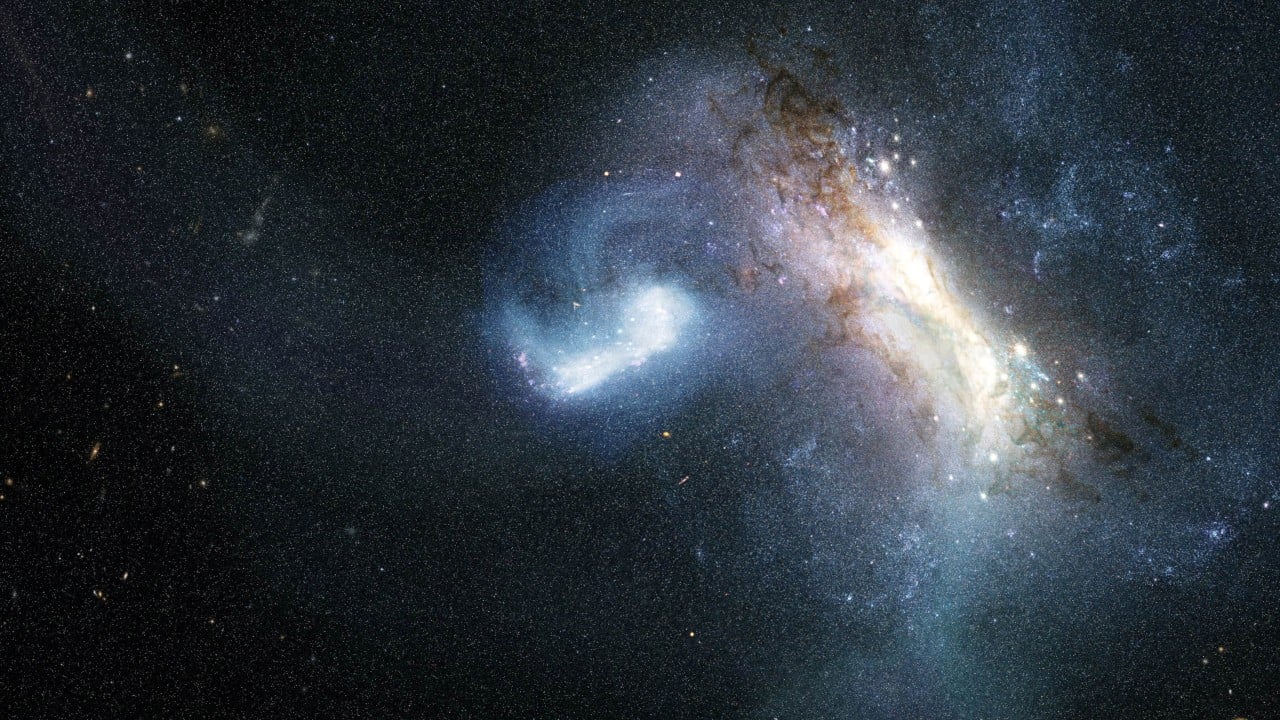
Astrophysical models of galactic formation have long wrestled with a fundamental accounting discrepancy: internal star formation rates alone cannot account for the total baryonic and dark matter mass observed in large spiral galaxies today. Recent observational data derived from the Hubble Space Telescope and the Gaia astrometric mission resolve this discrepancy by pushing the timeline of the Milky Way's earliest major galactic accretion back to 11.8 billion years ago. This event, involving a dwarf system designated as Low-energy-Kraken-Heracles, or LKH, occurred roughly two billion years after the Big Bang. By deconstructing the kinematics, metallicity gradients, and stellar cluster populations within the innermost 20,000 light-years of the galactic center, researchers have established a concrete empirical framework for how structural mass was acquired during the infancy of the universe.
The Kinematic Signature of Ancient Accretion
The primary challenge in identifying ancient galactic mergers lies in the dynamical relaxation of stellar orbits over billions of years. Stars originating from an external satellite system gradually lose their distinct orbital coherence as they mix with the host galaxy's stellar population. To bypass this analytical barrier, astronomers utilized globular clusters as stable cosmic chronometers. These dense assemblies of hundreds of thousands of stars retain their chemical and orbital signatures long after looser stellar associations have dispersed.
The analytical methodology relied on three independent variables extracted from Hubble and Gaia datasets:
- Stellar age distributions determined through Hertzsprung-Russell diagram fitting of cluster populations.
- Chemical composition metrics, specifically metallicity indices tracking elements heavier than helium.
- Space velocities and orbital trajectories mapping angular momentum relative to the galactic center.
By isolating stellar clusters within the inner 20,000 light-years that possessed distinct metallicities and retrograde orbits uncharacteristic of the primary galactic disk, the research team isolated the LKH remnant population. This population predates previously mapped accretion events, extending the confirmed merger history of the Milky Way by 1.8 billion years.
Mass Ratios and Gravitational Dynamics
At the point of collision, approximately 11.8 billion years ago, the universe operated under vastly different cosmological parameters, measuring less than 15 percent of its current age. The LKH dwarf system possessed an estimated stellar mass equivalent to 500 million solar masses ($5 \times 10^8 M_\odot$). Concurrently, the primordial Milky Way held a total mass roughly four times larger, placing the mass ratio of the merger at approximately 4:1.
This specific mass ratio dictates the mechanical nature of the encounter. Because the satellite galaxy was a fraction of the host's mass rather than an equal peer, the interaction did not result in a disruptive major merger that would have destroyed the young disk structure. Instead, it constituted a high-efficiency accretion event where the smaller system was gravitationally stripped, its stars deposited into inner halo and bulge orbits, and its constituent gas funneled directly into the galactic center.
The mechanical consequences of the LKH encounter are split into two distinct physical regimes:
- Stellar Dynamics: The stellar components crossed paths without direct physical collisions between individual stars, given the vast interstellar distances. Their integration was governed purely by gravitational potential reshaping, resulting in a dynamically quiet distribution of old stars into the inner core.
- Baryonic Gas Dynamics: The interstellar medium experienced severe hydrodynamic shocks. The collision between the gas reservoirs of LKH and the young Milky Way compressed atomic hydrogen, triggering a rapid burst of localized star formation.
The Hierarchical Assembly Timeline
The identification of the LKH merger anchors the foundational tier of a multi-stage assembly process. Galactic growth is not a continuous linear function; it proceeds via punctuated equilibrium where quiescent periods of internal star birth are punctuated by high-mass accretion episodes.
Following the LKH event, the Milky Way underwent subsequent structural transformations through later encounters. Approximately 1.8 billion years after LKH, the galaxy absorbed the Gaia-Sausage-Enceladus system, followed by the ongoing assimilation of the Sagittarius dwarf galaxy over the past six billion years. Each successive merger contributed incremental dark matter halos, enriched the chemical abundance gradients of the disk, and altered the structural boundaries of the galactic bulge.
Understanding this sequence corrects historical assumptions about isolated stellar evolution. The chemical enrichment required to produce subsequent stellar generations—including the material necessary for planetary systems billions of years later—was heavily accelerated by the primordial gas injections delivered by satellites like LKH.
Operational Constraints and Observational Barriers
Despite the precision of modern astrometry, significant data retrieval hurdles remain within the innermost galactic coordinates. High concentrations of interstellar dust obscure optical wavelengths, complicating the identification of individual remnant stars buried deep within the bulge. Consequently, current models rely heavily on statistical inferences drawn from globular cluster aggregates rather than complete stellar census data for the core.
Future observational strategies must prioritize infrared and spectroscopic surveys capable of piercing dust lanes to map radial velocity dispersions of individual sub-giant branch stars. This will test whether the LKH remnants possess distinct chemical abundance ratios in alpha-elements relative to native inner-disk populations.
Integrate these findings into galactic evolution models by treating early dwarf galaxy accretion not as an anomaly, but as the primary engine of inner bulge formation and early baryonic density scaling.