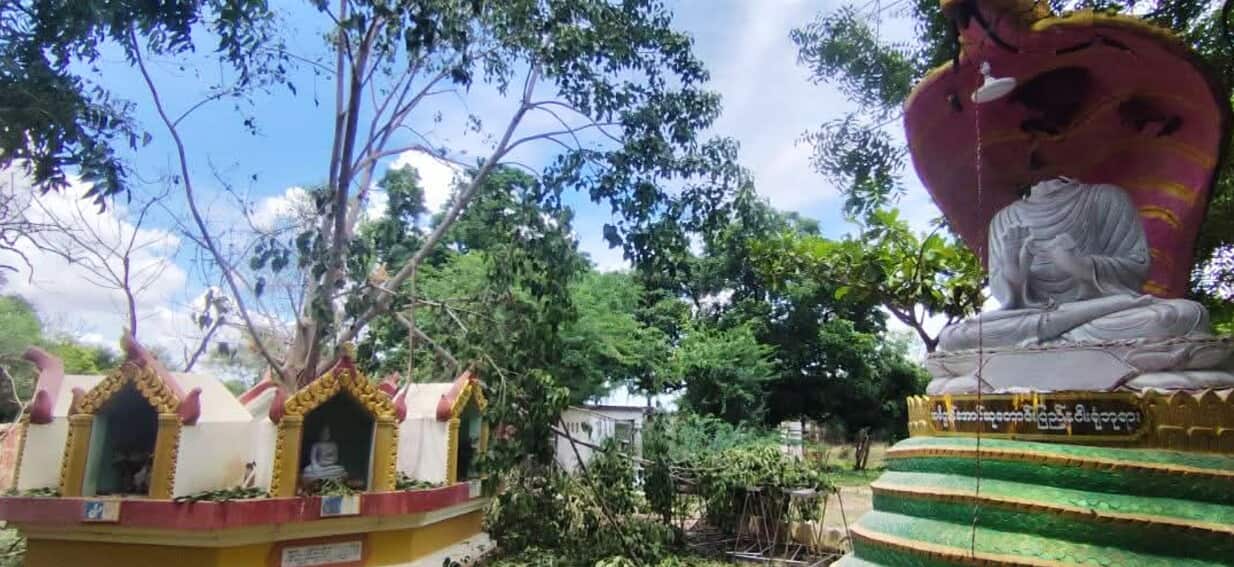
An aerial strike by Myanmar military forces on a Buddhist monastery compound in the central Sagaing region killed 14 civilians and wounded 20 others, punctuating an aggressive escalation of air campaigns against non-combatant hubs. The attack struck Swel Le Oh village in Myaung township, roughly 75 kilometers west of Mandalay, while more than 100 people participated in a week-long meditation retreat observing Buddhist Lent.
The Mechanics of an Air War on Civilians
The sequence of the strike reveals a calculated terror tactic rather than an errant stray munition. A military jet fighter dropped a primary payload directly into the monastery compound at approximately nine in the morning. Fifteen minutes later, as survivors scrambled to assess the initial damage and tend to the fallen, a second bomb struck a nearby residential structure where participants had sought cover.
This double-tap method mirrors a broader operational shift by the junta's air force. Ground forces have steadily lost territorial control across the Sagaing heartland and other resistance strongholds to the People's Defense Forces and ethnic armed organizations. Unable to retake lost ground on foot, the military relies entirely on its technological advantage in the skies.
International bodies have tracked this alarming trajectory. Recent findings released by the Independent Investigative Mechanism for Myanmar (IIMM) documented a sharp surge in aerial bombardments. Deprived of conventional military logistics and facing severe manpower shortages, the armed forces increasingly utilize whatever airborne assets remain operational.
The Anatomy of Impunity in Sagaing
Sagaing has long served as the crucible of the armed resistance against military rule. Because the local population overwhelmingly supports anti-junta networks, the region bears the brunt of collective punishment strategies. Monasteries, historically sanctuaries of community life, education, and spiritual refuge, occupy a central role in rural society. By targeting these spaces, the command structure signals that no sanctuary remains immune from total war.
The junta routinely dismisses civilian casualty reports by categorizing all opposition elements and local assemblies as terrorist targets. State media channels and foreign ministry statements maintain that rules of engagement are strictly observed and that operations avoid sacred or non-military infrastructure. Yet, the physical evidence on the ground tells a radically different story. Burned residential frames, craters carved into holy grounds, and hastily dug graves for fourteen victims in Swel Le Oh starkly contradict official denials.
Local defense organizations possess zero radar networks, surface-to-air missiles, or effective anti-aircraft countermeasures. Communities hear the roar of the jet engine long before the ordnance drops, leaving mere seconds to find shelter under corrugated tin roofs or wooden floors that offer zero protection against fragmentation bombs.
The Cost of Global Indifference
Diplomatic paralysis continues to shield the military command from meaningful accountability. While United Nations investigators meticulously log war crimes and compile dossiers for future tribunals, the daily toll mounts across rural townships.
Survivors of the Myaung township strike did not wait for international observers or forensic teams. Following the bombardment, villagers performed emergency cremations and burials before abandoning their homes entirely, fleeing across fields to seek temporary safety in neighboring communities. This forced displacement transforms thriving agricultural villages into ghost towns, hollowing out the local economy and fracturing the social fabric that sustains the civilian population.
The monastery courtyard in Swel Le Oh is quiet now, save for the wind rustling through scorched prayer halls. The state air fleet continues its rotation across the skies, searching for the next target below.


