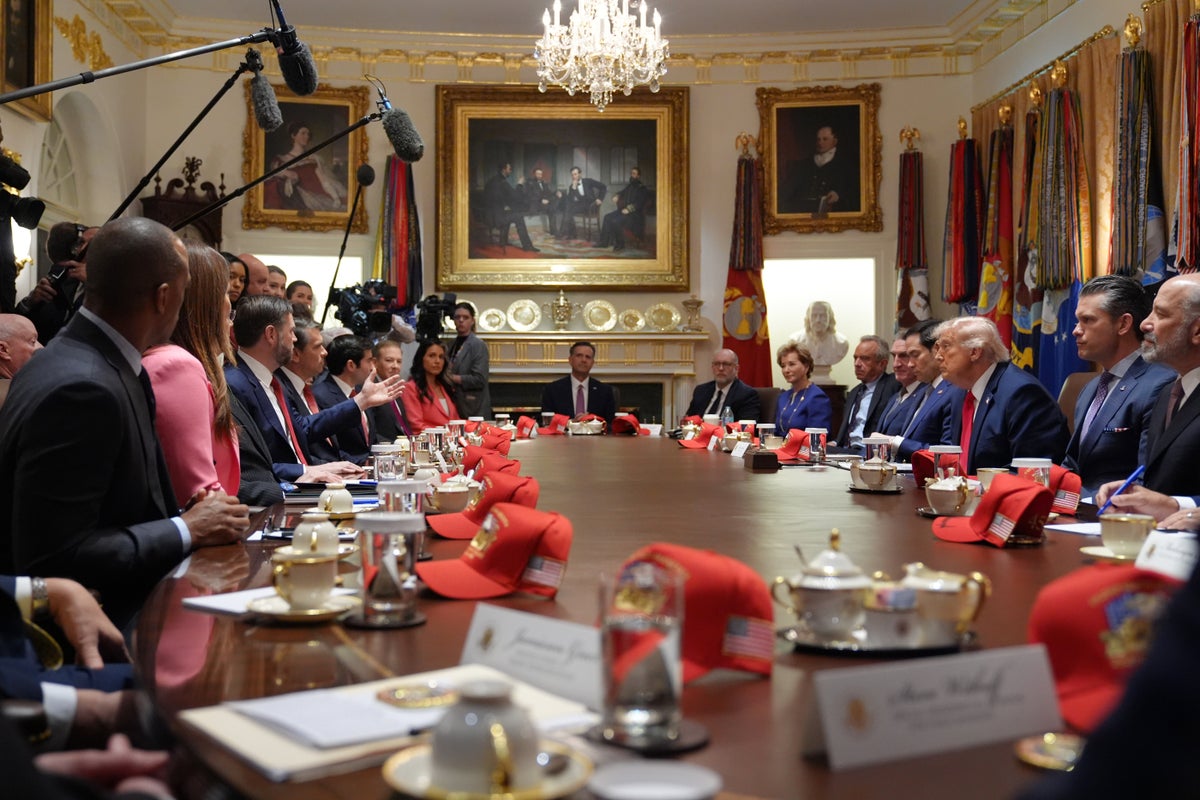
The convergence of state ceremony and private enterprise reaches its logical apex when a sitting chief executive utilizes the physical architecture of the executive branch to market commercial merchandise. During a formal Cabinet assembly, the explicit promotion of a fifty-five-dollar "Trump 250" baseball cap—engineered to coincide with the upcoming United States Semiquincentennial—serves as a high-visibility case study in brand equity extraction. Where standard political analysis observes this development through the lens of institutional decorum or ethical friction, a structural assessment reveals a sophisticated, dual-track optimization strategy designed to capture economic rent while consolidating political capital.
This mechanism operates by intentionally blurring the boundary between public commemorative milestones and private intellectual property. Understanding this dynamic requires breaking down the venture into its core component parts: the legal containment of the assets, the mechanics of the direct-to-consumer premium pricing strategy, and the utilization of state-sponsored media exposure to bypass traditional marketing acquisition costs. You might also find this similar story interesting: Why the India Germany Green Partnership Is a Trillion Dollar Mirage.
The Legal Architecture: Capitalizing on the Semiquincentennial
The foundational step of this commercial operation relies on establishing exclusive ownership over phrases and iconography linked to a historical milestone. In the months leading up to the celebration, corporate entities acting on behalf of the private family enterprise filed formal applications with the United States Patent and Trademark Office. These filings sought exclusive rights to "Trump 250" wordmarks and graphical images across various consumer categories, including apparel, housewares, and sporting goods.
This intellectual property positioning creates a distinct legal moat separating the private entity from the official, nonpartisan federal body tasked with overseeing the national anniversary. By embedding a private surname directly into the public commemoration, the enterprise achieves an immediate commercial capture of the historical event. As extensively documented in latest articles by Bloomberg, the results are notable.
Private vs. Public Moats
The competitive landscape of commemorative merchandise is structured by two distinct operational frameworks:
- Official Public Initiatives: Tasked with historical preservation, public-private partnerships, and mass-scale civic programming, these entities operate under strict non-profit guidelines, allocating revenue to regional celebrations and infrastructure.
- The Private Brand Extension: Operates free from the bureaucratic overhead of official committees. By utilizing a lean manufacturing model and direct-to-consumer web architecture, it converts ambient public patriotism into immediate, high-margin revenue.
The Economics of Premium Merchandising
The pricing structure of the commemorative inventory reflects a deliberate positioning within the premium consumer goods bracket. A baseline analysis of the product line reveals a calculated margin profile:
| Product Category | Consumer Price | Imputed Margin Tier |
|---|---|---|
| Commemorative Blanket | $200 | Ultra-Premium / High Margin |
| Crewneck Sweatshirt | $72 | Premium Apparel |
| Promotional Baseball Cap | $55 | Standard Anchor Product |
| Insulated Drink Tumbler | $42 | Core Accessory |
| Branded Golf Balls (3-Pack) | $18 | Entry-Level Novelty |
A standard retail baseball cap carries a production-to-shelf cost function heavily dictated by volume, materials, and domestic or international labor inputs. At a market price of fifty-five dollars, the product departs completely from standard utility-based pricing and enters the domain of affinity-based premium pricing.
The economic justification for this premium relies on an absolute inelasticity of demand among the core consumer cohort. For a dedicated political base, the purchase is not weighed against the functional utility of a hat; it is categorized as a low-friction financial contribution to a broader movement, paired with a tangible asset that signals group affiliation. The manufacturing cost remains fixed, while the margin expands proportionally with the premium added by the brand identity.
The Cabinet Table as a Zero-Cost Customer Acquisition Channel
In traditional consumer retail, the greatest threat to profitability is the rising cost of customer acquisition through digital advertising networks, programmatic banners, and paid search optimization. The promotional event at the Cabinet meeting provides an elegant solution to this structural bottleneck by achieving an absolute elimination of marketing expenditures.
The structural flow of this zero-cost acquisition framework operates via a three-stage transmission mechanism:
[Executive Action: Cabinet Product Placement]
                      │
                      ▼
[Earned Media Amplification: Network Broadcasts & Print Journalism]
                      │
                      ▼
[Direct-to-Consumer Conversion: Unpaid Organic Traffic to E-Commerce Infrastructure]
- The Executive Stage: The physical product is introduced during an event with guaranteed press attendance. The presence of senior administrative officials, including Cabinet secretaries and advisors, establishes a backdrop of maximum institutional gravity.
- Earned Media Amplification: Cable news networks, digital publishers, and legacy print organizations immediately convert the visual image into global news coverage. This shift transforms a purely commercial product pitch into a highly debated national news item, securing prime media real estate without capital expenditure.
- Direct-to-Consumer Conversion: The target consumer demographic is exposed to the product through standard news feeds. This organic exposure drives immediate, unmediated traffic to the private e-commerce platform, translating public attention directly into transactional volume.
Systemic Risks and Operational Limits
While this model delivers unparalleled short-term margin expansion, it operates under distinct systemic constraints that limit its long-term viability as a sustainable business framework.
The primary vulnerability is the complete dependency on the continuous political relevance of a single individual. In a standard corporate structure, brand equity is diversified across institutional asset classes, product lines, and intellectual property portfolios that endure independently of executive leadership changes. In this configuration, however, any degradation in the underlying political capital results in an immediate and symmetrical contraction of the consumer base.
The model also faces a hard geographic and demographic constraint. The aggressive monetization of public milestones creates a sharp polarization within the consumer market. While it maximizes extraction efficiency among the enthusiastic supporter segment, it simultaneously alienates the broader, non-aligned consumer base, completely forfeiting the mass-market scale typically captured by secular, non-partisan national anniversaries.
Strategic Playbook for Brand Extraction
To maximize the conversion of upcoming national milestones into high-margin revenue streams without compromising operational stability, the enterprise must execute a structured, multi-phase commercial play.
First, expand the current product architecture to include tiered scarcity models. Introduce sequentially numbered, limited-edition variants of the core commemorative hardware—such as precious-metal inlaid variants or items paired with verified digital authentication—to capture the consumer surplus of high-net-worth collectors. This shifts the revenue model from a high-volume, low-tier commodity play to a high-margin scarcity framework.
Second, decouple the primary e-commerce transaction engine from direct state-adjacent events to mitigate growing institutional blowback. Establish secondary, licensed entities that handle distribution and fulfillment under long-term royalty agreements. This structural insulation maintains the inward flow of high-percentage licensing revenue while shielding the primary executive office from direct, operational-level criticism regarding the commercialization of public space.