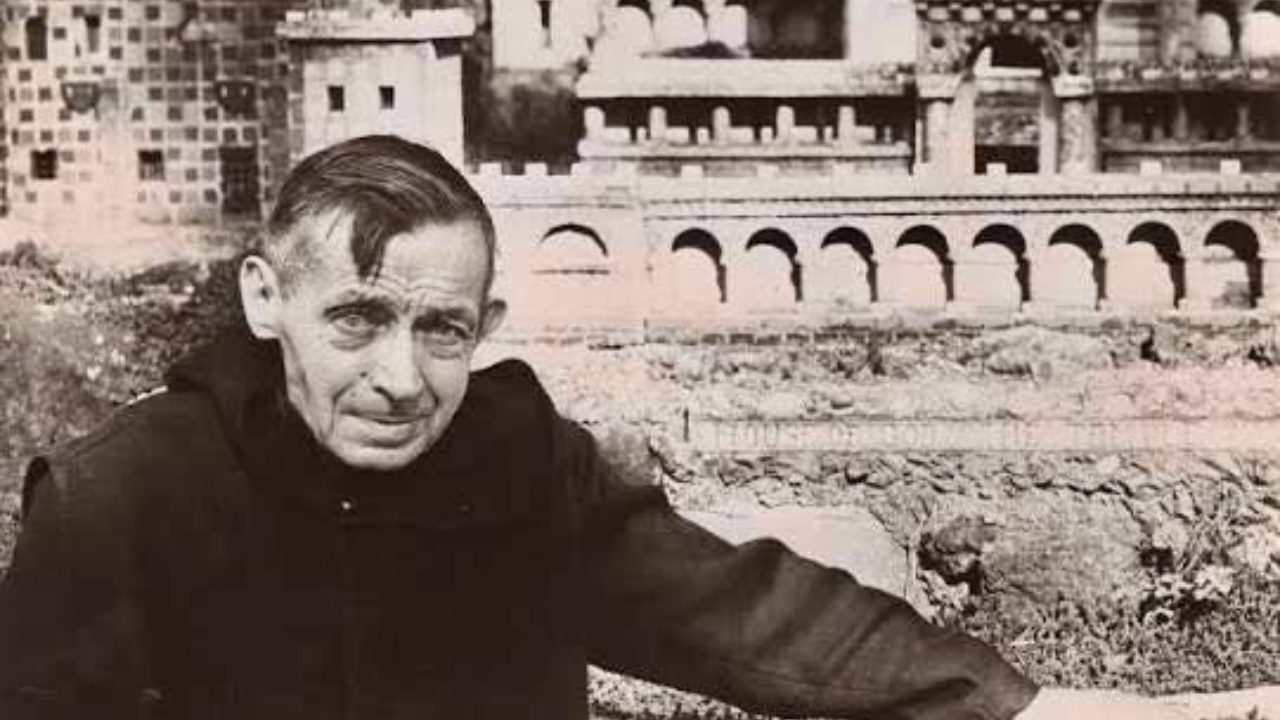
Dust settles differently in Alabama. It hangs thick and heavy, carrying the scent of pine sap and red clay, sticking to the wool of a heavy habit worn by a man who had no business building empires. In 1912, Brother Joseph Zoettl stood on the grounds of St. Bernard Abbey in Cullman. He was short. He was unassuming. He was bent over a wheelbarrow. And he was about to construct a sprawling, meticulous miniature world of global wonders, most of which he would never lay his actual eyes upon.
Imagine the silence of that workshop. Not an empty silence, but one filled with the steady, rhythmic chipping of limestone, the crunch of broken soda bottles, and the low murmur of prayer. Brother Joseph had arrived in America decades earlier from Bavaria, a quiet immigrant carrying little more than a deep Catholic faith and an innate architectural eye. He wasn't trained as an engineer. He had no drafting table worthy of a cathedral designer. Yet, armed with cement, wire, discarded milk bottles, and broken costume jewelry, he began to recreate the sacred geography of the earth.
Why do we build miniatures? Psychologists might tell you it is about control. When the real world is vast, unpredictable, and overwhelmingly loud, shrinking it down to tabletop size makes it manageable. But for Joseph, it was something else entirely. It was an act of devotion disguised as play. He was translating the distant echoes of history into tangible, touchable reality for people who would never cross an ocean.
Consider what he was looking at day after day. Cullman was a quiet farming community. The world outside was industrializing at a breakneck pace, plunging toward the horrors of the First World War. Yet, inside the walls of the abbey grounds, a different kind of history was taking shape. Piece by piece, shard by shard.
He started small. A grotto here. A modest shrine there. But ambition, once sparked by faith and patience, is a restless thing. Soon, the blueprints in his head demanded more space, more detail, more audacity. He turned his attention across the sea.
St. Peter’s Basilica rose from the Alabama soil. Not out of marble quarried in Carrara, but out of cast concrete, reinforced with scrap iron and old bedsprings. The Colosseum took shape, its arches formed with painstaking precision, populated not by roaring crowds, but by the quiet hum of Alabama cicadas. He built the Temple of Jerusalem. He built the Leaning Tower of Pisa. He built shrines, Egyptian temples, and European castles.
To understand the scale of what Brother Joseph achieved, you have to look down at the materials. This wasn't fine art funded by wealthy patrons. This was garbage transformed into glory. When local families finished their soda pop, they saved the bottles for the monk. When women lost costume jewelry, the broken beads found their way into his hands to serve as vibrant mosaics on dome tops and altar pieces. He saw divinity in the discarded. He looked at a pile of jagged green glass and saw the Mediterranean Sea.
There is a profound lesson in that alchemy. We live in an era obsessed with pristine, brand-new materials, digital perfection, and frictionless execution. We want our experiences curated and sanitized. Brother Joseph worked with what was broken. He took the literal trash of his community and cemented it into enduring monuments. He worked for over four decades, pushing his wheelbarrow through the southern heat until his hands were gnarled and scarred by cement burns.
Visitors began to trickle in. At first, it was just local parishioners and fellow monks. Then came travelers from neighboring towns, driving dusty Model Ts down unpaved roads to catch a glimpse of the miniature wonder tucked behind the abbey. They walked among structures twenty times smaller than the originals, yet somehow, standing before his miniature Jerusalem, they felt the same hush that pilgrims felt standing on actual stone.
That is the magic of true artistry. It bypasses scale. It speaks directly to the human desire to connect with something larger than ourselves.
By the time Brother Joseph passed away in 1961, he had created over 125 miniature buildings, populating what would come to be known as Ava Maria Grotto. He didn't live to see the internet age. He didn't have travel vlogs or drone footage to study his subjects. His reference library consisted of black-and-white postcards, magazine clippings, and the vast theater of his own imagination. He looked at a two-inch photograph of a Spanish palace and mentally mapped its geometry, down to the pitch of the roof and the curve of the courtyard arch.
Walk through the grotto today, and the air feels cooler under the canopy of ancient trees. The paint on some of the miniatures has faded slightly, weathered by decades of southern sun and winter frost. Yet, the structures remain remarkably resilient. They stand as a testament to what a single human being can accomplish with relentless focus and a profound lack of cynicism.
We often look at our own lives and feel hemmed in by our circumstances. We tell ourselves we cannot create, cannot explore, cannot make an impact because we lack the right resources, the right background, or the right connections. A Bavarian monk in a rural southern abbey dismantled that excuse with a trowel and a bucket of mortar.
He never left Alabama. Yet he lived in Rome, in Jerusalem, in Athens, and in Cairo. He walked the grand plazas of history without ever leaving his garden.
The afternoon sun dips low behind the pines of Cullman, casting long, sharp shadows across miniature domes and tiny marbleless columns. A single green shard from a 1920s medicine bottle catches the last ray of light, glowing like a forgotten emerald against the gray concrete.