The water used to smell like crushed mint and wet stone. If you woke up early enough in Kisumu, back when the mornings were still cold, you could hear the haplochromines—the tiny, jewel-toned cichlids—breaking the surface of Lake Victoria in thousands of synchronized pinpricks. They were small enough to fit in a child’s palm, flashing in shades of crimson, electric blue, and sulfur yellow.
To the people living along the shoreline in the early 1950s, those fish were not just scenery. They were dinner, currency, and the literal cleaners of the water. Recently making waves in this space: Air Rage is Not a Passenger Problem.
Then came the bucket.
It did not arrive with a fanfare or a warning siren. It arrived in the hands of colonial fisheries officials who looked at a lake the size of Ireland and saw a mathematical problem. To the bureaucratic mind, those hundreds of species of tiny cichlids were inefficient. They were too small to fillet, too bony to export, and too stubborn to catch in massive commercial nets. The officials wanted a prize. They wanted a commercial juggernaut that could turn a massive body of water into an industrial protein factory. More information on this are covered by Condé Nast Traveler.
So, they introduced the Nile perch.
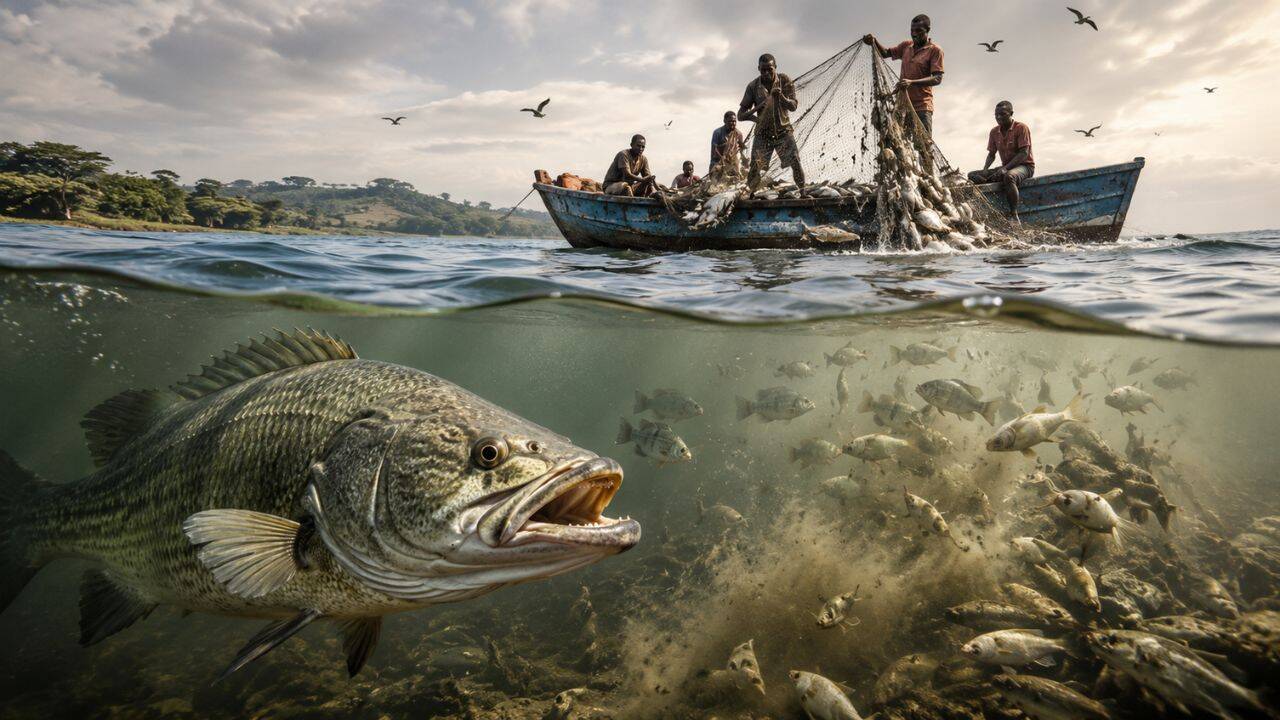
Lates niloticus. It is a creature built like a biological tank. It can grow to over six feet long. It can weigh more than a grown man. It has an eye that reflects a dull, predatory gold in the dark and a mouth that opens like a bucket to swallow everything in its path.
When those first few perch were slipped into the glass-smooth water near Jinja, Uganda, the officials thought they were engineering prosperity. They had no idea they had just dropped an economic and ecological bomb into the heart of East Africa.
The Night the Lights Went Out
To understand what happened next, you have to understand how the lake used to feed the land. For generations, traditional fishing was a communal choreography. Men went out in wooden canoes, casting light cotton nets. Women waited on the beaches to sort the catch, drying the tiny fish on the clean sand under a fierce sun. It was a low-overhead, high-yielding loop. It sustained millions.
By the late 1970s, that loop was broken.
The Nile perch spent its first two decades in the lake doing what apex predators do best: eating. It ate the blue cichlids. It ate the red cichlids. It ate the mud-dwellers and the surface-feeders. In what biologists now call one of the most rapid and devastating mass extinctions in human history, nearly two hundred species of fish vanished from the planet in the blink of an eye.
Imagine walking into a rainforest and finding every bird, lizard, and insect gone, replaced by a single, massive breed of wolf. That is what happened beneath the waves of Victoria.
But the true horror of the introduction was not just ecological. It was human.
As the tiny fish disappeared, the local economy folded like a cheap lawn chair. The traditional nets were shredded by the massive new monsters roaming the deep. A family canoe was no longer enough to bring home a living. To catch a Nile perch, you needed heavy nylon nets. You needed bigger boats. You needed diesel engines.
Almost overnight, the lake was gentrified.
Wealthy investors from the cities and overseas built large commercial trawlers. They set up processing factories along the shore. The local fishermen who had owned their lives for generations suddenly found themselves working as day laborers on boats owned by strangers, catching a fish they could no longer afford to eat.
The Fire and the Ash
The Nile perch brought another, hidden tax with it—one that changed the very air of the lake basin.
The old cichlids were easily dried by the sun. They were small enough that a afternoon on the hot sand preserved them for months. The Nile perch, however, is massive, oily, and thick. If you leave a sixty-pound perch on the sand, it rots before the sun can even warm it.
To preserve the meat for transport, it had to be smoked.
Suddenly, the shoreline became a furnace. To keep the smoking pits burning day and night, communities began cutting down the forests surrounding the lake. Miles of ancient trees were felled, chopped into firewood, and fed into the smokehouses.
With the trees gone, the rains washed the loose, red earth straight into the water.
Consider what happens next when you combine topsoil runoff with a lake that has lost its cleaners. The tiny cichlids used to eat the algae. With those fish inside the bellies of the Nile perch, the algae bloomed unchecked. It grew into thick, choking green mats that blocked the sunlight. The deep waters lost their oxygen. The lake began to suffocate from the bottom up.
The water no longer smelled like mint and wet stone. It smelled like rot.
The Leftovers
Step into a lakeside town today, and you will see the final, heartbreaking irony of the Nile perch boom.
Every morning, refrigerated trucks back up to the lakeside factories. They are loaded with pristine, white, boneless fillets of Nile perch, packed in ice, destined for upscale supermarkets in London, Paris, and Rome. It is a multi-million-dollar export industry.
But the people who live fifty yards from those factories do not eat the fillet.
Instead, women wait outside the factory gates with plastic buckets to buy what is left over: the carcases. The heads, the bones, and the strips of oily belly meat left behind by the filleting knives. They carry these frames back to the roadside stalls, frying them in boiling oil over charcoal fires to sell to locals who need cheap protein.
We were promised a miracle that would feed East Africa. Instead, the region was turned into a resource colony, exporting its ecology and keeping the crumbs.
It is easy to look at the story of Lake Victoria as a tragedy of good intentions gone wrong. But that misses the sharper, more uncomfortable truth. The colonial officials who brought the perch were not evil; they were arrogant. They believed that nature was a poorly designed machine that required human optimization. They looked at a complex, beautiful, self-sustaining ecosystem and thought they could make it a better business model.
The lake proved them wrong, but it was the people of the shoreline who paid the bill.
Now, the gold-eyed monsters still rule the dark water beneath the piers of Kisumu. The lake looks calm from a distance, a vast sheet of blue stretching to the horizon. But if you sit on the edge of the old wooden docks as the sun goes down, you realize the silence isn't peaceful. It is the quiet of a house that has been cleared out.