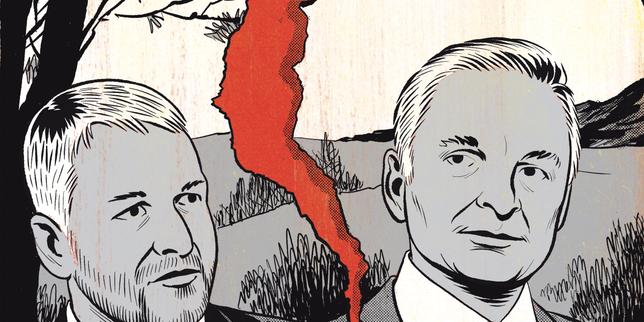
History does not always break through national borders with the sound of artillery fire. Sometimes, the fracture happens quietly across a dining room table, through a silent telephone line, or via opposing screens glowing in dark rooms thousands of kilometers apart. When bloodlines collide with geopolitical tectonic shifts, personal loyalties evaporate into ideology. This is the grim reality behind the headlines concerning Xavier and Thomas Moreau, two French brothers standing on opposite sides of the deepest chasm in contemporary European history. One chose the gilded corridors of Moscow and the ideological embrace of the Kremlin. The other found himself tied to the existential defense of Ukraine. Their divergence is not merely a family feud. It is a microcosm of a continent tearing itself apart at the seams, exposing how modern information warfare redraws the boundaries of kinship.
To understand the Moreau brothers is to understand the seductive pull of alternative narratives in a disintegrating global order. Xavier Moreau represents a very specific archetype of Western expatriate radicalization. A former officer in the French military who transitioned into business consulting and political commentary inside Russia, he integrated fully into the state-sponsored media ecosystem of Moscow. Over years of living under the Putin administration, his worldview hardened. He became a fixture on Russian television channels, delivering talking points that aligned precisely with official Kremlin doctrine. To him, the conflict in Eastern Europe was not an unprovoked war of aggression, but a necessary surgical strike against Western decadence and North Atlantic Treaty Organization expansionism. His life in Russia provided him with professional status, ideological certainty, and a community that validated his grievances against the West. For a different view, consider: this related article.
Across that ideological barricade stands Thomas Moreau, representing a starkly different reaction to the pressures of modern history. While Xavier absorbed the ethos of the Eurasian pivot, Thomas remained anchored to European democratic norms and the principle of sovereign territorial integrity. The physical distance between the brothers—one operating within the broadcast studios of the Russian capital, the other connected to the grim realities faced by Ukrainian society—mirrors an intellectual gulf that cannot be bridged by shared childhood memories or familial obligation. Every public statement, every televised appearance, and every ideological stance taken by Xavier serves as a direct affront to the world Thomas recognizes.
This familial rupture exposes a vulnerability that intelligence agencies and political strategists have exploited for decades. Propaganda is no longer confined to leaflets dropped from airplanes or shortwave radio broadcasts crackling through static. It lives in the algorithms of social media feeds, the curated echo chambers of Telegram channels, and the round-the-clock cable news programming that feeds confirmation bias to millions of viewers. When two brothers raised in the same household arrive at mutually exclusive interpretations of reality, it demonstrates the collapse of a shared factual baseline. When facts become entirely subjective, family ties lose their adhesive properties. Similar reporting on this matter has been published by The New York Times.
The phenomenon of the pro-Kremlin Western expatriate is an under-examined element of the current conflict. Figures like Xavier Moreau function as valuable ideological assets for the Russian state apparatus. They provide an external veneer of legitimacy to policies that face universal condemnation across Western capitals. By speaking fluent French and possessing Western credentials, they act as translators of state narratives for domestic European audiences disenchanted with their own governments. They weaponize legitimate criticisms of European Union bureaucracy or economic stagnation, funneling that discontent into unconditional support for a foreign autocracy. The emotional reward for these expatriates is immense. They go from being marginalized critics in their home countries to celebrated experts in a foreign power structure that amplifies their voices.
Yet, the price paid for this ideological conversion is profound alienation from one's origins. Families are collateral damage in the grand chess game of geopolitical realignment. In the Moreau household, political discourse ceased being an abstract debate over tax rates or foreign policy years ago. It became a matter of existential alignment. When one brother defends military actions that result in the destruction of cities and the displacement of millions, any pretense of normal familial interaction vanishes. The silence between them speaks louder than any public debate. It is the sound of a relationship sacrificed on the altar of geopolitical fanaticism.
The mechanics of this estrangement reveal how deeply the information ecosystem dictates human behavior. Xavier did not wake up one morning and decide to adopt a foreign worldview. The transformation occurred incrementally, reinforced by daily immersion in a media environment where dissent is systematically eliminated and alternative viewpoints are branded as treason. In Moscow, the narrative is monolithic. Every historical grievance is amplified, every geopolitical move is framed as defensive brilliance, and every opponent is cast as a fascist existential threat. Living inside that bubble for years reshapes cognitive processing. The individual stops questioning the premises of the state because doing so would mean dismantling their entire adopted identity.
Conversely, Thomas experienced the conflict through the lens of European solidarity and humanitarian shock. The visual evidence of destroyed infrastructure, mass graves, and civilian suffering in Ukraine created an immovable moral anchor. For someone viewing the war through this framework, accommodating a brother who acts as a mouthpiece for the aggressor is psychologically impossible. Moral clarity leaves no room for familial relativism. Either the invasion is an unjustified crime against peace, or it is a heroic liberation. There is no middle ground where two brothers can agree to disagree over Sunday dinner.
This dynamic extends far beyond a single French family. Across Europe and North America, dinner tables have become ideological battlegrounds. Parents and children, siblings, and lifelong friends find themselves separated by invisible front lines constructed by algorithmic feeds and polarizing media diets. The polarization is engineered to be absolute. Social media platforms reward outrage and confirm preexisting biases, ensuring that users on opposing sides of the political spectrum are not merely disagreeing on solutions, but inhabiting entirely different factual universes. The Moreau brothers are merely a high-profile manifestation of a societal neurosis affecting millions of households.
Consider the role of military backgrounds in shaping these divergent paths. Xavier’s past as a French officer hints at a specific institutional mindset that values hierarchy, order, and geopolitical strength over messy democratic processes. Many Western military veterans who migrate toward Russian state media share a profound disillusionment with post-Cold War Western foreign policy, particularly the interventions in Iraq, Libya, and the Balkans. They view Western hypocrisy as license to support any alternative power center that challenges Washington and Brussels. The enemy of my enemy becomes not just a temporary ally, but a moral authority. This black-and-white thinking simplifies a complex world, offering psychological comfort to those who feel alienated by modern democratic societies.
Thomas, operating from a different professional and civic vantage point, likely views that institutional disillusionment as a betrayal of core ethical principles. The defense of international law and sovereign borders is not negotiable based on the past mistakes of Western governments. Two wrongs do not make a right, and the commission of a war of conquest cannot be justified by pointing to historical grievances. This fundamental disagreement over the hierarchy of moral imperatives makes reconciliation impossible. One sees realpolitik and civilizational defense; the other sees naked imperialism and human suffering.
The psychological toll of such public schisms is rarely discussed by analysts who treat geopolitical conflicts purely as movements of battalions and economic sanctions. Behind every ideological warrior on television is a network of bewildered relatives trying to make sense of how a loved one crossed an uncrossable line. Friends from childhood watch in horror as people they grew up with parrot talking points from foreign state-controlled networks. The institutional trust that once held societies together has degraded to the point where personal bonds are treated as expendable currency in the global culture war.
As the conflict grinds forward with no diplomatic resolution in sight, the positions of both brothers calcify further. Xavier remains embedded in the Russian security and media bubble, structurally incapable of stepping back without invalidating years of public positioning. Thomas remains tied to the European reality, watching the casualties mount and wondering how the brother he once knew vanished behind a wall of state television broadcasts and ideological dogma. There is no neat resolution to this story, no heartwarming reconciliation scene where politics are set aside for the sake of blood.
The tragedy of Xavier and Thomas Moreau is the tragedy of Europe in the twenty-first century. It demonstrates that the most dangerous battlefields are not always marked on military maps. They exist in the spaces between people who once shared a language, a history, and a home, but now look across the abyss and see a stranger wearing the face of a brother.