The mist still clung to the stone walls of Verdun when the buses arrived.
For decades, the name Verdun has belonged to the ghosts of 1916—to the mud, the shell craters, and the heavy silence of an earth that remembers too much. But on this crisp morning, the soil answered to a different kind of footfall. It was the sound of young boots hitting the asphalt, rhythmic and hesitant all at once.
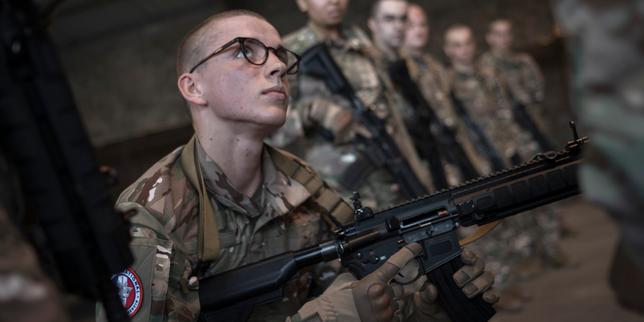
These were not career soldiers hardened by distant deployments. They were the first wave of young citizens stepping into France’s renewed national service, carrying backpacks that still smelled of home and pockets full of nervous apprehension. They had arrived not to fight a war, but to learn what it means to belong to something larger than an individual screen.
Cold statistics rarely capture the weight of a transition like this. When a government reintroduces a framework for civic duty, it is easy to debate the logistics in air-conditioned rooms. It is easy to crunch the numbers on housing, instructors, and funding. But standing at the gates of a historic citadel, looking at nineteen-year-olds who spent their formative years navigating lockdowns and digital isolation, the reality looks entirely different.
Consider what happens when a generation defined by hyper-individualism is asked to fold a cot, line up in the cold, and share a room with strangers from entirely different social strata.
Silence descended as the first briefing began. A young man near the front—let’s call him Lucas, though his face could belong to any city or village—shifted his weight from foot to foot. He wore a hoodie zipped up to his chin, a physical shield against the sudden exposure of being part of a collective. His phone sat powered off in the locker room, a silent brick for the next several weeks. The modern tether had been cut.
In that sudden quiet, the invisible stakes of the experiment became palpable. This is not merely about teaching youth how to march or how to read a map of the Meuse. It is an attempt to stitch together a frayed social fabric. For months, these recruits had lived in parallel universes curated by algorithms. Now, they were forced into a shared physical space where their actions had immediate consequences for the person standing to their left and right.
The instructors knew this choreography well, even if the world around them had changed. They did not shout with theatrical fury; instead, they spoke with the calm authority of experience. They explained the history etched into the monuments surrounding the barracks. They talked about defense not just as an abstract military doctrine involving tanks and treaties, but as a daily practice of resilience, mutual aid, and civic awareness.
History is heavy in Verdun. You cannot dig a trench or clear a parade ground without brushing against the memory of a divided Europe. Yet, the irony was not lost on the veterans observing the exercise: the young people standing on this ground were being asked to defend peace, not by preparing for the trenches of the past, but by learning how to talk to one another across deep cultural and economic divides.
As the morning gave way to a pale afternoon sun, the initial stiffness began to dissolve.
By lunchtime, the mess hall buzzed with a sound that felt almost archaeological: unscripted, face-to-face human conversation. Laughter bounced off the concrete walls. Arguments flared briefly over the quality of the rations before dissolving into shared groans. Lucas sat across from a nursing student from Marseille and an apprentice mechanic from a rural farming town—three people who, under normal circumstances, would never have occupied the same room for more than five minutes, let alone shared a table.
This is the hidden engine of national service. It is a slow, unglamorous friction that smooths out the sharpest edges of modern isolation.
Critics will rightly point out the immense organizational hurdles. Skeptics will question whether a few weeks in a historic garrison can genuinely alter the mindset of a generation accustomed to instant gratification and digital escape. They have a point. Transformation does not happen overnight because of a uniform or a flagpole.
Yet, watching the recruits stumble through their first collective drill—feet out of sync, arms swinging with awkward determination—it became clear that measuring the success of this program solely through recruitment metrics misses the point entirely. The true measure lies in the subtle shift from me to we. It lies in the moment a teenager realizes that his fatigue is shared by the person next to him, and that survival, comfort, and progress depend entirely on cooperation.
When evening fell, the citadel took on a deep, bruised indigo hue. The floodlights flickered on, cutting sharp shadows across the stone courtyards where generations of soldiers had once stood before facing the unknown.
Inside the dormitories, the noise quieted down to a low murmur of whispered conversations and rustling blankets. Phones remained locked away. For the first time in their lives, these young citizens were forced to sit with their own thoughts, unmediated by notifications or endless scrolls.
Outside, the wind whispered through the trees of the surrounding hills, carrying the damp chill of the river valley. In the morning, the bugle would sound again, calling them back to the drill square, the history lessons, and the quiet, demanding work of becoming citizens. The path ahead is long, uncertain, and filled with questions that no single program can answer. But as the lights went out across the barracks, one thing remained undeniably clear: the first step had been taken, and the ground beneath their boots would never be quite the same.


