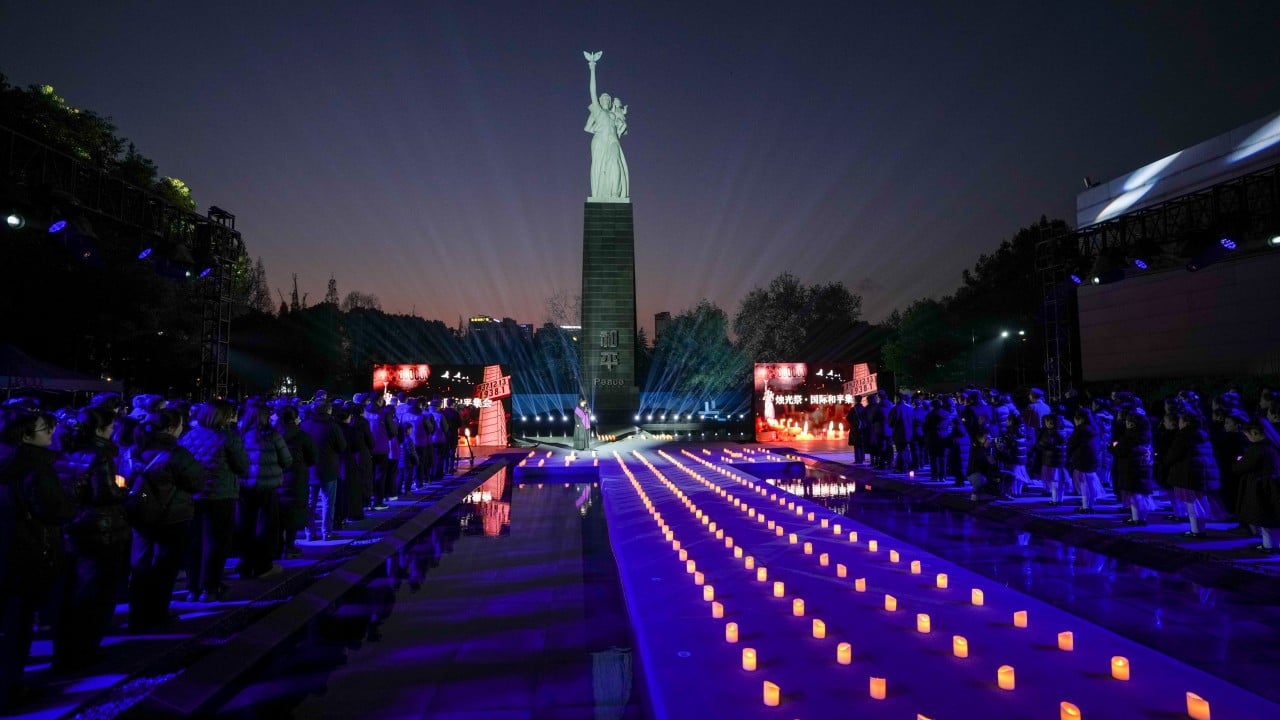
The international press is up in arms again over a museum display case in Tokyo. Western media outlets and regional neighbors are hyper-focusing on a specific exhibition at a Japanese military museum, accusing the institution of "rewriting history" because a placard uses the term "Nanking Incident" instead of "Nanking Massacre."
The lazy consensus among journalists and commentators is predictable. They argue that changing a single noun on a wall text is a calculated act of state-sponsored denialism designed to wipe atrocities from the collective memory. They treat semantic choices as definitive proof of historical erasure.
They are wrong. They are looking at the wrong variable.
Focusing on the vocabulary used in museum exhibits ignores how historical memory actually functions. Language in state-adjacent museums is rarely about hiding the past; it is about managing contemporary geopolitical risk. By treating a terminology dispute as an existential crisis of truth, critics fall into a trap that lets institutions off the hook for much deeper, structural narratives.
The Illusion of the Perfect Label
Journalists love a vocabulary war because it requires zero deep analysis. It is easy to write an angry headline about a word change. But the premise that a specific label inherently dictates public understanding is flawed.
In historical curation, terms like "incident," "affair," or "event" are frequently deployed not to deny that violence occurred, but to align with official diplomatic frameworks. For decades, official state documents across various nations have used seemingly sanitized language to maintain diplomatic flexibility.
Consider how different nations curate their own darkest chapters:
- The United States spent decades referring to the systemic displacement and slaughter of Native Americans as the "Indian Wars"—a term that implies a conflict between equals rather than a state-driven erasure.
- British textbooks frequently reference the "Troubles" in Northern Ireland, a casual euphemism for a decades-long sectarian conflict.
- French institutions long classified the Algerian War of Independence merely as "operations for the maintenance of public order."
Does the use of "Indian Wars" mean American historians deny the trail of tears? No. Does "the Troubles" mean the British public is unaware of the bombings in Belfast? Of course not.
When a Japanese museum uses "Nanking Incident," critics scream erasure. But if you walk into the exhibit, the actual timeline of events, the mobilization of troops, and the strategic outcomes are still presented. The grievance is not with the data; it is with the branding. When we obsess over the branding, we ignore the substance of the history being taught.
People Also Ask: Dismantling the Flawed Premises
The public discourse around historical curation is warped by poorly framed questions. Let us dismantle the most common ones.
Why do governments change historical terms in museums?
The common assumption is that governments alter terms to brainwash the youth. The reality is far more transactional. Changes to museum text are almost always a lagging indicator of diplomatic shifts, not a leading indicator of cultural amnesia. When a state-aligned museum alters its phrasing, it is usually responding to domestic political pressure or reacting to a neighboring country’s foreign policy maneuvers. It is a bureaucratic defense mechanism, not a psychological operation.
Can a museum actually rewrite history?
No. Museums reflect history; they do not write it. History is held in archives, academic journals, forensic records, and oral testimonies. A museum is a highly curated, commercialized space designed for public consumption. To believe that a museum changing a placard alters the reality of 1937 is to give a glass display case far too much power. If a society's knowledge of history depends entirely on a museum caption, that society's educational system has already failed.
The Curation Bureaucracy: How Memory is Actually Managed
I have spent years analyzing how state institutions construct public narratives. I have watched cultural ministries allocate budgets, and I have seen how the sausage gets made behind the scenes of major institutional exhibitions. It is never as conspiratorial as the public thinks, which makes the reality much more frustrating.
Museum curators rarely act as ideological zealots. Instead, they act as risk-mitigating bureaucrats.
When an exhibit undergoes a rewrite, the primary objective is usually to satisfy a complex web of stakeholders: older donors, veterans' associations, ministry officials, and international tourism boards. The result of this committee-driven process is a watered-down, neutral language designed to minimize friction.
[Stakeholder Pressures]
       │
       ├─► Veteran Groups (Demand honor/justification)
       ├─► Ministry of Culture (Demands diplomatic safety)
       ├─► General Public (Demands clear narrative)
       │
       ▼
[The Result: Neutralized, Bureaucratic Language]
The word "Incident" is the ultimate bureaucratic compromise. It acknowledges that a significant event occurred, satisfying the requirement for factual representation, while avoiding the legal and emotional weight of words like "Massacre" or "Genocide," which invite immediate political retaliation from neighboring states.
The downside of pointing this out is obvious: it satisfies nobody. It frustrates activists who want absolute moral clarity, and it annoys nationalists who want total vindication. But understanding this bureaucratic reality is the only way to read a museum accurately.
Stop Auditing Words; Start Auditing Structures
If you want to understand how an institution or a nation actually views its past, stop looking at the nouns on the placards. Start looking at the structural mechanics of the exhibition.
The real narrative trickery does not happen in the vocabulary; it happens in the layout, the lighting, and the structural emphasis. This is where real influence is exerted.
1. The Contextual Dilution
An institution can state the exact casualty numbers of an atrocity but completely alter its meaning by changing the context. If a museum lists the horrors of a siege but surrounds that display with artifacts showing the suffering of their own civilian population from air raids, they are creating a false moral equivalence. The words on the placard remain factually accurate, but the structural arrangement shifts the emotional weight.
2. The Timeline Severance
Watch how exhibitions sequence events. A classic tactic is to isolate an atrocity so it appears as an anomalous detour rather than the logical consequence of a systemic policy. By presenting a massacre as an isolated "incident" born from the chaos of a specific battle, the institution protects the broader reputation of the state's historical leadership.
3. The Depersonalization of Data
Look at how human suffering is quantified. When victims are reduced strictly to data points on a map or lines on a bar graph, the emotional resonance is neutralized. This is far more effective at distancing the public from historical horrors than simply changing a label. A sterile graph does not provoke outrage; it provokes a nod of academic acknowledgment.
The Actionable Framework for Reading Institutional History
The next time a controversy erupts over a museum label, do not join the superficial outcry. Use a systematic approach to evaluate what the institution is actually doing.
| Element to Evaluate | Superficial Approach | Critical Approach |
|---|---|---|
| Terminology | Focus on whether the word matches your moral vocabulary. | Ask who the target audience is for that specific linguistic compromise. |
| Exhibition Flow | Look at the artifacts in isolation. | Track what events immediately precede and follow the controversial section. |
| Funding & Oversight | Assume the curator made an independent intellectual choice. | Identify which state ministry or private foundation financed the gallery renovation. |
| Proportionality | Measure the physical size of the text block. | Compare the square footage dedicated to national triumphs versus national failures. |
Stop expecting state-funded institutions to act as objective arbiters of absolute moral truth. They never have been, and they never will be. They are repositories of a curated national identity.
When you spend your energy screaming about a word on a wall, you are playing the game exactly how the bureaucrats want you to play it. You are debating the packaging while the core narrative remains completely unchallenged. Walk past the placard. Look at the architecture of the room. That is where the real history is being hidden.