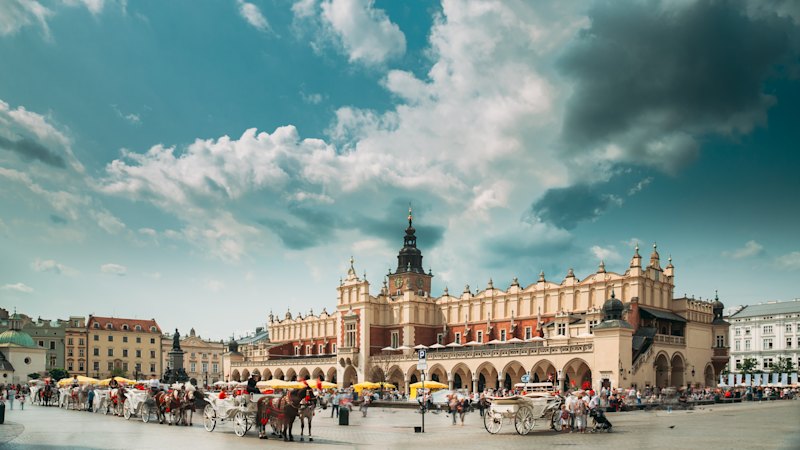
Cobblestones hold heat long after the sun drops behind the Cloth Hall. If you have ever walked across Krakow’s Main Market Square at dusk, you know that specific, golden hum—the clink of heavy glass beer mugs, the low murmur of a dozen languages tangled together, the sudden, piercing notes of the hourly trumpet call floating down from St. Mary’s Basilica. It is a place engineered by centuries of history to make a stranger feel entirely safe.
Until a single sound refuses to fit the rhythm.
The wire reports from Krakow give us the cold arithmetic of a tragedy. Six people killed. A gunman opening fire in a crowded tourist hotspot. Police cordons, flashing blue lights reflecting off Renaissance arches, an investigation underway. Read those dispatches and you get the skeleton of an event, stripped of flesh and pulse. You get numbers. You get geography. What you miss is the terrifying fragility of the invisible social contract that allows millions of us to board airplanes, step onto unfamiliar streets, and trust that the person walking toward us in a crowded square intends us no harm.
The Architecture of Assumed Safety
To understand why a shooting in central Krakow lands with such a dull, sickening thud, you have to understand what Poland—and Central Europe more broadly—represents in the modern travel imagination. For decades, statistical reality backed up the intuition of every backpacker and family wandering through the Old Town. Poland consistently ranks among the countries with the lowest rates of gun ownership and firearm-related homicides in the European Union. Strict licensing laws, mandatory psychological evaluations, and deeply ingrained cultural norms around firearms have made the sight of a civilian with a gun virtually nonexistent.
Consider a hypothetical evening on that square just moments before the violence begins. Call her Maja, a twenty-six-year-old barista wiping down outdoor tables near the edge of the Rynek, and beside her at a corner table, Thomas, a retired history teacher from Manchester nursing a cup of coffee while studying a folded map. Neither of them is scanning rooftops. Neither is mapping exit routes behind the potted boxwoods. Why would they? Their nervous systems are calibrated to an environment where the worst threat on a Tuesday evening is an overpriced dinner bill or a sudden summer downpour.
That calibration is not naivety. It is the baseline dividend of a high-trust society.
When a gunman shatters that baseline, the bullets do more than claim six lives. They retroactively rewrite the rules of the space. Every café umbrella, every horse-drawn carriage waiting near the church, every narrow alley leading toward the Vistula River suddenly transforms from picturesque scenery into tactical terrain. Where do you run when the architecture was designed in the thirteenth century to funnel crowds inward toward the market center?
The Anatomy of a Shattered Square
Sound behaves strangely in stone plazas. Anyone who has stood near an explosion or gunfire in an enclosed urban square knows the first reaction is rarely panic. It is confusion.
Pop. Pop. Pop.
Firecrackers. A backfiring delivery scooter. A dropped pallet of glass bottles outside a cellar bar. The human brain, desperate to preserve its equilibrium, reaches for mundane explanations before it accepts mortal danger. Ten seconds pass. Fifteen. By the time the third or fourth sharp crack echoes off the limestone facades of the historic townhouses, the illusion breaks. Chairs scrape violently against stone. Glasses shatter. A wave of sheer kinetic terror ripples outward from the epicenter, turning a leisurely evening crowd into a stampede pressing toward side streets like Floriańska and Szewska.
In those compressed, agonizing minutes, ordinary people become impromptu first responders. Tourists who ten minutes earlier couldn't pronounce a single Polish word find themselves screaming for ambulances, pressing linen napkins against wounds, dragging strangers behind stone pillars. Paramedics arrive to a scene that defies everything they train for during quiet shifts. Six individuals—people who woke up that morning thinking about flight connections, museum tickets, dinner reservations, or simply finishing a work shift—are gone.
I remember standing in another European square years ago, hours after a similar attack had been cleared by forensic teams. What stays with you isn't the police tape. It is the abandoned belongings left behind in the sprint for survival. A single canvas sneaker. A half-eaten pastry on a ceramic plate. A guidebook splayed face-down on the stone. Those objects hold a heavier silence than any official press conference ever could.
What the Wire Reports Leave Out
When breaking news hits international feeds with headlines like "Six killed after gunman opens fire on tourist hotspot in Krakow," the public immediately reaches for familiar questions. Was it terrorism? Was it a targeted criminal hit? Was it a lone individual in acute psychiatric crisis?
The uncomfortable truth—the one officials rarely admit in the first twenty-four hours—is that motive does almost nothing to alter the immediate trauma on the ground, yet we obsess over it because naming a cause feels like regaining control. If it is terrorism, we blame intelligence gaps or geopolitical currents. If it is organized crime, we tell ourselves innocent bystanders were simply in the wrong place at the wrong time. If it is an isolated breakdown, we search for missed warning signs in local healthcare or gun-control enforcement.
Look closer at how rare this actually is in Krakow, and the shock sharpens. Across Europe, gun violence remains heavily concentrated in specific pockets—often tied to illicit trafficking corridors or localized gang disputes in port cities—rather than the historic pedestrian zones of southern Poland. Because Poland enforces some of the strictest firearm acquisition barriers on the continent, requiring applicants to prove a concrete, legitimate reason for ownership alongside clean criminal and medical records, an active shooter event in Krakow operates as an extreme statistical outlier.
Yet outliers carry disproportionate psychological weight. Think of public safety like a pane of tempered glass. It can absorb tremendous everyday stress—crowds, protests, late-night revelry—without showing a scratch. Strike it at one precise, violent point, however, and the entire sheet fractures into thousands of tiny pieces at once. You cannot glue tempered glass back together. You have to replace the whole frame.
The Invisible Ripple Across a City
By morning, the physical evidence on the Main Market Square is scrubbed away. Municipal crews wash the cobblestones before sunrise. Forensic vans pull out through the narrow gates. Television crews set up tripods near the Adam Mickiewicz Monument, speaking into microphones in English, German, French, and Polish while commuters hurry past with their collars turned up against the morning chill.
But walk three blocks away from the cameras and you feel the invisible aftermath.
Hotel receptionists spend the morning answering frantic calls from families abroad, reassuring mothers in London and fathers in Berlin that their children are accounted for. Tour guides stand beside empty meeting points, checking their watches as cancellations trickle in on their phones. Local business owners, many of whom spent years recovering from earlier global travel disruptions, stare out through shop windows at a square that suddenly feels too wide, too exposed.
We rarely talk about the secondary casualties of sudden public violence—not to compare financial loss or anxiety to the grief of six families mourning their dead, which stands in a category of sorrow all its own, but because a city’s recovery depends on acknowledging how deeply the shock penetrates. A waiter who witnessed the shooting does not simply clock back in the next afternoon and carry trays with steady hands. A child who heard those gunshots echoing off the Cloth Hall will flinch at the sound of a slammed car door for years.
How We Live With Open Squares
So what happens when a place built for gathering becomes the site of a massacre?
History offers a quiet, stubborn answer. European cities have survived sieges, fires, occupations, and waves of modern violence precisely because their public squares are not optional ornaments. They are the lungs of civic life. You cannot fortify a medieval market square with metal detectors and concrete blast walls without destroying the very thing that makes it worth visiting—and worth living in.
Security analysts often discuss "soft targets," a cold, clinical term for places where human beings gather freely without checkpoints. Cafés. Parks. Concert halls. Train stations. Market squares. The phrase implies a flaw, as if openness itself were a structural defect waiting to be corrected. It isn't. Openness is the entire point of civilization. Every time we sit at an outdoor table with our backs to a crowded street, we are casting a quiet vote for a world governed by mutual trust rather than mutual suspicion.
Tomorrow, or the day after, someone will set a single candle on the cobblestones of Krakow’s Main Market Square. Then another. Soon a small island of flickering glass jars and white lilies will form near the edge of the stone, ringed by people standing in silence with their hands in their pockets. The trumpet player will still climb the stairs of St. Mary’s Basilica at the top of the hour, open the wooden shutters facing the four directions of the wind, and play the Hejnał mariacki—a melody that famously stops abruptly mid-note, honoring a thirteenth-century watchman shot in the throat while sounding the alarm for his city.
For seven hundred years, Krakow has remembered that interrupted song every single hour. Tonight, the interruption is painfully, unbearably real, leaving six empty chairs at tables across the world and a city listening closely to the silence between the notes.