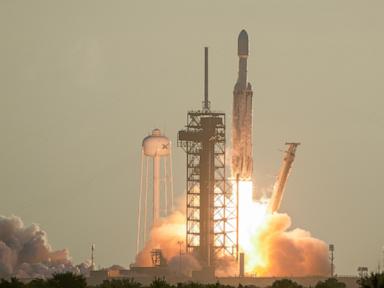
Blasting off from Kennedy Space Center on a SpaceX Falcon Heavy, NASA's newest $4 billion flagship observatory isn't just another shiny piece of hardware heading into the dark. The Nancy Grace Roman Space Telescope is finally airborne, and it's designed to rewrite astronomy textbooks. If you thought the James Webb or Hubble space telescopes already showed you everything worth seeing, you're missing the bigger picture. Those instruments act like high-powered microscopes, peering deeply into isolated corners of the cosmos. Roman works entirely differently. It's built to capture vast swaths of the sky in a single shot, opening up a panoramic view that humanity has never witnessed before.
Named after the astronomer known as the mother of Hubble, this mission tackles the universe's most stubborn puzzles. Scientists want to know why cosmic expansion is speeding up, what dark energy actually consists of, and how billions of hidden galaxies stitch themselves together. Getting answers requires a completely new kind of instrument. Roman delivers precisely that, combining a massive field of view with the sharp infrared clarity we've come to expect from modern space-based optics. Discover more on a similar subject: this related article.
Why the Roman Telescope Changes the Rules of Astronomy
Most people assume space telescopes just zoom in on pretty nebulas or distant galaxies one tiny square at a time. Hubble spent decades building up deep-field images by staring at minuscule patches of sky for days on end. Roman shatters that methodology entirely. Its primary mirror matches Hubble's eight-foot diameter, but the instrument package offers a field of view at least one hundred times larger.
Imagine trying to map an entire dense forest by looking through a single drinking straw. That's essentially how Hubble and Webb operate. Roman walks you out of the trees and gives you an aerial drone view of the entire continent. Over its primary five-year mission, Roman will image more than fifty times as much sky as Hubble covered in thirty years. Surveys that used to take millennia of telescope time will now happen in months. Further reporting by CNET highlights similar perspectives on this issue.
Astronomers often compare these observatories to camera lenses. Webb functions like a high-powered telephoto zoom, capturing incredible fine detail on individual targets. Roman works like a wide-angle panoramic lens, capturing millions of objects simultaneously. You need both perspectives to understand how cosmic structures evolve. Without the wide-angle context, those zoomed-in snapshots lack scale. Without the zoom, the wide shots lack depth.
Hunting Down the Invisible Universe
You can't talk about modern astrophysics without hitting the ultimate brick wall: dark energy and dark matter. Together, they make up about ninety-five percent of everything in existence. Ordinary matter—stars, planets, you, your morning coffee, and every galaxy you can see—accounts for barely five percent. We live in a universe mostly made of stuff we cannot directly see or touch.
Roman exists primarily to crack this case. By surveying more than two billion galaxies, the telescope will track how the universe expanded across different epochs of time. Measuring that expansion rate tells researchers how dark energy behaves and whether its strength changes as the cosmos stretches outward.
Dark matter hides differently, showing its presence only through gravity. When light from distant galaxies passes through dense clumps of dark matter, the gravity of that invisible mass bends the light rays. This phenomenon, known as gravitational lensing, creates warped, smeared images of background galaxies. Roman's massive sky surveys will map billions of these gravitational lenses. By analyzing those distortions, scientists can reconstruct invisible maps of dark matter across the universe, tracking how cosmic scaffolding grew from the primordial soup after the Big Bang.
Discovering Tens of Thousands of New Worlds
Beyond the invisible cosmic web, Roman carries another massive mandate: finding planets orbiting other stars. Discovering exoplanets used to require painstaking luck, waiting for a planet to transit across the face of a host star and block a tiny fraction of its light.
Roman scales this search up exponentially. Using a technique called gravitational microlensing, the telescope can detect planets that sit far away from their host stars, or even rogue planets drifting through interstellar space without any star at all. Microlensing happens when a foreground star passes in front of a background star, magnifying its light. If a planet orbits the foreground star, its gravity adds a distinct blip to the light curve.
Because Roman watches millions of stars packed densely toward the center of our galaxy, it expects to discover roughly one hundred thousand new exoplanets. This bounty will help astronomers figure out whether solar systems like ours are common or if Earth-like conditions are an extreme statistical anomaly.
The Technology Making It All Possible
Building an observatory of this magnitude requires engineering feats that sound like science fiction. The spacecraft sits at Sun-Earth Lagrange Point 2, a gravitational sweet spot located roughly one million miles away from Earth. This location provides a stable thermal environment and an unobstructed view of the deep universe, free from the thermal glow and atmospheric distortion of our home planet.
Even cooler is the hardware itself. The primary mirror used by Roman came from surplus spy hardware donated by the National Reconnaissance Office. NASA repurposed the leftover military optics, saving millions of dollars and years of manufacturing time.
The payload also includes a technology demonstration that could permanently alter planet hunting: a coronagraph instrument designed to block out the blinding light of host stars. Starlight is billions of times brighter than the planets orbiting it, making direct imaging nearly impossible with traditional optics. Roman's coronagraph uses specialized masks and deformable mirrors to cancel out stellar glare, allowing scientists to take actual pictures of exoplanets in visible light for the first time. If this tech demo succeeds, future telescopes will use scaled-up versions to search directly for chemical biosignatures in alien atmospheres.
Working Hand in Hand With Existing Observatories
Some critics wonder why NASA spends billions on a new telescope when Hubble and Webb are already operational. The reality is that modern astronomy requires a fleet, not a lone champion.
Think of Roman as the scout. It scans vast areas of space, identifies rare anomalies, spots ancient primitive galaxies, and flags unusual stellar nurseries. Once Roman finds something weird, astronomers can point the James Webb Space Telescope at that exact target to study its chemical composition in extreme detail. Meanwhile, Hubble provides ultraviolet observations that neither Roman nor Webb can easily replicate, bridging gaps in the light spectrum.
This collaborative ecosystem maximizes scientific output. Instead of competing for observing time on a single platform, researchers gain an integrated suite of instruments capable of looking at the universe from broad strokes down to microscopic atomic signatures.
How the Mission Fits Into the Global Astronomy Fleet
We stand on the brink of a massive data explosion. Roman will beam back petabytes of information, requiring advanced algorithms and machine learning just to sort through the billions of captured galaxies and stars. Citizen science projects will likely play a massive role here, allowing everyday space enthusiasts to help classify shapes and anomalies that automated pipelines miss.
The mission has a baseline five-year lifespan, though engineers designed it to support extended operations. Fuel is typically the main limiting factor for space telescopes operating at Lagrange Point 2, but Roman includes features that make future robotic refueling theoretically possible if commercial space infrastructure advances quickly enough.
When you look up at the night sky tonight, remember that a sophisticated eye is already settling into its permanent home a million miles away, getting ready to pull back the curtain on the darkest, most mysterious corners of our universe. The hidden universe is about to become a lot less secret.


