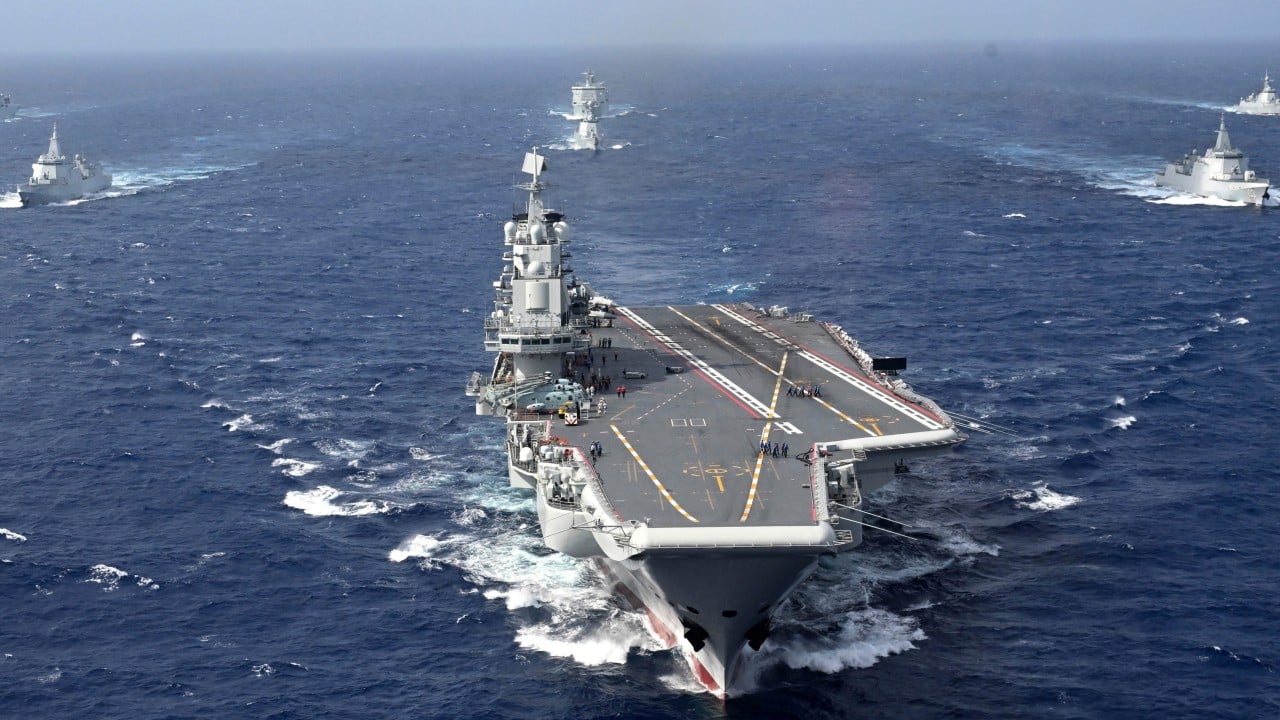
The People’s Liberation Army Navy (PLAN) is undergoing a structural shift from a green-water defensive force to a blue-water power projection fleet. At the center of this transition is the Shenyang J-35 "Blue Shark" fifth-generation stealth fighter. While initial assessments tethered the J-35 strictly to the electromagnetic catapults of the Type 003 Fujian and the nascent, nuclear-powered Type 004, recent operational testing indicates a broader objective: the universal integration of the J-35 across China's entire carrier inventory, including the Short Take-Off Barrier-Arrested Recovery (STOBAR) platforms, Liaoning and Shandong.
Evaluating whether the J-35 can effectively operate across all Chinese aircraft carriers requires an examination of physics, mechanical engineering, and fleet logistics. The viability of this universal deployment hinges on three specific constraints: launch mechanics, structural engineering compatibility, and the sortie generation rate.
The Launch Physics Matrix: Catapult vs. Ski-Jump
The primary constraint dictating whether the J-35 can operate universally is the method of acceleration during launch. China’s fleet utilizes two distinct launch paradigms: Catapult Assisted Take-Off But Arrested Recovery (CATOBAR) on the Fujian, and STOBAR on the Liaoning and Shandong.
+-----------------------------------------------------------------------+
|                         LAUNCH PHYSICS MATRIX                         |
+-----------------------------------------------------------------------+
|  CATOBAR (Type 003/004)                   STOBAR (Type 001/002)       |
|  - System: EMALS (Electromagnetic)        - System: 14° Ski-Jump Ramp |
|  - Force: Linear Motor Acceleration       - Force: Engine Thrust Only |
|  - Result: Max Payload Capability         - Result: Payload Penalized |
+-----------------------------------------------------------------------+
The CATOBAR Baseline
The Fujian uses an Electromagnetic Aircraft Launch System (EMALS). This mechanism applies a continuous, controlled linear force to the aircraft's nose gear via a shuttle. Because EMALS can adjust its energy output based on the precise weight of the aircraft, the J-35 can launch at its maximum takeoff weight (MTOW), carrying a full internal fuel load and maximum ordnance.
The STOBAR Constraint
The Liaoning and Shandong lack mechanical launch assistance, relying instead on a fixed 14-degree ski-jump ramp. Acceleration is entirely dependent on the aircraft’s onboard propulsion. For a heavy, twin-engine fighter to achieve flight velocity before running out of deck space, it must satisfy a strict thrust-to-weight ratio equation:
$$\frac{\text{Thrust}}{\text{Weight}} > 1.0$$
Because the J-35 is a medium-weight stealth fighter powered by WS-21 engines, its thrust-to-weight profile allows it to clear a ski-jump ramp. However, launching without catapult assistance requires a strict trade-off managed by the mission payload cost function:
$$\text{MTOW}_{\text{STOBAR}} = \text{Empty Weight} + \text{Fuel} + \text{Payload}$$
To successfully launch from the Liaoning or Shandong, the J-35 must reduce its $\text{MTOW}_{\text{STOBAR}}$. This reduction forces a compromise: the aircraft must sacrifice either internal fuel (reducing operational radius) or weapon payloads (reducing combat capability). Consequently, while the J-35 can physically fly off all three carriers, its combat profile on STOBAR ships will be fundamentally degraded compared to its performance on CATOBAR platforms.
Structural Engineering and Airframe Adjustments
Deploying a single aircraft design across both CATOBAR and STOBAR systems introduces severe mechanical stress variables. A truly universal carrier fighter must withstand two distinct vectors of physical trauma.
Catapult Launch Stresses
Catapult launches exert immense forward force directly through the nose landing gear. The naval J-35 features a reinforced twin-wheel nose gear and an integrated catapult launch bar. When operating on the Fujian, this assembly transfers the high-velocity energy of the EMALS directly into the reinforced keel of the airframe. When operating on STOBAR ships, this heavy launch bar is dead weight, yet the airframe must carry it, subtly degrading the thrust-to-weight ratio.
Arrested Recovery Impacts
Both STOBAR and CATOBAR systems utilize conventional tailhooks and arresting wires to stop the aircraft during landing. The kinetic energy dissipation during a carrier recovery is governed by the deceleration formula:
$$a = \frac{\Delta v}{\Delta t}$$
Stopping an aircraft traveling at roughly 140 knots within a 100-meter deck space subjects the tailhook assembly, rear fuselage, and landing gear to extreme vertical and horizontal forces. The J-35's airframe features heavy structural bulkheads and an arresting hook designed to absorb these loads uniformly. Because recovery dynamics are virtually identical on the Liaoning, Shandong, and Fujian, the J-35 requires no structural modification to land across the fleet, satisfying the primary condition for physical cross-deck compatibility.
Fleet Logistics and Space Optimization
The physical dimensions of an aircraft dictate its footprint on the flight deck and inside the hangar bay, directly influencing a carrier's total complement and operational tempo.
+-------------------------------------------------------------------------+
|                      AIR WING FOOTPRINT COMPARISON                      |
+-------------------------------------------------------------------------+
|  Dimension            | Shenyang J-15          | Shenyang J-35          |
+-----------------------+------------------------+------------------------+
|  Configuration        | Heavy Fleet Fighter    | Medium Stealth Fighter |
|  Deck Footprint       | Large                  | Compact                |
|  Wings                | Folding                | Folding                |
|  Volumetric Efficiency| Low Hangar Density     | High Hangar Density    |
+-----------------------+------------------------+------------------------+
The legacy fighter of the PLAN, the Shenyang J-15 "Flying Shark," is a large, heavy aircraft derived from the Soviet Su-33 architecture. Its footprint limits the total number of airframes that can be stored and operated simultaneously. The J-35 is a significantly more compact, medium-weight platform.
- Hangar Bay Density: The smaller physical dimensions of the J-35 allow for high volumetric efficiency within the constrained hangar spaces of the Liaoning and Shandong.
- Deck Management: Featuring hydraulic folding wings, the J-35 minimizes its parking spot factor on the flight deck. This smaller footprint allows deck crews to position more aircraft in the launch queues and parking areas.
- Complement Scaling: Replacing a portion of the J-15 fleet with J-35s increases the total fighter complement of a STOBAR carrier by roughly 20% to 30%, compensating for the payload limitations of individual aircraft through sheer volume.
Operational Reality and Strategic Limitations
While the engineering and logistical data prove that the J-35 can physically operate across all Chinese aircraft carriers, the operational reality introduces structural bottlenecks.
The primary limitation is the lack of specialized support aircraft on older hulls. The Fujian and Type 004 are designed to launch the Xi'an KJ-600, a heavy, propeller-driven Airborne Early Warning and Control (AEW&C) aircraft. The KJ-600 requires an EMALS catapult to achieve flight speed and cannot launch from a STOBAR ski-jump.
+-------------------------------------------------------------------------+
|                        FLEET INTEGRATION PARADIGM                       |
+-------------------------------------------------------------------------+
|  CATOBAR Strike Group (Fujian / Type 004)                               |
|  [KJ-600 AEW&C] ----(Data Link)----> [J-35 Stealth] ----> Target        |
|  Result: Long-range organic sensor cueing; optimal stealth profiles.    |
|                                                                         |
|  STOBAR Strike Group (Liaoning / Shandong)                              |
|  [Helo AEW&C] <---(Range Limit)---> [J-35 Stealth] ----> Target         |
|  Result: Degraded radar horizon; reliance on land-based radar networks. |
+-------------------------------------------------------------------------+
Without the KJ-600, J-35 units operating from the Liaoning or Shandong must rely on AEW&C helicopters, which suffer from severe ceiling, speed, and radar range limitations. This creates an information bottleneck. A fifth-generation stealth fighter relies on off-board sensor data to maximize its low-observable advantages. Operating from a STOBAR platform forces the J-35 to use its own radar more frequently, increasing its electronic emissions and undermining its primary defense mechanism: stealth.
Furthermore, engine maturity remains a critical variable affecting operational readiness. The current production blocks utilize the WS-21 engine. While sufficient for initial deployment, achieving the full supersonic cruise performance and reliability required for sustained blue-water operations depends on the long-term validation of these powerplants under high-salinity, high-humidity marine conditions.
The Fleet Allocation Playbook
The PLAN will not deploy the J-35 symmetrically across all platforms. Instead, look for a tiered integration model optimized by ship capability.
The Fujian and subsequent CATOBAR hulls will operate mixed air wings where the J-35 acts as the low-observable penetration asset, supported by the J-15T for heavy ordnance delivery and the KJ-600 for airborne command. On these platforms, the J-35 will operate at maximum internal fuel and weapon capacity, functioning as an offensive tool designed to contest air superiority in high-threat environments.
Conversely, the Liaoning and Shandong will utilize the J-35 primarily as a defensive upgrade. Operating with restricted fuel and light air-to-air missile configurations due to the ski-jump limits, these J-35s will provide a low-observable interceptor umbrella. This configuration shields the strike group from adversarial maritime patrol aircraft and anti-ship cruise missiles, transforming older, limited-range carriers into highly capable defensive bastions operating within the protective radius of China's land-based missile networks.