Silk rots.
Centuries ago, master artisans in the embroidery workshops of Suzhou understood a quiet, inconvenient truth about the medium that made them famous. Silk is soft, lustrous, and manageable, but it is also organic, finite, and ultimately subject to decay. It yields to the humidity of the Yangtze River valley. It fades under the aggressive glare of temple candles. Silk remembers time. If you liked this piece, you might want to read: this related article.
So, someone reached for a strand of human hair.
Imagine the quiet shift in the workshop. The light from a paper window catching a single, fallen filament from a weaver's own head. Instead of reaching for the dyed cocoons of the bombyx mori silkworm, the artisan threaded a steel needle with a sliver of personal anatomy. It was darker, coarser, and infinitely more stubborn. It did not want to bend. It resisted the twist of the fingers. Yet, once pierced through a backing of pale silk or gauze, it held a line with a terrifying, permanent defiance. For another perspective on this development, check out the recent coverage from Glamour.
That single, radical choice birthed an art form so hyper-realistic that modern visitors to museums in East Asia often lean in, squinting, convinced they are looking at sepia-toned photographs rather than thousands of microscopic knots tied with human protein.
To understand Chinese hair embroidery, you have to unlearn everything you know about painting.
In a traditional Western portrait, the artist adds medium to a surface. A stroke of oil here, a wash of watercolor there. The brush builds up mass. In hair embroidery, known historically as moxiu, the artist works entirely through subtraction and tension. Every line is an intervention. Every knot is a commitment.
Consider the scale of the difficulty. A single human hair is roughly seventy to one hundred micrometers thick. Compare that to the finest spun silk thread, which can be split, but only to a certain structural limit before it snaps into useless fuzz. Human hair, by contrast, possesses a natural tensile strength that rivals copper wire of the similar diameter. It has memory. Pull it too tight, and it puckers the fabric. Leave it too loose, and the portrait loses its sharpness, blurring into an amorphous shadow.
Centuries ago, this craft was born out of profound devotion. Buddhist monks and pious women began stitching religious texts and icons using their own hair or the hair of donors, viewing the act as a supreme sacrifice of the body to the divine. Hair was sacred. It was a piece of the soul left behind. To stitch a Buddha using the strands of one's own scalp was to graft a piece of mortal existence into the eternal.
Over generations, the practice drifted from sacred monasteries into the secular imperial courts. Portraiture evolved. By the late Qing Dynasty, artisans realized that human hair possessed a miraculous range of natural color variations. Without a single drop of dye, an embroiderer could sort strands by hue—jet black from a young woman, iron grey from an elder, amber-brown, pale flaxen—and blend them into flesh tones, eyelashes, and the wet sheen of a subject's eyes.
Watch, hypothetically, an artisan named Master Chen sitting by a north-facing window in modern-day Jiangsu.
The room is silent except for the faint scrape of fingernails against a wooden frame. Chen is seventy-four. His eyesight is preserved by decades of micro-adjustments, his hands steady despite the tremor of age. On his workbench rests a portrait of a nineteenth-century scholar, his beard rendered with such immaculate fidelity that individual strands appear to catch an imaginary breeze.
Chen does not use a template printed from a computer. He sketches with his mind, translating light and shadow into hair types. He selects a strand from a wooden sorting box. It is a coarse, steel-grey hair donated by a retired dockworker from Tianjin. It has the exact rigidity needed to depict the coarse bristles of a winter mustache.
He threads the needle. The eye of the needle is microscopic, requiring a moistened tip to slip the filament through. He holds his breath.
In hair embroidery, the breathing matters. If Chen exhales too heavily while pulling the knot tight, the silk backing ripples, and hours of work must be unpicked with a razor blade. It is surgery performed with textiles.
Why use hair instead of thread? The question sounds technical, but the answer is emotional.
Silk represents idealized nature. Hair represents lived reality.
When you look at a hair embroidery portrait of a weeping concubine or an ancient emperor, you are not looking at a representation of a person. You are looking at a structure built from the very substance of humanity. The portrait is made of the material that outlives us. Forensic scientists know that human hair is one of the most durable biological materials on earth; it resists decomposition, surviving in tombs for millennia long after flesh and bone have surrendered to the soil.
When artisans wove portraits out of hair, they were unconsciously building monuments against erasure. A painting can be scrubbed away. A silk tapestry rots in damp air. But hair—treated right, kept dry, framed behind glass—defies the decay of the body it came from.
The process is agonizingly slow. A single, palm-sized portrait can take months, sometimes years, of eight-hour workdays. The embroiderer works with dozens of distinct stitch types—flat stitches, knotted stitches, braided loops, and layered overlapping techniques that mimic the microscopic texture of human skin pores.
There is an inherent vulnerability in this medium. If an artist makes a mistake with oil paint, they paint over it. If they make a mistake with hair embroidery, pulling out a misplaced knot can tear the fragile silk foundation, ruining the canvas entirely. Every gesture is final. Every millimeter requires absolute conviction.
We live in an era of infinite reproduction. We press a button, and a machine spits out a million glossy copies of a digital photograph. We scroll through faces on screens that glow with synthetic light, consuming and discarding human identity at the speed of a thumb flick. Nothing feels permanent. Nothing requires our blood, sweat, or physical presence.
Perhaps that is why this ancient, obsessive craft feels so jarring today.
It reminds us that value is not measured by efficiency, but by the sheer, stubborn expenditure of human time. To spend three years sewing the portrait of a stranger using hair collected from anonymous donors is an act of radical counter-culture. It says that a human life, and the physical remnants of it, deserve to be looked at with absolute, unblinking attention.
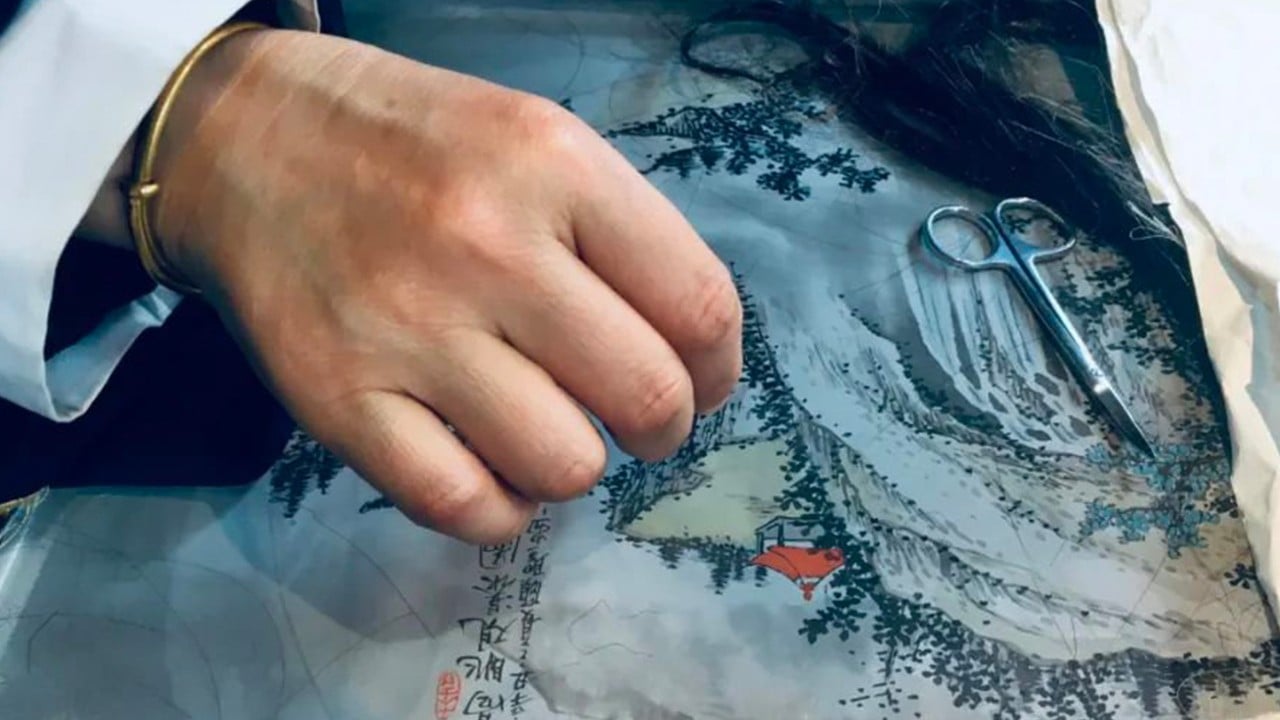
Master Chen finishes the final knot on the scholar's eyebrow. He snips the end with tiny, curved scissors, leaving a millimeter of length to settle naturally against the fabric. He steps back, rubbing his lower back with a grimace.
The portrait looks back at him. The eyes are glossy, deep, and unnervingly present. They do not look like ink on paper or thread on cloth. They look like someone is standing behind a window, watching the room change around them, waiting for the rest of the world to catch up.