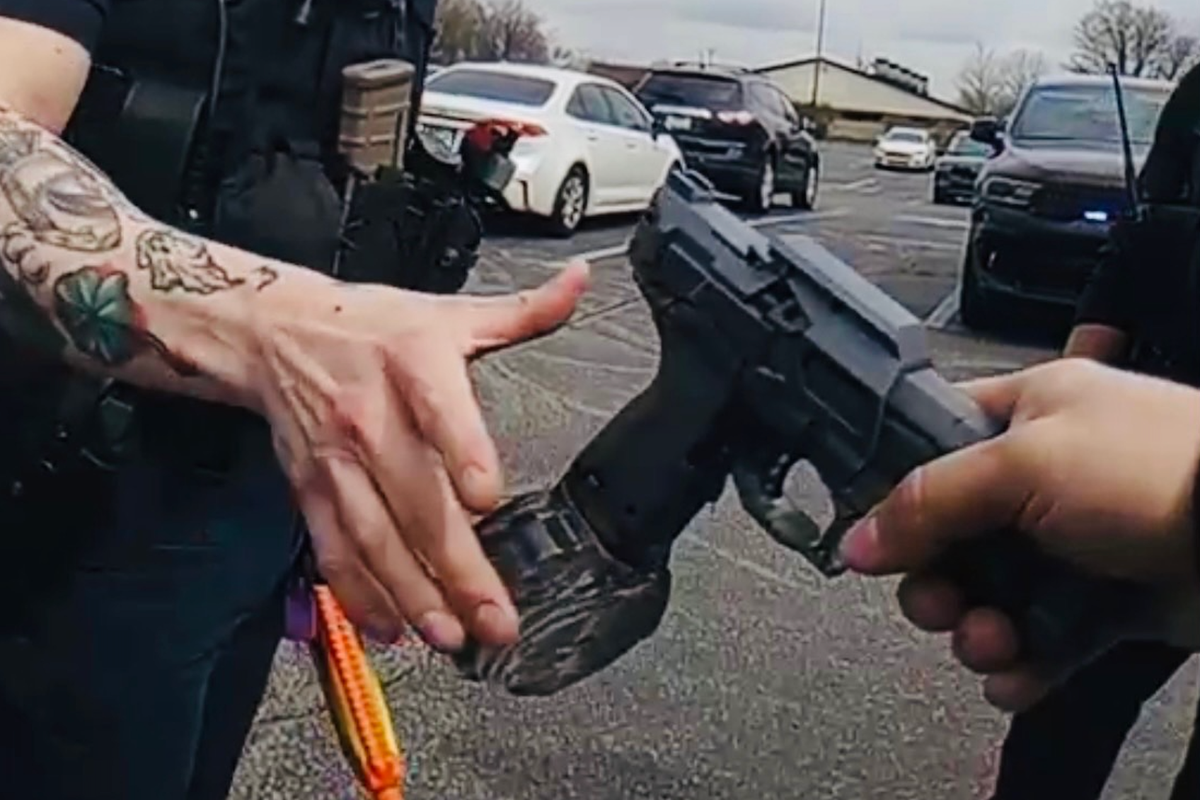
The sun was still high enough to turn the pavement into a heat lamp when the metal felt cold against the back of his neck.
A teenager doesn't think about ballistics. He doesn't think about the optical physics of a polycarbonate lens or the psychological weight of a silhouette in the periphery of a patrol officer’s vision. He thinks about the "Senior Assassin" game. He thinks about the group chat blowing up, the bragging rights of a clean soak, and the adrenaline of a successful ambush.
But when the plastic click of a toy met the heavy rasp of a service weapon clearing a holster, the game died. It died instantly, replaced by a vacuum of sound that occurs only when a life is about to change forever.
The Weight of a Plastic Shadow
We live in a world of visual shorthand. Our brains are wired to categorize shapes in milliseconds—a survival mechanism honed over millennia. A long barrel, a pistol grip, and a finger near a trigger guard translate to "threat" before the conscious mind can register the color of the plastic.
This isn't a story about a crime. It is a story about a catastrophic failure of perception.
The boy, let’s call him Elias—a kid whose biggest previous worry was a chemistry mid-term—found himself face-down on the asphalt. The "weapon" in question was a water gun. It wasn't even a realistic replica; it had the neon flourishes and translucent reservoir of something you’d find in a summer clearance aisle. Yet, in the high-tension environment of a modern neighborhood watch and a jittery police force, that toy became a gateway to a cell.
The handcuffs didn't feel like a prank. They were heavy. They bit into his wrists with a finality that doesn't exist in the world of high school games.
Seventy-Two Hours in the Grey
Three days.
That is seventy-two hours. It is four thousand, three hundred and twenty minutes. For a seventeen-year-old, it is an eternity of fluorescent lights and the smell of industrial floor wax and unwashed anxiety.
While his classmates were sitting in third-period English, Elias was navigating the labyrinth of the legal system. The charge? Often, in these cases, it’s brandishing a replica firearm or inducing panic. The legal definitions are broad, designed to catch the dangerous, but they frequently snag the oblivious.
Imagine the sensory shift. One moment, you are laughing with friends, plotting a harmless prank. The next, you are stripped of your belt, your shoelaces, and your identity. You are a number on a docket. You are a risk assessment.
The statistics on these incidents are growing. Across the country, "Senior Assassin" games—where students "kill" each other with water or Nerf projectiles—have led to high-speed chases, home break-ins, and dozens of near-fatal encounters with law enforcement. We see the headlines and we tsk-tsk at the "reckless youth," but we rarely stop to consider the psychological scar tissue forming on a child who realizes the adults in the room are truly, bone-deep afraid of them.
The Mirage of Safety
There is a particular kind of trauma that comes from being misunderstood at gunpoint. It creates a rift in the social contract. We tell our children that if they follow the rules, they are safe. But the rules of a game and the rules of the street are governed by two different sets of physics.
Consider the officer’s perspective. This is the uncomfortable truth we have to face: an officer responds to a "man with a gun" call. They have seconds to decide if they are going home to their families or if they are becoming a headline. When the "gun" is pulled from a waistband, the color doesn't matter as much as the motion. The tragedy is baked into the interaction before a single word is spoken.
Elias spent his first night in a holding cell wondering if his life was over. He wasn't thinking about the "lesson" he was learning. He was thinking about his mother’s face when she got the call. He was thinking about how his college applications might now be filtered through the lens of a criminal record.
The invisible stakes of a water gun fight are suddenly very, very visible when you're staring at a cinderblock wall.
The Cost of the Game
We treat these incidents as anomalies, but they are symptoms of a deeper friction. We have a generation of kids who grew up with digital realism, where the line between a "toy" and a "tool" is blurred by high-fidelity graphics and tactical aesthetics. At the same time, we have a society on a hair-trigger, where the default response to the unknown is a 911 call.
When these two forces collide, the casualty is usually a kid’s innocence.
By the second day, the adrenaline had long since evaporated. It was replaced by a crushing boredom and a mounting terror. In many jurisdictions, a minor held on these charges isn't just released with a "don't do it again." They are processed. They are fingerprinted. Their DNA might even be entered into a database. All for a quart of lukewarm tap water and a piece of molded plastic.
The legal fees alone can gut a family’s savings. The cost of a defense attorney to argue that a neon-green Super Soaker isn't a "deadly weapon" is a tax on a mistake that shouldn't have been possible.
The Long Walk Out
When Elias was finally released on the third day, the air outside the precinct felt different. It was thinner. Less certain.
His friends were waiting, but the game was over. The group chat had gone silent. The thrill of the "assassination" had been replaced by the sobering reality that the world doesn't play by the same rules as the playground.
He didn't go home and tell his friends how "cool" or "tough" he was. He went home and slept for fourteen hours. When he woke up, he threw the water gun in the trash. He didn't just throw the toy away; he threw away the version of himself that believed the world was a safe place for a joke.
We focus so much on the legality of the arrest or the overreach of the police, but we miss the human center: a boy who went out to play and came back a defendant.
The marks on his wrists from the handcuffs faded within a week. The feeling of being hunted, of being a target for something far more dangerous than a splash of water, stayed. It sits in the back of his mind every time he sees a patrol car or hears a siren. It is a quiet, persistent hum of "what if."
The sun still sets over the pavement, and the neighborhoods still look the same. But for one teenager, the world has been permanently recalibrated. He knows now that the difference between a laugh and a life-shattering mistake is often just a matter of perspective, a few grams of plastic, and three days of silence.
The plastic toy sits at the bottom of a landfill now, its bright orange tip buried under a mountain of actual refuse. It is a fitting end for an object that, for seventy-two hours, had the power to stop a life in its tracks.