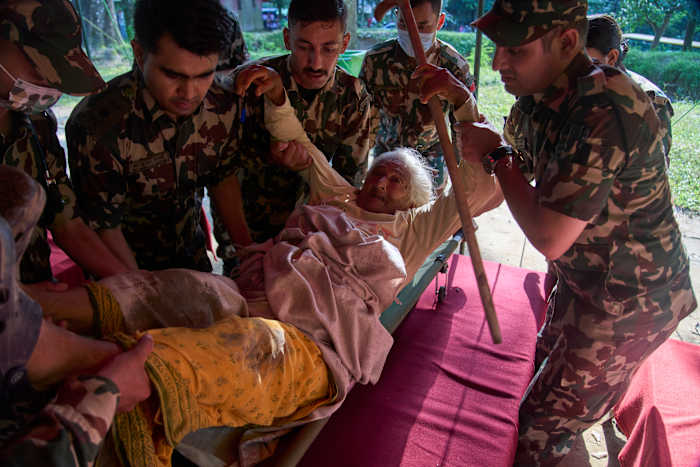
A wall of water, mud, and ice tore down the Himalayas without warning, turning a quiet mountain morning into an absolute nightmare. The catastrophic flash flood along the Nepal-China border has already claimed hundreds of lives, with the official death toll in Nepal climbing to 469 while nearly 1,000 people remain missing. But the immediate destruction is only half the story. Right now, a newly formed barrier lake on the Tibetan side of the border is actively overflowing, threatening to unleash a second wave of devastation down river valleys that are already buried in debris.
What Actually Triggered the Catastrophe
Initial reports blamed a sudden earthquake, but the US Geological Survey quickly corrected the record. The seismic signature that registered as a magnitude 5.2 event wasn't tectonic at all. It was a massive glacial collapse. Don't forget to check out our previous coverage on this related article.
Satellites and ground sensors captured the terrifying mechanics of the event: a massive chunk of ice—roughly 0.2 square kilometers in size—broke off at an elevation of about 5,200 meters and plunged 1,200 vertical meters straight onto the valley floor. That impact pulverized rock and ice, instantly melting snow and generating an unstoppable, hyper-concentrated debris flow that slammed into the Bhote Koshi and Trishuli river systems.
Water levels surged by up to 9 meters in just 30 minutes. Roads vanished, bridges were pulverized, and hydropower stations under construction were swallowed by the torrent. To read more about the history here, The New York Times provides an informative breakdown.
The Secondary Threat From the Barrier Lake
Rescue operations haven't just been difficult; they've been actively interrupted. Authorities in both Nepal and China have ordered emergency suspensions of rescue flights and ground searches because the debris-clogged river system has pooled into a massive natural dam.
This barrier lake, located roughly 1,000 meters above the hard-hit Gyirong Port area, has accumulated millions of cubic meters of water. Chinese water resource officials warn that millions more cubic meters of water are funneling into the basin. With the lake already spilling over its makeshift banks, scientists and engineering teams are staring down the barrel of a potential glacial lake outburst flood.
If that barrier gives way completely, the resulting surge will sweep through districts that are already struggling to process the scale of the first disaster.
The Human Toll and the Tourist Crisis
The remoteness of the Himalayan terrain makes tracking casualties an agonizing process. Hundreds of foreign nationals—including trekkers, pilgrims heading toward sacred sites like Mount Kailash, and migrant laborers working on infrastructure projects—are among the missing.
Military helicopters have managed to airlift thousands of survivors to safety, pulling injured people out of mud-choked hydropower tunnels and isolated riverbanks. Yet, families searching for loved ones face a grim reality. Entire villages have been erased, submerged under thick layers of dark brown sediment that hide the scale of the loss.
Why the Himalayas Are Becoming a Danger Zone
This disaster isn't an isolated fluke. The Hindu Kush Himalayan region is warming at roughly twice the global average, destabilizing mountain permafrost and shrinking glacial ice at an unprecedented rate. When glaciers retreat and melt unchecked, they leave behind unstable moraine walls and hanging ice sheets that can trigger catastrophic avalanches with minimal provocation.
Governments across South Asia are facing immense pressure to upgrade early-warning infrastructure in high-altitude transboundary river basins. Traditional forecasting models simply cannot keep up with the speed at which climate-driven high-mountain hazards are evolving.
For now, emergency crews remain stationed on high alert. Evacuation orders line the valleys of the Trishuli and Bhotekoshi rivers, and residents are urged to stay entirely clear of riverbanks until engineering teams can safely drain or stabilize the overflowing lake upstream.