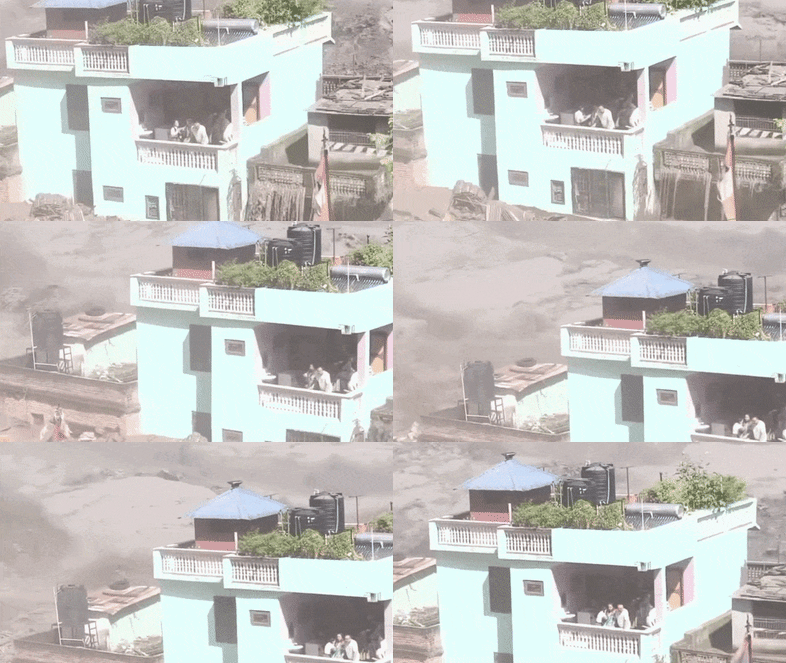
When a wall of water, ice, and debris tore through Trishuli Bazaar on August 26, 2026, it flattened concrete buildings as if they were built of cardboard. Yet one pale green, 40-year-old house stayed put. Viral footage showed a family stranded on the balcony while neighbors vanished into the gray torrent. It looks like a Hollywood special effect. It's actually a stark lesson in heavy-duty engineering and geographic luck.
People love calling things miracles when they don't understand the physics. Let's look past the viral videos and examine why this specific structure stayed standing while everything around it crumbled. For another view, consider: this related article.
The Engineering Reality Behind the Green House
You don't survive a catastrophic debris flow by wishing hard. Prakash Pandey Pyakurel, the owner, built this house four decades ago with specific environmental threats in mind. Because it sat close to the river corridor, the family didn't cut corners on the foundation. They packed two or three layers of dense road material beneath the base to anchor it against shifting earth.
Engineers pointing out the structural layout note a few critical defensive traits: Related reporting on this trend has been shared by NBC News.
- Reinforced-Concrete Frame: The building relied on an interconnected skeleton of steel-reinforced concrete columns and beams rather than weak brick masonry alone. When lateral shockwaves hit, the frame distributed the load across the entire structure.
- Foundation Depth: Standard river scour usually washes away the dirt supporting a structure, causing it to tilt and collapse. This foundation held its ground long enough to defy the current.
- Flow Diversion: Location mattered just as much as materials. The main high-velocity channel of the debris flow sheared past the building's flank rather than striking its central load-bearing axis dead-on.
The Terrifying Reality on the Ground
While internet users shared the clip as an inspiring piece of digital content, the reality inside those walls was pure terror. Six family members scrambled upward as the muddy water swallowed the ground floor, destroying a storage warehouse and sweeping away vehicles. They waited nearly two hours, trapped on upper levels, watching their neighborhood vanish.
Rescue didn't come from automated systems. Local residents from a nearby toll area rigged a makeshift bridge using a pipe and a rope, pulling the family across to safety before authorities and the military managed to secure the wider zone. Everyone inside made it out alive, but they walked out into a landscape stripped of roads, bridges, and livelihoods.
What This Disaster Teaches Us About River Corridors
Flash floods triggered by glacier and ice collapses near borders are becoming harder to predict and exponentially more violent. When millions of tons of slurry move at highway speeds, standard building codes fail.
Most homes in mountain valleys are built to handle seasonal rain, not walls of boulders and ice. When you build near Himalayan river systems, standard construction methods are a gamble. This house survived because it was over-engineered for its specific plot four decades ago. Most modern developments skip those foundational costs to save money upfront.
The family is now facing the grueling task of clearing the mud and figuring out how to restart. The house stands as a lonely monument, half-buried and stripped of its lower level, proving that while smart engineering can buy you precious time against a natural disaster, living right on the edge of a volatile river corridor always carries a heavy toll.