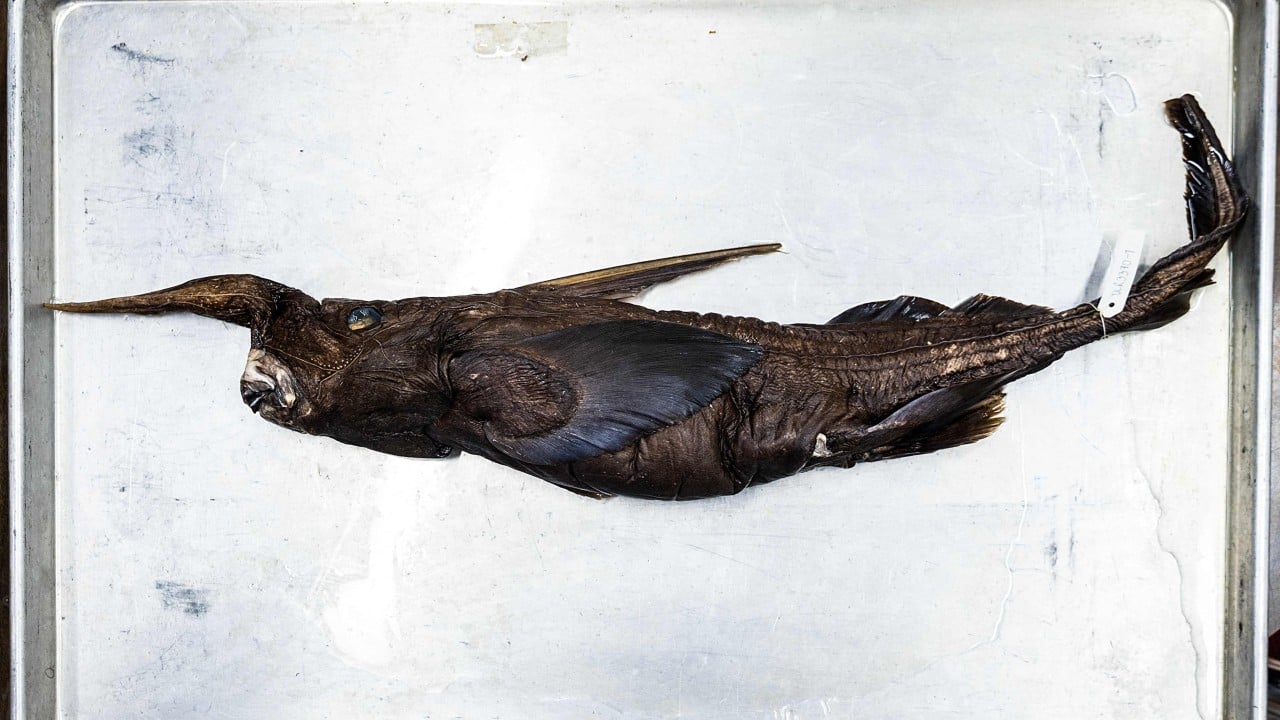
The ocean deep has a knack for holding onto its secrets, but every now and then, it throws us a bone. Or rather, a piece of cartilage. Scientists just confirmed a brand-new species of ghost shark swimming in the pitch-black waters off the Pacific coast of Costa Rica.
It is a weird, pale creature with a paddle-shaped nose and eyes that look like they belong in a horror flick. Formally named Rhinochimaera costaricana, it is the first long-nosed chimaera ever found in the Eastern Pacific Ocean.
Most people hear "ghost shark" and think of a Hollywood monster. But if you talk to deep-sea biologists, you get a completely different story. They will tell you this discovery is a warning light for ocean conservation. Here is what is actually going on beneath the waves and why this bizarre fish is causing such a stir.
The Freakish Anatomy of a Living Fossil
Ghost sharks are not actually sharks. They are chimaeras, a group of cartilaginous fish that split from the main shark lineage roughly 400 million years ago. While dinosaurs came and went, these guys stayed in the deep, barely changing.
The newly described Rhinochimaera costaricana looks like a patchwork quilt of different animals. It has an elongated snout packed with sensory nerve endings used to detect the faint electrical fields of prey in the dark. It is basically swimming around with a high-tech metal detector attached to its face.
A team of Costa Rican and Brazilian researchers, led by biology student Naidely Valeria Vidaurre Quesada from the University of Costa Rica, officially published the description in the journal Zootaxa. They did not just stumble upon a live one; they had to do some serious detective work. The team compared 49 separate body measurements against a database of over 90 individuals from the three previously known species in the Rhinochimaera genus.
The Costa Rican fish stood out instantly. It has a shorter nose than its cousins, a taller first dorsal fin, more space between its fins, and fewer bumpy tubercles along its tail.
The physical traits were weird enough, but the genetic data sealed the deal. DNA testing on the specimens showed a genetic divergence of 3.9% to 4.7% from its closest relatives. In the world of marine biology, that is a massive gap. It is definitive proof that this is a completely unique branch on the evolutionary tree.
The Long Wait for Recognition
You might think scientists dropped a high-tech submarine into the abyss and dragged this fish up yesterday. That is not how deep-sea taxonomy works. It is usually a much slower, more tedious process.
The discovery relies on three male specimens collected between 2000 and 2023. The very first specimen was caught way back in 2000 near Isla del Caño. The other two were pulled up in 2023 near Cabo Blanco in the Puntarenas Province.
For nearly a quarter of a century, that first specimen sat in a jar of preservative, likely misidentified or tucked away in a museum drawer. It takes a dedicated researcher with the right tools to look at an old specimen, run modern DNA sequencing, and realize they are holding a piece of history.
All three fish were found at depths between 390 and 787 meters (around 1,280 to 2,580 feet). That is way past where any recreational diver can go. Down there, sunlight is a myth, the pressure is crushing, and the water is barely above freezing.
The Bycatch Problem Nobody is Talking About
Here is the uncomfortable truth about the Rhinochimaera costaricana discovery: every single specimen we have was caught as bycatch during commercial fisheries surveys. They were accidentally scooped up in deep-water nets.
The International Union for Conservation of Nature (IUCN) has not even had a chance to assess the conservation status of this new ghost shark. We have no idea how many are down there. We do not know their population size, their exact range, or how quickly they reproduce. Because they live so deep, they likely grow slowly and reproduce late in life, which makes them incredibly vulnerable to overfishing.
If commercial trawlers are dragging heavy nets across the seafloor at these depths, they could be wiping out entire populations of species we do not even know exist yet. It is highly probable that unique deep-sea creatures are going extinct before we can give them a name.
What Needs to Happen Next
This discovery should change how we manage the ocean. If you want to help protect these overlooked deep-sea ecosystems, you can track the organizations doing the real groundwork.
Keep tabs on the Costa Rica Fisheries and Aquaculture Institute (INCOPESCA) and the University of Costa Rica. They are the ones pushing for better marine protections and smarter fishing regulations.
Supporting international initiatives that restrict deep-sea bottom trawling is another practical step. When management policies rely on accurate maps of marine biodiversity, ecosystems win. We can only protect what we know is there.