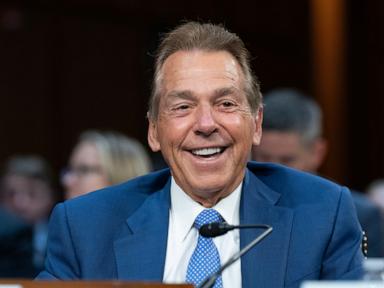
Nick Saban wants you to believe the sky is falling. Sitting before the Senate Commerce Committee, the legendary former coach deployed his best folksy terror, warning that college football is a Ferrari screaming at 150 miles an hour toward the Grand Canyon. He wants Congress to pull the emergency brake. He wants the federal government to step in with the Cruz-Cantwell bill to cap athlete compensation, restrict transfers, and freeze the market.
He is completely wrong.
The lazy consensus dominating sports media right now frames this as a battle between old-school purity and modern greed. Commentators tear their hair out over athletes securing millions and entering the transfer portal at will. They paint the bipartisan bill introduced by Senators Ted Cruz and Maria Cantwell as the last line of defense against absolute chaos. Meanwhile, the SEC and the Big Ten are getting dragged for withholding their support, accused of hiding behind vague corporate objections about unresolved issues.
This entire narrative misreads the basic economics of modern sports. Saban is not trying to save college athletics. He is trying to cartelize it. The SEC and the Big Ten are not dodging regulation because they love chaos; they are dodging it because they know the proposed legislation is a poorly disguised bailout for athletic departments that do not know how to run a business.
The Myth of the Level Playing Field
The foundational lie of the Cruz-Cantwell bill is that it aims to restore fair competition. Senator Cantwell claimed the goal is to ensure success is determined by how universities build a team, rather than which school has a billionaire in its back pocket.
This assumes a level playing field ever existed in college sports. It never did. Before Name, Image, and Likeness (NIL) collectives took over, competition was dictated by which universities could spend $100 million on sci-fi-inspired training facilities, laser-tag rooms, and gold-plated recovery pods. The elite programs used massive booster networks to fund a facilities arms race designed specifically to circumvent the rules against paying players directly.
When you strip away the romanticism, college football has always been an open market masquerading as an amateur charity. The only difference now is that cash goes directly into the pockets of the workers rather than being laundered through luxury real estate projects on campus.
Let us dissect the mechanics of what happens if you artificially suppress player compensation through a federal mandate. If Congress caps what an athlete can earn from a collective, the money does not magically vanish from the ecosystem. Boosters will still want their alma mater to win. Instead of writing checks to an NIL collective, that money shifts right back into under-the-table handshakes, luxury housing, or inflated salaries for support staff. You cannot legislate away demand in a multi-billion-dollar entertainment industry. You merely force it back into the shadows.
The Fraudulent Logic of the Lane Kiffin Rule
One of the most celebrated aspects of this bill is the so-called Lane Kiffin Rule, which seeks to restrict coaches from abandoning their programs during the season, alongside strict limits allowing players only one free transfer during their college careers.
This is an absolute double standard. For decades, head coaches have torn up contracts, walked out on players the week before a bowl game, and signed massive extensions with rival schools without a single tier of government intervention. When a coach leaves, it is called savvy career management. When a twenty-year-old offensive lineman transfers to a school closer to home or to secure a better financial deal, critics call it a crisis of character that threatens the fabric of higher education.
Limiting athletes to a single free transfer does not build team culture. It creates a trapped workforce. In any other industry, if a middle manager realizes their boss is toxic or that a competitor is offering double the salary, they walk. Nobody forces a software engineer or a marketing executive to sit out a year of work because they switched employers.
I have watched athletic departments burn millions of dollars on legal fees trying to enforce non-compete clauses on assistant coaches, only to lose in court because judges recognize restraint of trade when they see it. Forcing a federal restriction on student-athletes will face the exact same constitutional buzzsaw. It violates basic antitrust principles, and no amount of congressional hand-waving can change the fact that you cannot legally strip one specific class of young adults of their economic mobility just to make a coach's job easier.
Why the Power Conferences are Rejecting the Bait
The media is treating the SEC and the Big Ten as the villains of this saga because they refused to send representatives to testify alongside Saban. Critics argue these two mega-conferences are simply greedy, terrified that federal intervention will disrupt their television revenue monopolies.
The reality is far more calculated. The SEC and the Big Ten are playing an entirely different game. They realize that this bill is an existential trap. One of the quietest yet most dangerous provisions in the Cruz-Cantwell proposal gives conferences the option to pool their media rights under a centralized framework. Proponents argue this would stabilize the sport.
Imagine a scenario where the SEC willingly dilutes its multi-billion-dollar media valuation to prop up the failing brands of the Pac-12 or struggling mid-major conferences. It makes zero business sense. The SEC and the Big Ten have spent the last five years aggressively consolidating the most valuable brands in television—bringing in Texas, Oklahoma, USC, and UCLA. They did not do that out of a desire to share the wealth; they did it to prepare for an inevitable breakaway from the NCAA framework entirely.
The two super-conferences are withholding support because the bill fails to provide total, ironclad federal preemption over state laws. Without that preemption, a school in Texas could still bypass federal limits by utilizing state-level legislation that shields its collectives from punishment. The SEC and Big Ten executives are smart enough to see the trap: if they agree to federal caps without total preemption, they tie their own hands while leaving rogue states free to operate outside the boundaries. They are refusing to sign a contract that leaves their flank completely exposed.
The Reality of the Athlete Employee
The real question nobody in Washington wants to answer honestly is the employment question. Every piece of legislation brought before Congress is a desperate, frantic attempt to avoid the inevitable: declaring college athletes employees under the National Labor Relations Act.
Saban and his political allies are terrified of this outcome because employment means collective bargaining. It means worker's compensation for injuries. It means athletic departments would have to open their books and show where the money actually goes.
Instead of treating athletes like employees, universities want to maintain a system where they enjoy all the benefits of a professional sports franchise with none of the liabilities. They want to dictate schedules, control behavior, and generate hundreds of millions in licensing fees, while hiding behind the shield of amateurism to avoid payroll taxes and long-term health obligations.
The argument that identifying athletes as employees would ruin non-revenue sports like track and field or swimming is an empty scare tactic. Athletic departments routinely flush millions down the drain on bloated administrative salaries, excessive travel budgets, and multi-million-dollar buyouts for fired coaches. If a school can afford to pay a terminated football coach twenty million dollars to sit on a couch, it can afford to pay minimum wage and health insurance to its soccer players. The issue is not a lack of revenue; it is a total lack of budgetary discipline.
Stop Trying to Fix the System
The premise underlying the entire congressional hearing is fundamentally flawed. We are asking a group of octogenarian politicians to fix an industry they do not understand, using tools that do not work, to protect a status quo that died five years ago.
Stop trying to regulate the transfer portal. Stop trying to cap NIL money. The market is currently undergoing a violent, necessary correction. For fifty years, the NCAA operated an illegal wage-fixing cartel. Now that the cartel has collapsed under the weight of its own hypocrisy, the sudden shift to an open market looks chaotic. But chaos is simply what a free market feels like to people who have spent their entire lives protected by a monopoly.
If a university cannot survive in an environment where players are paid what they are worth, that university should not be operating a big-time professional entertainment business. It is time to let the market clear. Let the SEC and the Big Ten break away. Let them form a professional super-league where players sign explicit employment contracts, collective bargaining agreements dictate the rules, and the transfer portal is replaced by a transparent free-agency system with clear contractual penalties for breaking a deal.
The Cruz-Cantwell bill is an attempt to use federal law to freeze college sports in amber, protecting wealthy institutions from the financial consequences of their own choices. Nick Saban can keep crying wolf about his runaway Ferrari. The rest of the world should step aside and let the vehicle run its course.