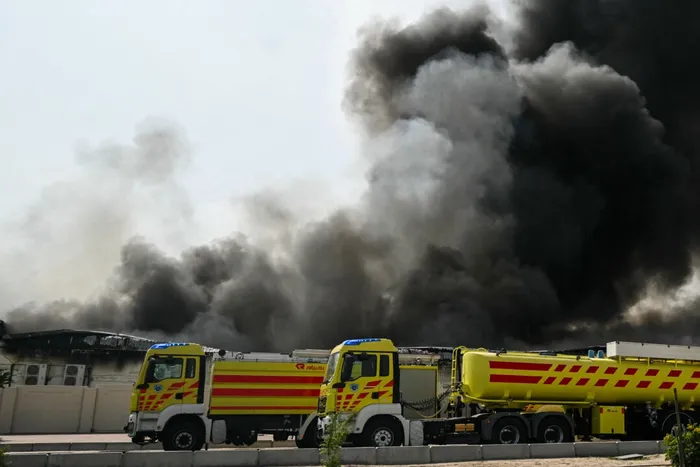
The air above Akrotiri usually tastes of salt and jet fuel. It is a predictable, rhythmic atmosphere. On a standard Tuesday night, the Mediterranean breeze carries the distant hum of the surf and the occasional, thunderous roar of a Typhoon fighter jet returning to its nest. For the thousands of British personnel and their families living on this small thumb of Cypriot soil, the base is more than a strategic outpost. It is a neighborhood. There are schools here. There are grocery stores and playgrounds where children learn to ride bikes under the watchful eye of some of the most advanced radar systems on the planet.
Then the rhythm broke.
It didn't start with a siren. It started with a buzzing. A low, persistent mechanical drone that felt out of place, like a hornet trapped in a quiet bedroom. This wasn't the confident scream of a multi-million-pound sovereign aircraft. This was something smaller. Something cheaper. Something that shouldn't have been there.
When Sky News first broke the report of a suspected drone strike at the British Sovereign Base Area in Cyprus, the world's eyes flickered to the map. But for those on the ground, the map is irrelevant. The reality is the sudden, sharp realization that the walls of a fortress are only as high as the technology used to surveil them.
The Ghost in the Machine
A drone strike is a sterile term. It sounds like a surgical procedure. In practice, it is a psychological breach. Imagine a soldier, perhaps twenty-four years old, standing watch at a perimeter that has felt largely untouchable for decades. This base is a vital artery for operations across the Middle East. It is the bridge between the West and the volatile theaters of the Levant.
Security isn't just a job here; it’s an absolute.
But modern warfare has become democratized. You no longer need a state-sponsored air force to knock on the door of a superpower. You need a few thousand dollars, a steady GPS signal, and a willingness to see what happens when a plastic-and-carbon-fiber bird meets a hardened military installation. The suspected strike represents a shift in the gravity of global tension. It signals that the "front line" is no longer a trench in a distant desert. It is the sky above a sleepy Mediterranean peninsula.
The reported incident involved small, unmanned aerial vehicles. These aren't the size of Cessnas. They are often no larger than a kitchen appliance. They move with a twitchy, insect-like agility that makes them infuriatingly difficult for traditional radar to track.
Consider the physics of the problem. Radar is designed to find metal giants moving at hundreds of miles per hour. When you ask it to find a slow-moving, plastic object the size of a seagull, the math changes. The variables of detection become a nightmare of false positives and electronic noise.
The Invisible Stakes of a Silent Sky
Why does a small explosion—or even the mere presence of these drones—matter so much?
Because of the "Quiet Threat."
If an enemy can put a drone over Akrotiri, they can put a camera over it. If they can put a camera over it, they can see exactly when the jets take off. They can see the shift changes. They can see the vulnerabilities in the fuel depots. Every successful flight, even one that ends in a crash or a harmless detonation, is a data-gathering mission. It is a test of the fence.
The people living on the base understand this instinctively. To the outside world, a report like this is a headline to be scrolled past. To the spouse of a technician living in base housing, it is a reason to keep the curtains closed. It is a reminder that the world's friction points are rubbing together right in their backyard.
The geopolitical weight of Cyprus is hard to overstate. It is a stationary aircraft carrier. From these runways, the RAF projects power into Syria, Iraq, and beyond. If that projection is even slightly wobbled by the nuisance of low-cost drone harassment, the cost of doing business in the region skyrockets.
We are seeing the birth of a new kind of siege. Historically, a siege meant surrounding a city and starving it out. Today, a digital siege means surrounding a base with "persistent observation." It means making the occupier feel watched, 24 hours a day, by an enemy that might be sitting in a basement five miles away—or five hundred.
The Mathematics of Modern Terror
The cost-to-damage ratio is the most frightening part of this equation. Let’s look at the logic of the engagement.
A single defensive missile used to intercept a drone can cost upwards of £100,000. The drone it is trying to kill might cost £2,000. If an adversary sends fifty drones, they have spent £100,000. To stop them all, the defender must spend £5,000,000.
This is an economic war of attrition. You don't have to destroy the base to win. You just have to make it too expensive and too stressful for the base to function. This is the "Asymmetric Trap." It’s a game where the giant is forced to use a sledgehammer to swat a fly, and every time he misses, the fly gets a little bolder.
The reports from Cyprus suggest the damage was minimal. No one was killed. The runways stayed open. But the psychological barrier has been scorched. The "suspected" nature of the strike adds a layer of fog to the fire. Who sent them? Was it a state actor testing the waters? A local group with a grievance? Or a proxy group funded by a power looking to send a subtle message of reach?
In the world of intelligence, a strike without a signature is often more terrifying than an open declaration of war. It creates a vacuum of accountability.
When the Horizon Changes
For those of us watching from the safety of our screens, it’s easy to get lost in the jargon of "UAVs" and "Sovereign Base Areas." But strip it all back.
Think of the night sky over the Mediterranean. It should be a place of beauty, of ancient constellations and the soft glow of coastal towns. Now, for the men and women at Akrotiri, that sky has become a source of intense, squinting scrutiny. Every blinking light on the horizon is no longer just a star or a commercial flight to Paphos. It is a question.
The response to this will likely be invisible to us. It will involve new frequencies of electronic jamming. It will involve microwave emitters and high-energy lasers that can cook the circuits of a drone mid-air. The arms race has moved from the stratosphere down to the treetops.
The real story isn't the explosion. It’s the silence that follows. It’s the way the guards now look up instead of out. It’s the realization that the distance between a quiet family dinner in a base bungalow and a global flashpoint is now measured in the few seconds it takes a battery-powered motor to cross a perimeter fence.
The wind in Cyprus still smells of salt. But for now, it also carries the sharp, metallic tang of a new reality. The fortress hasn't fallen, but the birds are circling, and they don't seem to be looking for a place to land.
The buzzing has stopped for tonight, but the echo remains.