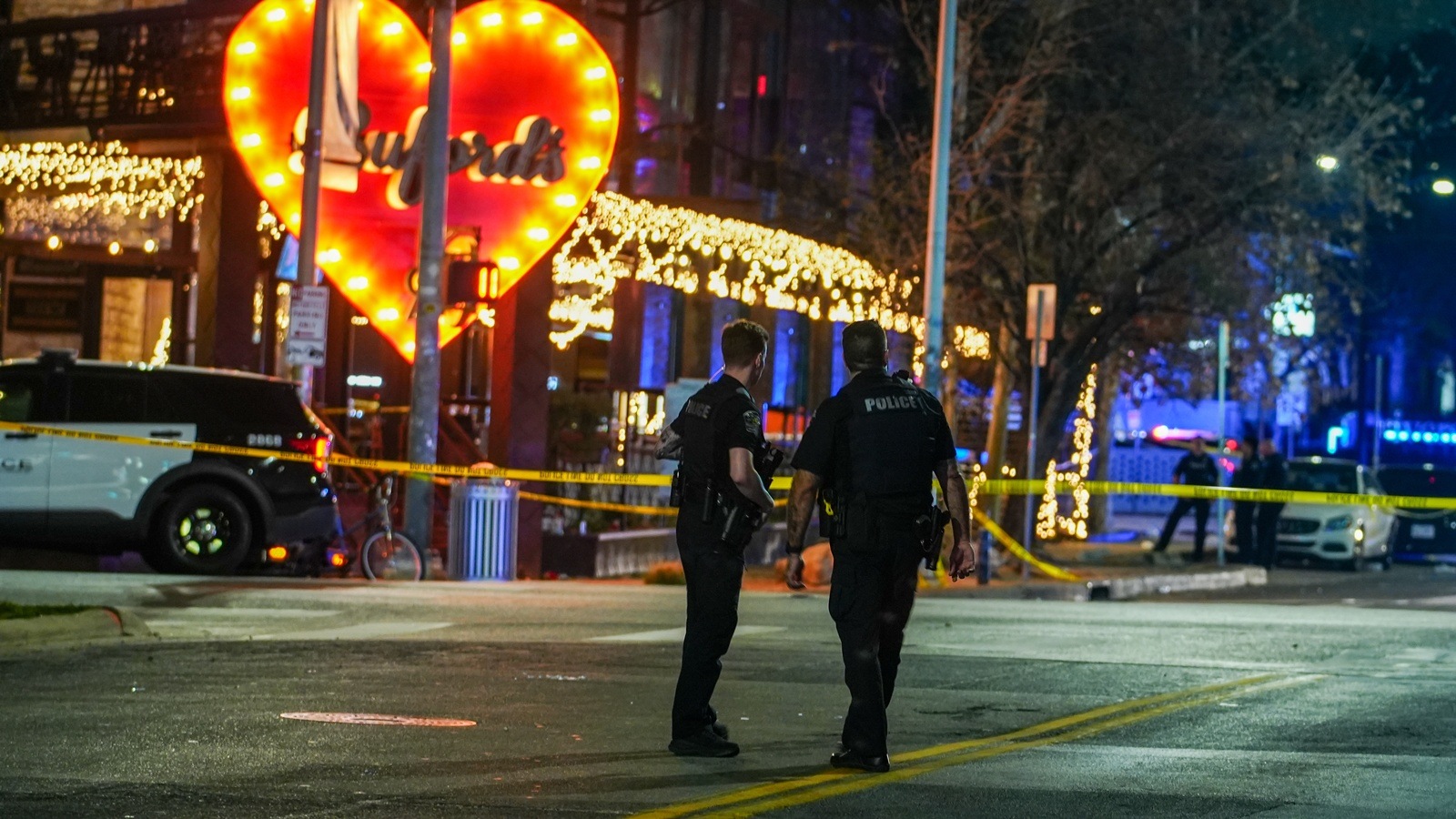
The humidity in Austin usually carries the scent of smoked brisket and cedar elm, but on a Saturday night in the Entertainment District, it smells like expensive cologne and cheap beer. It is a sensory overload. Neon signs for bars like The Library and Buckshot flicker in a rhythmic, mechanical pulse, competing with the thrum of bass vibrating through the pavement. People come here to disappear into the crowd. They come to forget the work week, to find a spark with a stranger, or to simply stand in the middle of a street where the noise is loud enough to drown out their own thoughts.
Then the rhythm broke.
It wasn't a fade-out or a transition. It was a jagged, violent tear in the fabric of the night. At approximately 1:30 a.m., the percussion of the city was replaced by the sharp, metallic cracks of gunfire. In the span of a few panicked minutes near a crowded bar, the "Live Music Capital of the World" fell silent, replaced by a sound that no one ever forgets once they’ve heard it in person: the sound of a thousand people trying to inhale at the exact same time.
The Anatomy of a Crowd
To understand what happened in Austin, you have to understand the physics of a crowd. When seventeen people are struck by lead in a confined urban space, the tragedy isn't just in the ballistics. It’s in the geography.
Imagine a hypothetical young woman named Elena. She’s twenty-four, celebrating a promotion, and standing near the entrance of a bar. In her mind, she is in a place of safety and celebration. In reality, she is part of a high-density human matrix. When the first shot rang out, the instinct wasn't to run; it was to freeze. The brain requires a few seconds to categorize a sound that shouldn't exist in a civilized space. Is it a firework? A car backfiring? A stage prop?
By the time the realization hits—the "fight or flight" override—the exits are already choked. In Austin, fourteen people were wounded and three lives were extinguished not in a vacuum, but in a chaotic scramble where every second felt like an hour. The shooters, according to investigators, weren't targeting a specific person with clinical precision. They were venting a dispute into a sea of humanity.
This is the invisible stake of urban violence. It isn't just the intended target who pays the price. It is the bystander holding a drink, the bouncer checking an ID, and the musician packing up a guitar case. The bullets don't discriminate between a grudge and an innocent Saturday night.
The First Responders’ Ghost Story
The police officers patrolling Sixth Street are used to drunks and scuffles. They are trained for the standard friction of a nightlife economy. But when the reports of "shots fired" came over the radio, the atmosphere shifted from "crowd control" to "battlefield medicine."
Officers didn't wait for ambulances. They couldn't. The streets were too crowded, the logistics too tangled. Instead, they became makeshift surgeons. They used their own hands to apply pressure to femoral arteries. They turned belts into tourniquets. There is a specific kind of trauma that settles into the bones of a first responder who has to decide, in a split second, which of the fourteen bleeding bodies needs their help first.
The statistics tell us three are dead. The numbers don't tell us about the bloodstains on the officers' boots that won't wash off, or the way the silence of the street afterward felt heavier than the gunfire itself.
Austin has seen growth that defies logic over the last decade. It is a tech hub, a cultural mecca, and a blue island in a red sea. But that growth brings a specific kind of volatility. As more people pack into the same city blocks, the margin for error shrinks. A disagreement that might have ended in a fistfight twenty years ago now ends with a crime scene tape stretching from one end of the block to the other.
The Ripple Effect of Fourteen Seconds
We often talk about "the injured" as if they are a monolith. We count them, assign them a number, and move on to the next news cycle. But "injured" is a deceptive word.
For some of the fourteen survivors in Austin, "injured" means a lifetime of physical therapy. It means the smell of gunpowder will now trigger a panic attack in the grocery store. It means a permanent limp, a prosthetic limb, or a piece of shrapnel lodged too close to a spine to ever be removed.
Consider the financial weight. A single gunshot wound can result in medical bills exceeding $100,000 before the patient even leaves the ICU. For a young person without premium insurance, the "night out" becomes a decade of debt. This is the hidden cost of a few seconds of rage. The shooters stole more than lives; they stole the trajectory of fourteen families.
The Ghost in the Machine
Why does this keep happening in the places we love most?
The debate usually retreats into the well-worn trenches of gun control versus mental health, but that binary choice ignores the messy reality of the American street. We are living in an era of hyper-accessibility. Guns are more prevalent, but so is the hair-trigger temper of a society that has forgotten how to de-escalate.
In the Austin shooting, the suspects were young. This wasn't a calculated terrorist plot or a mob hit. It was a "dispute between two groups." Think about that. A "dispute." A disagreement over a word, a look, or a girl escalated into a mass casualty event because the tools of lethality were within arm's reach.
The tragedy is compounded by the fact that Sixth Street is supposed to be the soul of the city. When you attack a place like that, you aren't just hitting bodies; you are hitting the idea of community. You are telling people that the "public square" is a dangerous gamble.
The Morning After the Rain
By 4:00 a.m., the crime scene technicians were the only ones left. The neon signs were still buzzing, though their glow seemed sickly against the graying sky. The street was littered with the debris of a vanished party: single shoes, broken glass, cell phones that wouldn't stop ringing as worried parents called over and over again.
One phone, lying face up near a gutter, showed a notification for a missed text: "Are you home yet? Let me know when you're safe."
The person who owned that phone was likely in a hospital bed, or perhaps they were one of the three who would never send that text back.
We look for meaning in these events because the alternative—that life is fragile and can be snuffed out by a stranger’s bad mood—is too terrifying to accept. We want a policy change, a new law, or a beefed-up police presence to tell us it won't happen again. But as the sun rose over the Texas Capitol building, just a few blocks away, the only certainty was the grief.
Austin will keep growing. The music will start playing again by Tuesday. The tourists will return, lured by the promise of "Keep Austin Weird." But for seventeen families, the city will never look the same. They will always see the shadows where the neon used to be. They will always hear the silence that follows the music.
A city is a living thing, and when you pierce it with fourteen bullets, it doesn't just bleed. It loses its voice. On Sixth Street, the echoes of that Saturday night are still bouncing off the brick walls, waiting for someone to explain why a "dispute" was worth the price of a human soul.
The sun eventually burned through the Austin haze, illuminating a sidewalk that had been scrubbed clean. To a passerby, it looked like any other Sunday morning. But if you knelt down and looked closely at the cracks in the pavement, you could still see the dark, stubborn stains of a night that refused to be forgotten.