The air inside Munich’s Showpalast was thick with the scent of high-end catering and low-grade panic.
Outside, the historic Bavarian streets were quiet, bathed in the soft glow of a mid-July evening. This city is the undisputed cradle of the internal combustion engine. It is a place where families have worked for BMW or Audi for generations, where the thrum of a finely tuned piston is considered a heartbeat.
But inside the arena, a different kind of heart was beating. It was made of silicon.
He Xiaopeng stood center stage. The founder of the Chinese electric vehicle upstart that bears his name was speaking English with a distinct Hubei accent. To the German journalists in the front row, the name "XPENG" still sounded foreign, perhaps even threatening. He knew this. He tackled the cultural barrier head-on, explaining that naming a company after yourself isn’t an act of vanity—it is an old-school pledge of personal accountability. A promise that if the machine fails, the man is blamed.
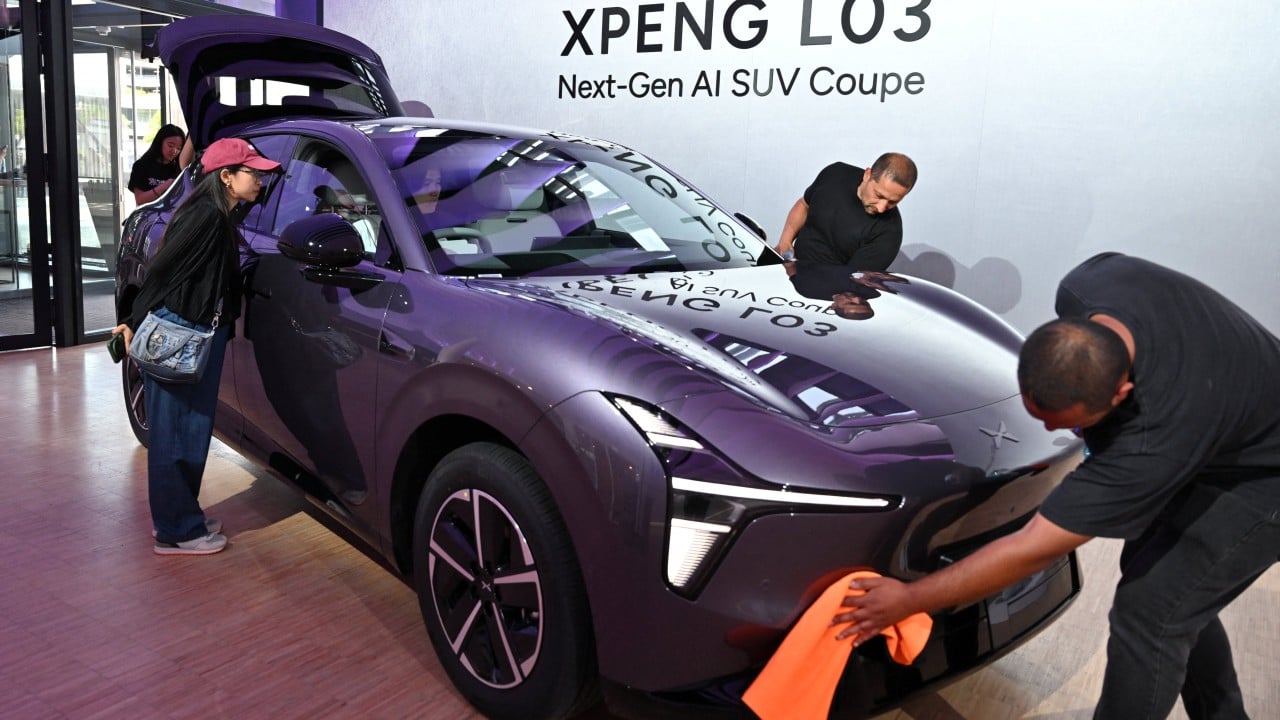
Behind him sat the Mona L03.
It did not look like a traditional, boxy SUV. Designed by JuanMa Lopez—a man whose previous pen strokes shaped the predatory lines of the Ferrari Purosangue—the L03 looked like a teardrop sculpted by a hurricane. Every curve was an argument against the wind, achieving an aerodynamic drag coefficient of just 0.228.
The silence from the local contingent was deafening. They weren’t just looking at a new car. They were looking at a fundamental shift in the global balance of automotive power, taking place right in their own backyard.
The Ghost in the Munich Machine
To understand why this launch felt less like a press conference and more like an occupation, you have to look at what was happening beneath the sheet metal.
For years, European legacy automakers comforted themselves with a comfortable myth: Chinese software works in Shenzhen, but it will lose its mind in Stuttgart. They believed that Europe’s narrow, centuries-old alleys, unpredictable roundabouts, and strict motorist etiquette would paralyze the artificial intelligence driving Beijing’s EV revolution.
XPENG decided to test that myth on Munich's trickiest roads.
Days before the curtain rose at the Showpalast, a heavily camouflaged L03 was quietly navigating the city's tightest corners. It didn't rely on expensive LiDAR sensors or pre-loaded, high-definition digital maps. Instead, it used a pure-vision system powered by a second-generation Vision-Language-Action model.
Consider what happens next when that software meets reality.
Two proprietary Turing AI chips, churning out an astonishing 1,500 TOPS of computing power, act as the vehicle's eyes and brain. During local testing, the system encountered European construction detours and complex right-of-way rules it had never seen before. It didn't freeze. It didn't scream for human intervention. It smoothly yielded to pedestrians, navigated around obstacles, and adjusted to local driving etiquette with almost zero additional data training.
It was a demonstration of physical AI that felt unsettlingly human. For a continent that prides itself on engineering precision, watching an algorithmic brain effortlessly master its streets was a sobering wake-up call.
The Cold Math of a Clean Sheet
But software doesn’t close a sale; the ledger does. And this is where the story shifts from a tech showcase into an economic knife fight.
The base price of the L03 in Germany was announced at €35,600.
Even with the European Union’s hefty tariffs on Chinese imports baked into the sticker price, that figure lands like a brick through a plate-glass window. It undercuts a base Tesla Model Y in Germany by thousands of euros. For a dual-income family living in an urban suburb—the exact demographic XPENG is targeting—the math is brutal.
The traditional automotive elite have long argued that you get what you pay for. If a car is cheap, the interior must feel like a recycled Tupperware container.
Step inside the L03, and that defense crumbles.
More than 72% of the cabin is wrapped in soft-touch materials. There is no traditional instrument cluster. Instead, a massive 26.8-inch head-up display projects vital data directly into the driver’s field of view, complemented by a 15.6-inch central touchscreen running on a localized Google Maps Auto platform. It is a premium digital environment designed for a generation that values connectivity over heritage.
Then there is the engineering paradox of the powertrain.
XPENG understands that while Chinese buyers have largely conquered range anxiety, European drivers are still deeply skeptical of charging networks, especially when winter hits the Alps. The solution was a dual-powertrain strategy. For the purists, the battery-electric version offers up to 520 kilometers of WLTP range and fast-charges from 10% to 80% in just twenty minutes.
But the real Trojan horse for the European market is the extended-range version.
By pairing a smaller battery with a 1.5-liter gasoline generator that acts solely as an onboard power station, the L03 breaks the tyranny of the charging plug. On pure electricity, it covers daily commutes with ease. When the generator kicks in, the total range stretches to over 1,000 kilometers.
It is an agonizingly practical compromise for a market that wants the future but fears the present.
The Sixty-Minute Verdict
While the executives in Munich were busy analyzing the specs, the market gave its own answer.
As the launch event concluded, order books opened simultaneously across 64 overseas markets. The digital infrastructure groaned under the sudden spike in traffic.
One minute passed. Then five. Then seven.
In just seven minutes, XPENG logged 20,000 firm orders. By the time the hour mark hit, that number skyrocketed to 46,859.
To put that in perspective, legacy brands often spend millions on advertising campaigns just to move that many units in a quarter. XPENG did it in the time it takes to have a casual lunch. It was a visceral validation of a strategy that blends aggressive pricing, advanced automation, and deep regional localization.
The company isn't just shipping cars from Guangzhou and hoping for the best. They have established a European research and development center right in Munich. They have localized production across the border at the Magna Steyr plant in Austria. They are building a footprint of 150 dealer locations and planning over 1,000 corporate supercharging stations across 13 European countries.
They are digging in for a long war.
The old guard will point out that building an empire requires more than a successful launch night. Trust is an asset earned over decades, not minutes. European buyers are notoriously loyal, and the XPENG badge still lacks the historical weight of a three-pointed star or a blue-and-white roundel. There are regulatory minefields to walk through, liability frameworks to navigate, and the permanent challenge of keeping a massive digital infrastructure secure.
But as the lights dimmed in the Showpalast, the atmosphere in Munich felt permanently altered.
The Chinese auto industry is no longer knocking on Europe's front door, asking for permission to enter. They have bypassed the gate, parked on the lawn, and offered the keys to the next generation of drivers at a price that defies traditional economics.
The industry's future is no longer a distant debate about what might happen by the end of the decade. It is happening now, guided by vision-language algorithms navigating the narrow alleys of Bavaria, silently rewriting the rules of the road.