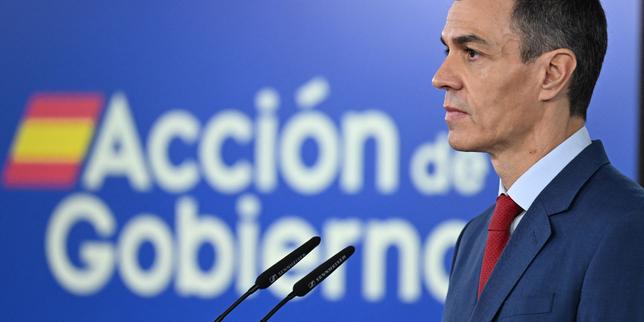
The air in the Moncloa Palace usually tastes of old wood and the quiet, heavy stillness of power. But when the digital storm broke over Madrid, that stillness evaporated. Pedro Sánchez, a man who has made a career out of surviving political shipwrecks, found himself staring at a new kind of horizon. It wasn't a domestic rival or a standard diplomatic dispute. It was a direct salvo from the most powerful office in the world, delivered with the blunt force of a sledgehammer.
Donald Trump had turned his sights on Spain.
The threats weren't whispered in corridors. They were shouted. They concerned tariffs, trade, and the kind of economic isolation that can turn a thriving Mediterranean economy into a cautionary tale. For a country like Spain—a nation that prides itself on its openness, its tourism, and its integrated role in the global machine—this wasn't just a policy shift. It was an existential tremor.
The Weight of the Map
To understand why a few words from Washington can make the floor shake in Madrid, you have to look at the invisible threads connecting a vineyard in La Rioja to a shipping port in Algeciras. When a superpower threatens "consequences," it isn't just threatening a government. It is threatening the farmer whose olives might suddenly become too expensive for an American supermarket. It is threatening the engineer in Seville working on aerospace parts destined for US soil.
Spain found itself in a position that felt uncomfortably lonely for a few hours. The world was watching to see if the European project was a sturdy shield or just a collection of nice ideas written on expensive parchment. If Spain was picked off, who would be next?
The tension was thick enough to choke. Then, the phones started ringing.
A Continental Pulse
Emmanuel Macron didn't wait for a formal summit to make his position clear. The French President knows that in the modern era, an attack on one European border is an attack on the very concept of the Union. His support for Sánchez wasn't just a gesture of neighborly friendship. It was a calculation of survival.
When Macron speaks of "European sovereignty," he isn't just using a buzzword. He is describing a fortress. If the US administration thought it could peel Spain away from the pack, it underestimated the collective memory of a continent that has spent centuries learning what happens when it stands divided.
The European Commission followed suit. The messaging shifted from polite diplomatic inquiry to a unified front. Brussels signaled that any move against Spain would be met with the full weight of the European Union. This is the "invisible stake" that rarely makes it into the headlines: the moment a collection of different languages and cultures decides to speak with a single, unwavering voice.
The Human Cost of a Tariff
Think about a hypothetical small business owner—let's call her Elena. Elena runs a mid-sized factory outside of Valencia that produces high-end ceramic tiles. For three generations, her family has sold these tiles to developers in Florida and California.
When the news broke of Trump's threats, Elena didn't think about "geopolitical alignment." She thought about her payroll. She thought about the twenty-four families whose livelihoods depend on those containers crossing the Atlantic. To Elena, a 25% tariff isn't a statistic. It is the sound of a factory going silent. It is the realization that years of building trust and quality can be erased by a single signature in a city thousands of miles away.
This is where the political becomes deeply personal. Pedro Sánchez wasn't just defending a platform; he was tasked with defending Elena’s right to exist in the global market. The support from Macron and the EU wasn't just "strategic cooperation." It was the only thing standing between Elena and a closed gate.
The Strategy of the Bully and the Shield
There is a specific rhythm to the way these international confrontations play out. It begins with the shock. A sudden, aggressive demand designed to disorient. The goal is to provoke a panicked concession.
In this case, the play was to isolate Spain, perhaps betting that the rest of Europe was too distracted by their own internal squabbles to care. But a curious thing happened on the way to the trade war. Instead of fracturing, the European core tightened.
The logic is simple: if you allow your neighbor's house to be shaken, your own foundation becomes suspect. By standing behind Sánchez, Macron and the EU leadership were drawing a line in the sand. They were telling the American administration that the era of picking off individual European nations is over.
The Silence After the Storm
As the initial dust settled, the reality of the situation began to crystallize. The threats remained, but the context had changed. Spain was no longer a lone actor trying to negotiate with a giant. It was a vital organ in a much larger body, and that body had made it clear it would fight to protect its parts.
The uncertainty is still there. You can feel it in the way the markets fluctuate and the cautious tone of the evening news in Madrid. There is a vulnerability in being a medium-sized power in a world where the old rules are being torn up and rewritten in real-time.
But there is also a new kind of confidence. It’s the confidence of a leader who realizes he isn't standing on a shrinking island, but on a continent that has finally decided to remember its own strength.
The phone in the Moncloa Palace still rings. The messages from Washington haven't necessarily become kinder. But the voice answering them is steadier now. It is the voice of a man who knows that when he speaks, he isn't just speaking for Spain. He is speaking for an idea that is much harder to break than a single trade agreement.
The sun sets over the Guadarrama mountains, casting long, golden shadows across the stone plazas. In the cafes, people still talk about the threats, the prices, and the man across the ocean. But the panic has been replaced by a quiet, watchful resolve. They know that the storm is coming, but for the first time in a long time, they also know they aren't the only ones holding the umbrella.