The air on a college campus in autumn usually tastes like ambition. It smells of damp grass, stale coffee from the library vending machines, and the electric, low-humming anxiety of young adults trying to figure out who they are supposed to become. On that particular evening at Virginia State University, the routine was familiar. Dorm doors propped open with wedge blocks. Music bleeding into concrete hallways. Laughter bouncing off brick facades.
Then came the sound that rewrites the physics of a evening in a fraction of a second.
Pop. Pop-pop-pop.
It does not sound like thunder. Thunder rolls. It announces its arrival with a warning pressure in the chest. Gunfire is sharp, clinical, and rude. It tears through the ambient noise of student life with absolute indifference. In that single auditory fracture, the collective illusion of safety evaporates.
Five people shot.
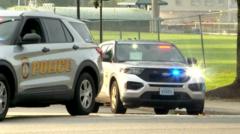
The dry police bulletins will tell you the numbers later. They will list injuries, hospital transports, and the sprawling perimeter established by state and local law enforcement. They will speak of multiple suspects at large, drifting away into the Virginia night like smoke, leaving behind crime scene tape fluttering lazily in the wind.
Numbers are clean. They fit neatly into a spreadsheet. They allow us to distance ourselves from the raw, jagged edges of what actually happened on that quad.
Let us get closer.
Imagine standing in a crowded dormitory common room. You are twenty years old. You are arguing with your roommate about whether a midterm exam is curved or curved-down, and suddenly, the floor drops out from under your universe. Someone screams down the corridor. Not a yell of excitement, but the guttural, primal sound that every human being recognizes instantly.
Run.
Doors slam. Lock mechanisms click into place with frantic, trembling fingers. Cell phones emerge from pockets, glowing in darkened rooms, screens illuminating wide, terrified eyes. Parents miles away are fast asleep, completely unaware that their child is currently sliding their back down a drywall partition, pressing their mouth into their palm to muffle the sound of their own ragged breathing.
This is the hidden tax of living in an era where public spaces have transformed into variables of uncertainty.
We talk about campus safety in boardrooms and legislative hearings with detached, administrative vocabulary. We talk about access control, lighting audits, and response times. But safety is not a policy memo. Safety is a visceral, biological sensation. It is the ability to walk across a quad at ten o'clock at night wearing headphones without scanning the shadows for an exit route. When five people are struck by bullets in a place designed for growth, discovery, and the clumsy beauty of early adulthood, that baseline human right is stolen.
The aftermath is a strange, haunting dissonance.
Hours after the sirens fade and the local news vans pack up their satellite dishes, the silence returns. But it is not the peaceful silence of a sleeping university. It is a heavy, bruised quiet. The kind of quiet where every passing car sounds like a threat, and every slam of a heavy metal fire door causes collective flinching a hundred yards away.
Investigators are currently piecing together the fragments. They are searching for shell casings, reviewing blurry camera footage, and knocking on doors. They are asking the classic, agonizing questions. Who pulled the trigger? Why? Where did they vanish to?
Yet, while the manhunt continues across the jurisdiction, the deeper crisis remains unaddressed by flashing lights and police tape.
We have normalized this.
That is the most terrifying realization of all. We read the headline—multiple suspects at large, five injured—and we process it with a grim, exhausted nod. Another campus. Another city. Another cluster of lives permanently altered by a flash of absolute senselessness. We scroll past it to check the weather or sports scores, numbing ourselves because the alternative is feeling the full weight of a broken culture.
Every time a community is punctured by violence, a concentric wave of trauma ripples outward. It touches the roommate who hid in the closet. It touches the professor who cancelled the morning lecture. It touches the mother three states away who stares at her phone for hours, waiting for a text that confirms her child is breathing.
The suspects may be at large, swallowed by the highways and backroads of Virginia, but accountability requires more than an eventual arrest. It requires a reckoning with the conditions that allow anger and alienation to turn into lethal metal flying through crowded student spaces.
The quad will eventually fill up again. Students will walk to their classes. The grass will grow back where the crime scene markers stood.
But the air will taste different. The illusion has been permanently shattered, leaving behind a stark, unyielding reality that demands we look closer, care deeper, and refuse to accept this as just another headline in the daily feed.
The lights stay on in the library windows long after midnight. Inside, a student stares at a blank laptop screen, listening to the wind rustling the oak trees outside, wondering how long it will take for the world to feel safe again.