The room was too quiet. Anyone who has spent time in an operating theater knows the specific symphony of a surgery in progress: the rhythmic, reassuring beep of the heart monitor, the sharp rustle of sterile plastic, the low, urgent murmurs of a surgeon asking for a clamp, a suture, a sponge.
But on a rainy Tuesday evening in a specialized research hospital, the human voices stopped.
Sarah, a veteran surgical nurse with twenty-two years of trauma experience, stood with her hands gloved and ready. Her job, usually, was to anticipate the human mind. She knew before Dr. Arispe even asked when a bleed was becoming problematic or when a patient’s tissue was too friable to hold a standard stitch. She read the tension in Arispe’s shoulders.
Tonight, she was reading a screen. And the entity performing the delicate internal architecture of a cholecystectomy—a gallbladder removal—didn't have shoulders.
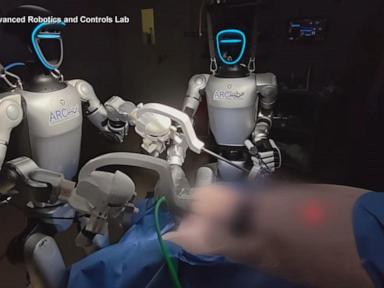
It had two gleaming, white-carbon composite arms. They ended in micro-forceps so precise they could peel the skin off a grape without bruising the flesh beneath. This wasn't the standard DaVinci rig where a human doctor sits at a console a few feet away, manipulating joysticks like an expensive video game.
This was autonomous.
The machine was making the decisions.
The Fiction of the Flawless Hand
We have been fed a myth about surgery. The myth tells us that the greatest surgeons possess hands of absolute stillness, possessing a god-like perfection that never wavers.
It is a lie. Even the finest human hands suffer from physiological tremor. Our hearts beat, our blood pumps, our muscles fatigue. If a surgeon stayed up too late, drank one cup of coffee too many, or is worried about their own child’s failing grade at school, that micro-tremor changes. In the tight, terrified geography of a human abdomen, a millimeter of variance is the difference between a clean excision and a nicked hepatic artery.
Medical literature shows that standard laparoscopic complications occur in roughly shifting percentages, but they almost always trace back to human visualization limits or fatigue.
The humanoid robot in front of Sarah did not sleep poorly last night. It did not have a mortgage. It viewed the patient’s internal organs through a stereoscopic 3D camera fed into a neural network trained on over three hundred thousand hours of surgical video footage. It didn't just see the gallbladder; it predicted the density of the surrounding tissue based on real-time haptic feedback loops firing at eight hundred times per second.
Watching it work was not terrifying. That was the most unsettling part of the experience for Sarah. It was profoundly, deeply beautiful. The metallic arms moved with a liquid grace that made human movement look jerky, clumsy, and primitive.
The Weight of the Invisible Ghost
To understand how we arrived at an autonomous machine holding a blade over a living human being, you have to look at the math of human scarcity.
Right now, the global medical community faces a quiet, devastating deficit. We do not have enough specialized surgeons. In rural communities, regional clinics, and developing nations, a treatable condition like an inflamed appendix or a localized tumor becomes a death sentence simply because the nearest qualified hands are a twelve-hour flight away.
The dream was never to replace the warmth of a doctor. The dream was to clone their capability.
Consider how an autonomous system learns. When a human surgeon retires, forty years of hard-won intuition, muscle memory, and crisis management vanish from the earth. When a humanoid surgical AI operates, every micro-adjustment, every unexpected anatomical anomaly, and every successful recovery is instantly uploaded to a shared cloud.
One machine learns, and every machine everywhere inherits that knowledge instantly. It is an compounding loop of medical expertise that never dies, never tires, and never grows old.
But standing in that room, Sarah felt a cold knot form in her stomach.
A machine can calculate optimal tool paths. It can avoid major blood vessels with mathematical certainty. But what happens when the unexpected occurs? What happens when the anatomy does not match the textbook, or the scans, or the training data?
Human beings possess a strange, unquantifiable trait: we can leap across logical chasms when a crisis hits. We call it instinct. A surgeon notices a strange discoloration, a subtle change in the way a liver feels to the touch, or an inexplicable drop in blood pressure that the monitors haven't fully registered yet. They pivot. They break the rules to save a life.
A machine follows the code. If the code meets an undefined variable, it stops. And in medicine, a pause can be fatal.
The Anatomy of Trust
"Look at the retraction," Dr. Arispe whispered from the observation deck behind the glass. His hands were tucked into his armpits, completely out of the sterile field. His face was a mask of intense concentration, mixed with a visible, wounding realization.
He was looking at his own obsolescence.
The robot had encountered a dense layer of scar tissue from a previous, forgotten inflammation the patient had suffered years ago. To a human, this scar tissue is tough, leathery, and difficult to separate from the healthy common bile duct. Arispe would have taken ten minutes here, picking away slowly, sweating through his gown.
The machine didn't hesitate. It used an integrated ultrasonic scalpel, modifying its frequency based on the acoustic resonance of the tissue. It knew the density of the scar versus the density of the duct. It hummed—a high-pitched, musical note—and the scar tissue parted like mist.
"I couldn't have done that clean," Arispe admitted softly. His voice lacked jealousy; it was filled with a clinical, stark reverence.
Yet, if you ask a room full of people if they would sign a waiver to let a pilotless airplane fly them across the Atlantic, most will say no, even when presented with data proving autopilots make fewer errors than tired captains. We have a deep, evolutionary need to know that someone with skin in the game is at the controls. We want a person who shares our mortal vulnerability to be responsible for our survival.
If the plane crashes, the pilot dies too. If the patient dies on the table, the robot does not weep. It does not go home to a quiet house, pour a drink, and stare at the wall, haunted by the face of the person they lost. It simply resets its parameters for the next morning.
The Changing of the Guard
The surgery took forty-two minutes. A standard human time for this specific pathology is closer to an hour and fifteen.
The machine retracted its arms, encased them in their protective sheaths, and executed a self-diagnostic sequence. The monitor flashed a simple green checkmark. Patient stable. Blood loss minimal—less than five milliliters.
Sarah moved in to finish the closing stitches on the skin incisions, a task left to the human team to maintain tactile validation of the wound site. As she pushed the needle through the epidermis, she looked up at the silent machine towering over the table.
It felt less like a tool and more like an arriving resident—brilliant, tireless, devoid of ego, yet entirely blank behind the eyes.
The future of medicine isn't coming in a sudden, catastrophic wave of automation that fires every doctor in the world. It is arriving in increments, one impossible stitch at a time, until the line between human intent and mechanical execution blurs into nothingness.
We are entering an era where the human hand is no longer the gold standard of healing. We will live longer because of it. We will survive diagnoses that used to be terminal. But as Sarah cleaned the final incision, she couldn't shake the feeling that something quiet and precious was being left behind on the sterile floor—the terrifying, beautiful, deeply human gamble of life trusting life.