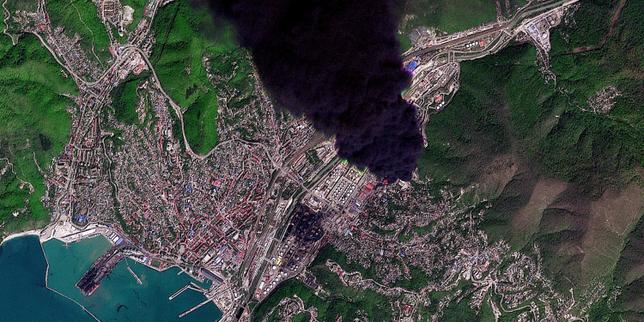
The air in Tuapse usually tastes of salt and heavy crude. It is a humid, industrious scent that clings to the back of the throat, a constant reminder that this city on the edge of the Black Sea exists for one reason: to move the black blood of the earth from the Russian interior to the rest of the hungry world. For decades, the rhythm of the town was dictated by the low hum of the refinery and the clanking of tankers. But lately, the rhythm has broken.
Imagine a man named Yuri. He is a composite of the workers who walk these docks, a man who has spent twenty years watching the pressure gauges at the Rosneft refinery. He knows the specific metal groan of a cooling pipe and the way the sea fog rolls in to mask the flickering pilot lights of the stacks. On a Tuesday night in May, Yuri isn't looking at gauges. He is looking at the sky. He is listening for a sound that shouldn't be there—a lawnmower engine buzzing in the stratosphere, high and thin, carrying a payload that can turn his place of work into a pillar of fire. For a more detailed analysis into this area, we suggest: this related article.
Ukraine has found a way to reach out and touch the nerves of the Russian economy. This isn't the grand, sweeping movement of tank divisions across a muddy steppe. It is a war of centimeters and circuits.
The Ghost in the Machine
The drones come in the dark. They are often made of plywood, plastic, and cheap electronics, yet they navigate across hundreds of miles of hostile airspace with a terrifying, singular focus. When they arrived over Tuapse this week, they weren't looking for soldiers. They were looking for the distillation towers—the tall, silver lungs of the refinery that crack crude oil into the fuel that powers everything from Lada sedans to T-90 tanks. To get more details on the matter, extensive coverage is available at BBC News.
A refinery is a fragile giant. It is a pressurized labyrinth where one spark in the wrong place doesn't just cause a fire; it triggers a chain reaction that can silence a facility for months. By hitting Tuapse, Ukrainian forces are performing a kind of kinetic surgery. They are bypassing the front lines entirely to strike at the wallet of the Kremlin.
The logistics are staggering. To hit a target like Tuapse, a drone must evade layered S-400 missile batteries and sophisticated electronic jamming that tries to scream louder than the drone's own GPS brain. When a drone makes it through, it represents more than a tactical success. It represents a lapse in the perceived invincibility of the Russian hinterland. For the people living in the shadows of the refinery, the war is no longer something happening "over there" in the Donbas. It is a flash of light that shatters their bedroom windows at 3:00 AM.
The Economics of a Fireball
Money is the silent protagonist of this conflict. Every time a refinery like Tuapse is forced to go offline, the global energy market shudders, if only for a moment. But the real pain is domestic. Russia relies on its refined products to keep its internal machinery grinding. When the towers at Tuapse stop smoking, the supply chain kinks.
Consider the math of the strike. A drone might cost $30,000 to build in a clandestine workshop in Kyiv or Kharkiv. The damage it inflicts can easily soar into the tens of millions of dollars in equipment, lost revenue, and the astronomical cost of specialized repairs. Because of international sanctions, replacing the high-tech components of a damaged refinery isn't as simple as ordering a part from a catalog. It requires "gray market" smuggling or cannibalizing other plants. It is a slow, agonizing drain on the industrial capacity of a superpower.
Russia has tried to adapt. You can see it in the grainy videos uploaded to Telegram: heavy machine guns bolted to the roofs of industrial buildings, frantic tracers reaching up into the blackness like glowing fingers. It feels primitive. It is the height of 21st-century satellite navigation being met by the frantic rattling of 20th-century lead.
The Human Cost of the Horizon
Back to Yuri. He stands in his small kitchen, the tea in his glass vibrating as the air defenses begin to thump in the distance. There is a specific kind of dread that comes from living near a "strategic asset." You realize that your home, your workplace, and your family are all situated on a giant bullseye.
The invisible stakes are found in the eyes of the refinery workers who have to go back to shift the next morning. They walk past charred metal and the smell of chemical foam, knowing that the sky is now a permanent front line. This is the psychological weight of the drone age. It removes the safety of distance. It makes the geography of the hinterland irrelevant.
The authorities in the region are quick to issue statements. They speak of "intercepted" targets and "minor debris." But the pillars of black smoke rising over the Black Sea coast tell a different story. They tell a story of a conflict that is liquid, shifting, and increasingly desperate.
A Siege Without Walls
We often think of a siege as a ring of soldiers surrounding a city. What is happening to Russia’s oil infrastructure is a digital siege. The walls are not made of stone; they are made of radar signatures and flight paths. Ukraine is betting that if they can hit enough of these nodes, the entire system will eventually seize up.
It is a gamble played out in the dark. Every successful strike on a place like Tuapse forces Russia to pull air defense systems away from the front lines to protect its economic heart. Every move creates a new hole somewhere else. It is a deadly game of whack-a-mole where the stakes are the very fuel that keeps the war moving.
The night sky over the Black Sea used to be a place of quiet beauty, a backdrop for the lights of passing ships. Now, it is a theater of anxiety. As the sun rises over Tuapse, the smoke begins to clear, revealing the jagged silhouette of the refinery. The fire might be out, but the silence that follows is louder than the explosion. It is the silence of a city waiting for the next buzz in the air, the next flash on the horizon, and the realization that the distance between the front line and the front door has vanished forever.
The oil continues to flow, but the pressure is no longer just inside the pipes. It is everywhere. It is in the way people walk a little faster to their cars, the way they glance upward when they hear a distant motor, and the way they realize that in this new world, the sky is no longer empty. It is watching. It is waiting. And it has a very long memory.


