Cold.
It is the first thing you notice when you drive three hours away from the nearest highway exit just to stare at a patch of empty blackness in the middle of November, wrapped in two wool blankets that still fail to keep the frost out of your marrow. In similar developments, take a look at: Why Matan Kahana Taking the Knesset Gavel Has Benjamin Netanyahu Calling Foul.
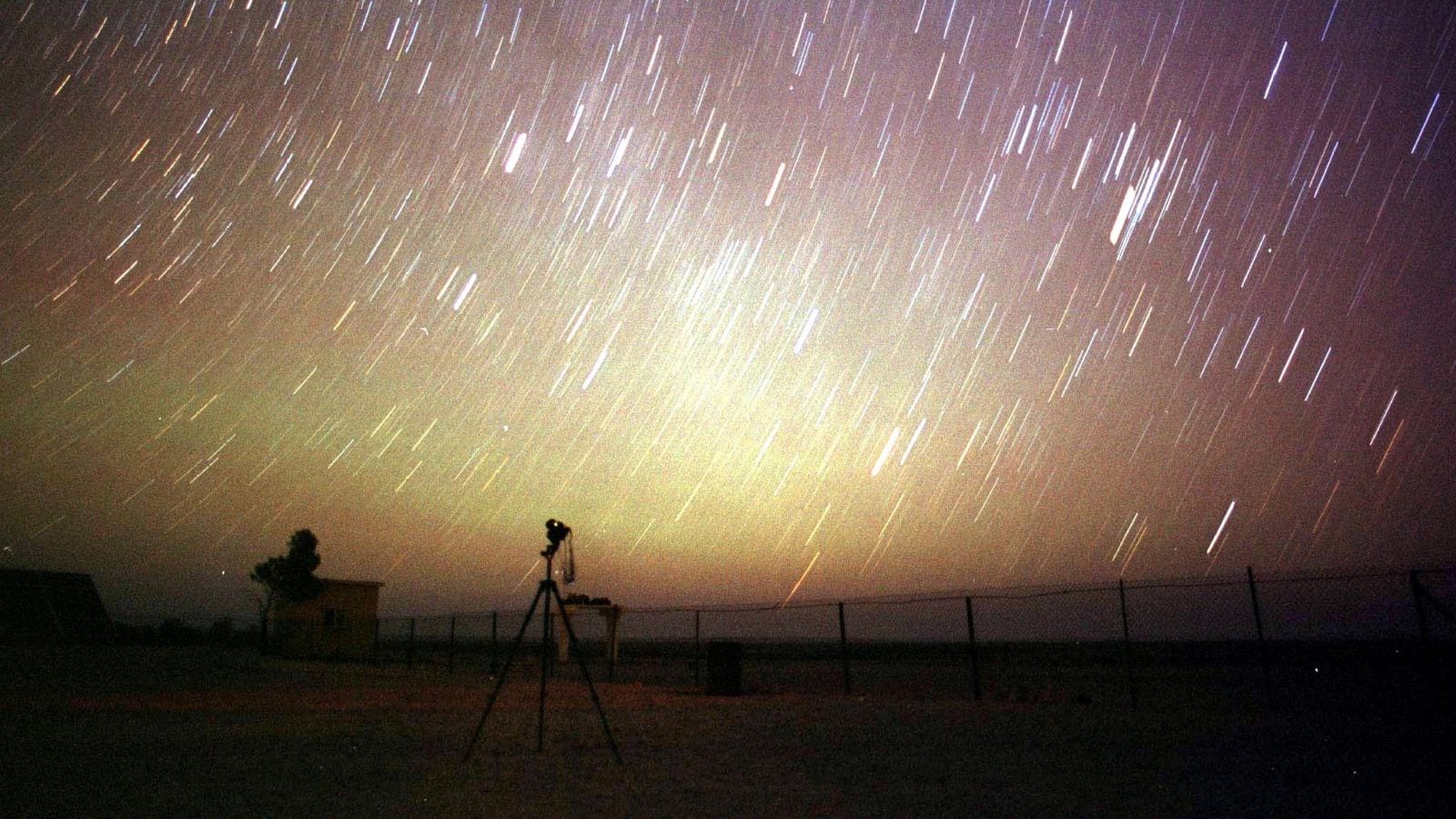
Ask anyone who has chased the Leonids meteor shower across rural fields or high-altitude desert plateaus, and they will tell you the same story. You arrive at midnight. You crane your neck until the muscles at the base of your skull ache. For forty minutes, nothing happens except the slow, indifferent wheeling of the winter constellations and the distant barking of a farm dog. Doubts creep in. You wonder why you didn't stay in bed, why you trusted an astronomical calendar promising celestial fireworks when all you are getting is hypothermia and a stiff neck.
Then, at 2:14 a.m., a hairline fracture of emerald and white rips across the dome of the sky in less than a second, leaving behind a glowing ionization trail that hangs in the freezing air like cigarette smoke before fading into nothing. The Guardian has also covered this fascinating subject in extensive detail.
That single streak is why people endure the frostbite. Because the Leonids do not merely put on a light show; they offer a rare, violent collision between human patience and deep cosmic time.
The Ghost of Comet Tempel-Tuttle
Most people read astronomy articles expecting a simple schedule—a neat box telling them when to step onto their back porch and look up. Standard reports will tell you that the Leonids peak every year around November 17 or 18, producing roughly ten to fifteen meteors per hour under dark skies. They will mention that the shower radiates from the constellation Leo, the Lion, and leave it at that.
What those dry summaries miss is the sheer violence of what is actually happening seventy miles above your head.
To understand what you are watching, consider a hypothetical scenario: imagine driving a convertible at highway speed through a swarm of mosquitoes, except the mosquitoes are grains of sand left behind by a dying comet, and your windshield is Earth’s upper atmosphere slamming into them at forty-four miles per second. That is seventy-one kilometers every single second—faster than a rifle bullet, faster than almost any other meteor shower Earth encounters all year.
Those grains of sand belong to Comet 55P/Tempel-Tuttle, a cosmic wanderer roughly two miles wide that loops around the sun once every thirty-three years. Every time Tempel-Tuttle swings close to the sun, solar heat vaporizes its icy crust, shedding billions of tons of dust and gravel along its orbital path. Think of the comet as a leaky dump truck rattling down a circular highway, leaving a trail of debris in its wake. Every November, Earth’s orbit intersects that exact stretch of highway.
When a speck of comet dust no larger than a lentil hits our atmosphere at 158,000 miles per hour, the friction does not merely burn it up; it instantaneously superheats the surrounding air to thousands of degrees. What we call a shooting star is not a rock burning. It is a brief, violent flash of glowing plasma—the atmosphere screaming as a piece of ancient solar system history disintegrates.
1833 and the Night the Sky Broke
I used to think meteor storms were exaggerated folklore, the kind of tall tales nineteenth-century farmers invented before electric lights robbed us of the night sky. Studying the historical record cures that skepticism fast.
In the early hours of November 13, 1833, residents across eastern North America woke up to what they genuinely believed was the end of the world. Contemporary accounts describe meteors falling as thick as snowflakes in a blizzard. People ran out of their cabins in terror, waking neighbors to pray as hundreds of thousands of fireballs lit up the ground so brightly you could read a newspaper by their light. In some places, observers estimated over 100,000 meteors per hour.
That night did more than terrify the public; it gave birth to modern meteor astronomy. Before 1833, scientists assumed shooting stars were atmospheric weather phenomena, akin to lightning or swamp gas. Looking at the 1833 storm, observers noticed something uncanny: no matter where you stood, every single streak appeared to trace backward to a single point in the constellation Leo. That geometric realization proved that the debris was coming from deep space, moving along a fixed trajectory that Earth was plowing through.
The Leonids earned their legendary reputation because of that thirty-three-year cycle. Whenever Comet Tempel-Tuttle returns to the inner solar system—as it did in 1833, 1866, 1966, and the turn of the millennium between 1999 and 2002—Earth occasionally plows directly through fresh, dense ribbons of comet dust rather than the thin, dispersed background trail.
During the 1966 Leonid storm, observers in the American Southwest watched thousands of meteors per minute pour out of Leo, describing the sensation not as watching stars fall, but as feeling Earth hurtling headlong through a tunnel of light.
The Invisible Stakes Above Our Heads
There is a catch to chasing a thirty-three-year storm, and it carries stakes that go far beyond disappointed stargazers.
For one thing, celestial mechanics are notoriously humbling. Even astronomers armed with supercomputers and orbital modeling admit how fragile their predictions are. Jupiter’s massive gravity tugs at Tempel-Tuttle’s debris trails, nudging those invisible rivers of dust slightly left or right over the decades. A shift of just a few thousand miles—a rounding error on a solar-system scale—is the difference between a generational storm of three thousand meteors an hour and a quiet night where you count twelve streaks before sunrise.
When I drove out to Joshua Tree during a predicted outburst year a few seasons back, I met a retired aerospace engineer named Arthur setting up a lawn chair beside a tripod. He had traveled from Seattle with two thermoses of black coffee and three layers of fleece. When I asked him what he expected to see, he laughed and tapped his temple.
"Nothing," Arthur said. "Or everything. In 1998, the models missed the peak by sixteen hours, and half the amateur astronomers on the West Coast stared at empty sky while Europe got hammered with fireballs. You don't come out here for a guarantee. You come out here because if you stay home, you're guaranteed to miss it."
Arthur also pointed out something most casual skywatchers never consider: while we lie on blankets hoping for a show, satellite operators around the globe treat a Leonid outburst like a hurricane warning.
At forty-four miles per second, a speck of comet dust carries the kinetic energy of a small explosive. Hundreds of billions of dollars in global communications, weather forecasting, and GPS infrastructure orbit Earth completely unshielded by the atmosphere that protects us on the ground. During major Leonid peaks in the late 1990s and early 2000s, space agencies and commercial satellite companies actually tilted their spacecraft edge-on into the debris stream—like turning a knife blade into the wind—to minimize the surface area exposed to hypervelocity sandblasting.
Every streak you see burning up in the dark is a bullet our atmosphere just took on our behalf.
How to Actually Watch the Leonids Without Giving Up
If you want to experience the Leonids without quitting after twenty minutes, forget everything movies have taught you about stargazing. You do not need a telescope. In fact, a telescope is the worst tool you could bring; its narrow field of view acts like looking at a fireworks show through a drinking straw. Your naked eyes are the only instruments wide enough to catch meteors tearing across forty degrees of sky at once.
Timing is where most beginners fail. People step outside at 9:00 p.m., see nothing, and go back inside. That happens because the constellation Leo does not even rise above the eastern horizon until around midnight. Before midnight, Earth’s bulk is physically blocking the incoming stream of dust. Once midnight passes, your location on Earth rotates forward into the direction of our planet's orbital motion—meaning you are now sitting on the front bumper of the car, facing directly into the oncoming swarm. The hours between 2:00 a.m. and dawn are when the sky wakes up.
Moonlight is your other mortal enemy. A bright gibbous or full moon acts like a giant floodlight in the upper atmosphere, washing out the faint, fast meteors that make up seventy percent of the shower. In years when the moon is near new or sets before midnight, the sky turns into velvet, and even an average fifteen-meteor-per-hour year reveals delicate, needle-thin streaks you would never notice from a suburban driveway.
Find a dark-sky site at least forty miles away from city light domes. Give your eyes a full thirty minutes in total darkness without checking your phone—one glance at a glowing screen destroys the chemical adaptation your retinas worked half an hour to build. Recline in a zero-gravity chair or lie flat on a thick sleeping pad so you are not straining your neck, and look roughly forty-five degrees away from Leo itself. Meteors seen near the radiant appear short and stubby because they are coming straight toward you; the long, dramatic slashers appear farther across the sky, catching the atmosphere at a shallow angle.
The Long Wait for 2033
We are currently in the quiet valley between storms. Tempel-Tuttle is far out in the dark reaches beyond Uranus, slowly turning back toward the sun for its next grand return in the early 2030s. Until then, each November offers a quieter, more intimate rehearsal: fifteen meteors an hour, punctuated by the occasional blinding fireball—known as a bolide—that flares bright enough to cast shadows on the frost-covered grass and leave behind a persistent glowing train that twists in the upper-level winds for minutes at a time.
It is easy to feel impatient in a world engineered for instant gratification, where every spectacle can be summoned on a glass screen in your pocket. The Leonids refuse to operate on our schedule. They run on a thirty-three-year clock governed by gravity, ice, and orbital geometry, utterly indifferent to whether anyone is awake to witness them.
And maybe that is the quiet secret behind why people keep dragging folding chairs into freezing fields every November.
Somewhere around 4:00 a.m., when the coffee in your thermos has gone lukewarm and your toes have gone numb inside your boots, the horizon begins to bruise with the faintest hint of blue. You start packing up your blankets, convinced the show is over. Then you glance up one last time, and a piece of a comet that last visited Earth before you were born slices silently across the dawn, burning itself out in a single, breathless flash just to remind you that you are standing on a moving rock hurtling through the dark.