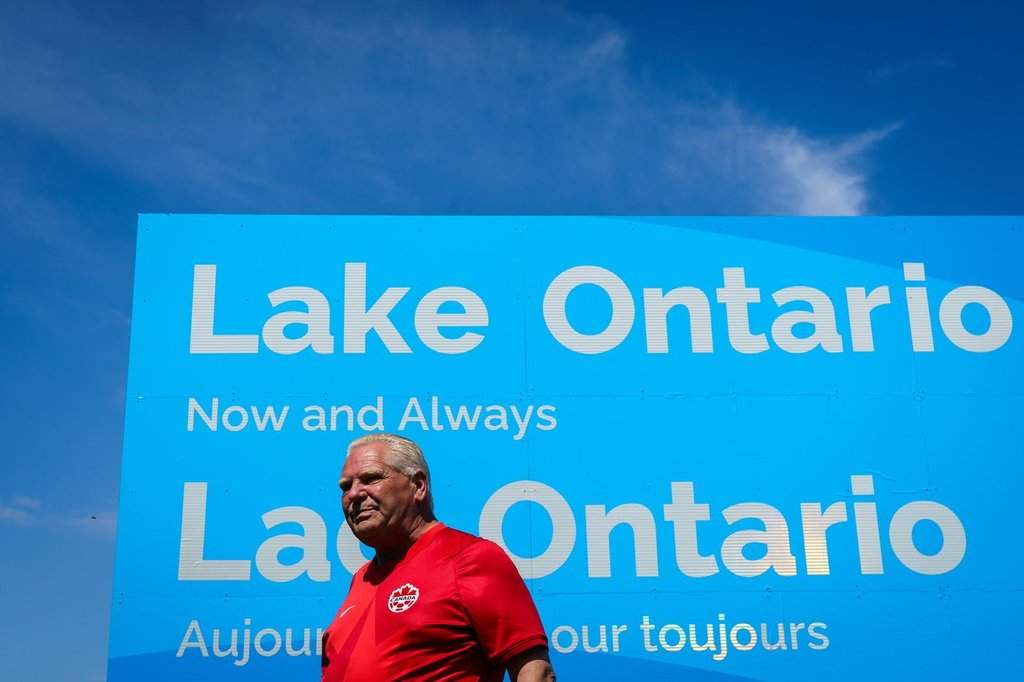
Doug Ford stood at a podium, puffed out his chest, and declared that the world will always call it Lake Ontario because politicians love nothing more than planting flags in puddles of irrelevance.
The lazy consensus in every newsroom across the continent is that this is a spat about nomenclature, geography, and local pride. It is treated as a harmless cultural friction point between a brash American administration and a defensive provincial premier protecting his turf. Every talking head on television is arguing over whether the map will change or stay the same.
They are all missing the plot.
The name of a body of water does not matter. What matters is the institutional incompetence that treats symbolic territorial posturing as a substitute for actual economic strategy. I have spent two decades watching governments panic over branding exercises while the underlying infrastructure rots from the inside out. Ford wants to fight a microphones-and-cameras war over a historical label because fighting a real war requires competent governance, zoning reform, and the brutal work of fixing supply chains.
Let us look at the mechanics of this distraction.
When a politician focuses public outrage on a noun, look at what verb they are trying to hide. While the province argues over whether a massive freshwater basin sounds sufficiently Canadian or adequately American, the commercial shipping lanes connecting those very ports face mounting congestion, outdated locks, and capital expenditure shortfalls that have been ignored for thirty years.
You cannot navigate a container ship through civic pride.
Geographic naming conventions are sticky because commerce makes them sticky, not politicians. The market does not care about executive orders or nationalist decrees issued from legislative buildings. The market cares about depth, draft restrictions, port throughput, and intermodal connectivity. If a shipper can move goods cheaper through a renamed corridor, they will call it whatever the manifest requires. If they cannot, no amount of defiant flag-waving by a premier will save the margin.
Let us dismantle the core premise of the nationalist argument here. The assumption is that retaining a traditional name preserves sovereignty and economic security. That is an inversion of reality. Sovereignty is a function of economic gravity, not cartographic stubbornness. When an economy relies on exporting raw timber and unfinished automotive parts while importing its own finished goods back across the same water at double the price, the name on the map is just a decorative border around a tributary.
I have seen companies blow millions on rebranding campaigns when their underlying product architecture was fundamentally broken. Governments are just corporations with a monopoly on violence and worse feedback loops. Ford’s outburst is the state-level equivalent of a failing retailer changing its storefront sign while the roof is actively caving in.
Consider the alternative perspective. Imagine a scenario where every politician involved in this dispute spent half the energy they used on press conferences actually streamlining cross-border regulatory friction for logistics firms. The transit times for freight crossing the Niagara frontier would drop by twenty percent overnight. Instead, we get a masterclass in performative resistance.
The public falls for this because naming things feels permanent. It scratches an evolutionary itch for tribal ownership. We want to believe that if we name a mountain, a river, or a lake, we control it. But nature does not negotiate with municipal bylaws, and global trade routes do not pause for patriotic soundbites.
The most damning indictment of this entire manufactured controversy is how easily it distracts from real resource management. While everyone is debating whether a digital map will update its labels, the actual water quality, invasive species management, and industrial runoff policies governing that watershed are chronically underfunded and poorly enforced. We are arguing over the wrapper while the contents spoil.
If you want to understand how a region declines, watch how it reacts to trivial threats while ignoring structural collapse. A thriving industrial base does not need to legislate its identity. It commands authority through output, innovation, and logistical supremacy. When you have to rely on a premier reminding you what a lake is called, you are already losing the argument.
Stop caring about what politicians call the water. Start asking why the boats carrying your future are stuck at the dock.
The map does not care about your feelings, and neither does the market.