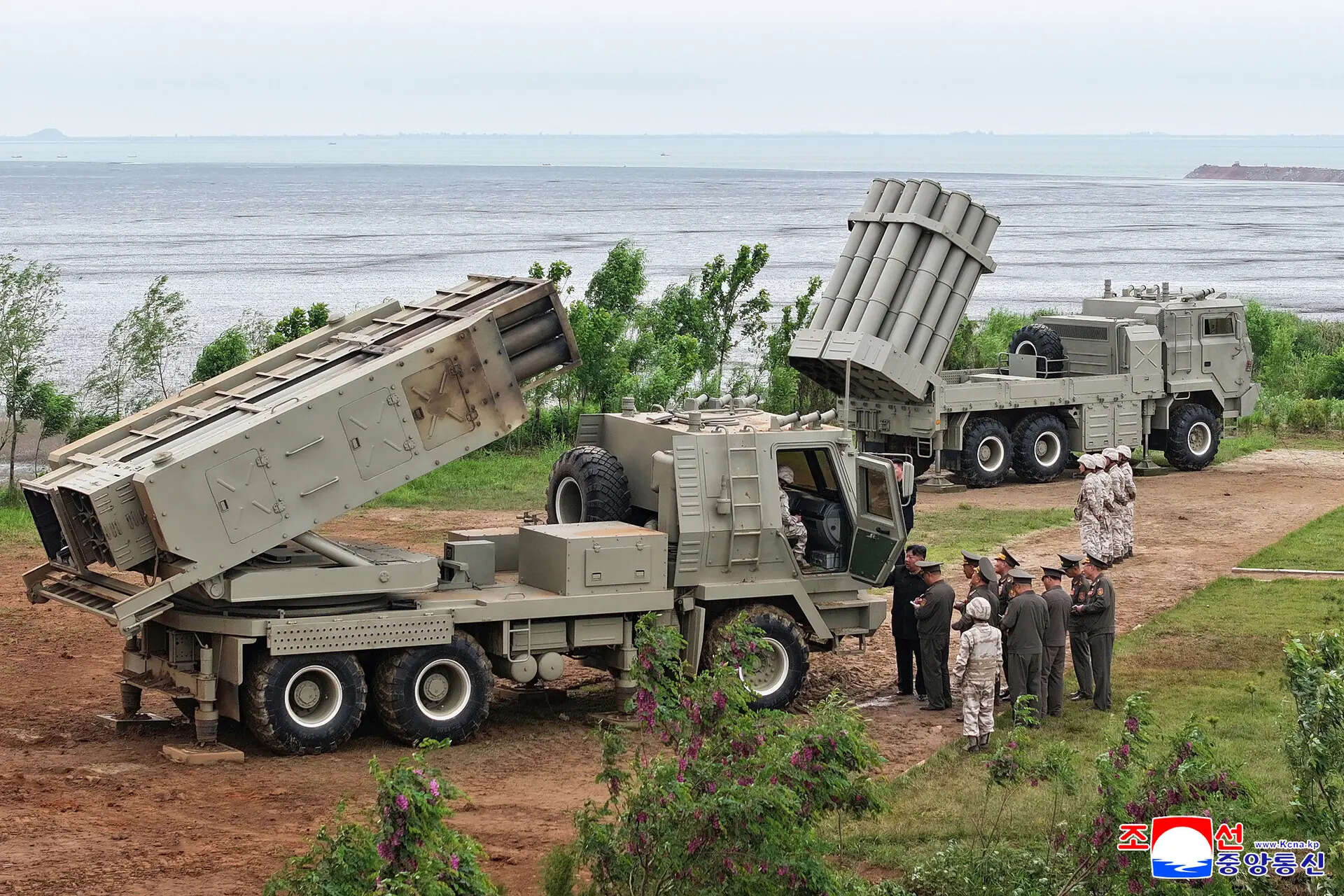
The international security establishment is having another collective panic attack. Mainstream media headlines are blaring with warnings about North Korea's recent tests of "AI-guided" cruise missiles and "special mission" warheads near the South Korean border. The narrative is as predictable as it is lazy: an unpredictable rogue state has combined weapons of mass destruction with algorithmic autonomy, fundamentally shifting the balance of power in East Asia.
It is a terrifying story. It is also completely wrong.
The Western defense apparatus has fallen into a trap of its own making, conflating basic automation with true artificial intelligence to justify ballooning defense budgets and mask systemic vulnerabilities in allied air defenses. Having spent two decades analyzing Western missile defense architecture and tracing the reality of East Asian military procurement, I have seen this exact playbook before. Pyongyang launches a missile with a shiny new marketing label, and Washington panics on cue.
If you peel back the layers of sensationalism, the reality is far more mundane—and far more dangerous. Pyongyang is not building Skynet. They are running a brilliant, low-tech asymmetric spoofing campaign that the West is eagerly buying into.
The Algorithmic Myth: What North Korea is Actually Flying
Let us clarify terms immediately, because the defense press routinely fails to do so. True autonomous target recognition (ATR) requires massive onboard computational power, high-fidelity sensor suites, and vast training datasets that allow a missile to identify, re-route, and strike specific moving assets in real time without GPS or human intervention.
To believe North Korea has deployed functional, AI-driven terminal guidance on a low-flying cruise missile requires you to ignore the fundamental laws of semiconductor supply chains. Advanced machine learning models require specialized hardware. The high-end graphics processing units (GPUs) and application-specific integrated circuits (ASICs) needed to run real-time neural networks on an edge device like a missile nosecone are under the tightest export controls in human history.
Pyongyang is not manufacturing these chips domestically. While they have proven remarkably adept at smuggling dual-use electronics through front companies in Southeast Asia, the hardware they secure is overwhelmingly commercial-grade microcontrollers and legacy silicon.
What the media calls "AI guidance" is actually a combination of two legacy technologies:
- Terrain Contour Matching (TERCOM): A guidance system developed by the United States in the 1960s for the Tomahawk missile. It compares radar altimeter data against a pre-loaded digital elevation map to find its way.
- Digital Scene Matching Area Correlation (DSMAC): An optical tracking method that takes pictures of the ground and matches them against satellite photos stored in the missile's memory.
This is not intelligence. It is automated pattern matching. It is deterministic, rigid, and decades old. When a Pulhwasal-3-31 or Hwasal-2 cruise missile flies an erratic path over the Yellow Sea, it is not "thinking" or adapting to South Korean radar placement in real time. It is merely executing a pre-programmed script written by an engineer in Pyongyang days before launch.
The Real Threat is Cheap, Not Smart
The Western obsession with the "AI" label ignores the actual strategic threat of these tests. By focusing on a fictional technological leap, defense analysts are missing the brutal math of saturation warfare.
Cruise missiles are fundamentally different from ballistic rockets. Ballistic missiles fly high, fast, and predictably. They are easy to spot but hard to intercept because of their sheer speed. Cruise missiles fly low, slow, and hug the terrain. They hide in the radar clutter of mountains and islands, making them incredibly difficult to detect until they are right on top of a target.
The real danger of North Korea’s cruise missile program is not that the weapons are smart, but that they are becoming cheap and reliable enough to manufacture in bulk.
Imagine a scenario where Pyongyang launches an initial wave of fifty legacy Scud and Nodong ballistic missiles. The joint US-South Korean "Kill Chain" strategy and the Terminal High Altitude Area Defense (THAAD) batteries stationed in Seongju would easily track these targets. Allied Patriot (PAC-3) systems would engage them.
But while allied radars are fixed on the upper atmosphere dealing with that ballistic threat, a second wave of one hundred low-cost, low-flying cruise missiles sneaks through the valleys of the Korean Peninsula. They do not need artificial intelligence to be effective. They just need to arrive at the exact moment allied air defense fire-control radars are saturated.
By framing this as an AI revolution, Western commentary treats it as a future problem. In reality, the vulnerability is current, structural, and entirely independent of machine learning.
Dismantling the "Special Mission" Warhead Rhetoric
The competitor press repeatedly highlights Pyongyang's use of the term "special mission warhead" as evidence of a new, potentially tactical nuclear capability tailored for regional escalation. This is a profound misunderstanding of North Korean strategic communication.
In military terminology, when a state refuses to specify the payload of a newly tested delivery vehicle and resorts to vague descriptors like "special mission," it is almost always a sign of operational limitations, not a breakthrough. It is a linguistic placeholder designed to maximize ambiguity and force adversaries to assume the worst-case scenario.
A tactical nuclear warhead requires extreme miniaturization and rigorous environmental testing to ensure the physics package can survive the intense vibrations and thermal stress of low-altitude cruise flight. While North Korea has undeniably advanced its nuclear program, their telemetry data suggests they are still struggling with the reliability of small-form-factor warheads on non-ballistic platforms.
By labeling these tests as "special missions," Pyongyang achieves three objectives without spending a dime on actual engineering:
- Deterrence Inflation: They force South Korean planners to treat every single cruise missile flight as a potential nuclear event, complicating command-and-control decisions during a crisis.
- Intellectual Property Spoofing: They project an image of parity with US and Russian cruise missile variants (like the Kalibr or Tomahawk), which actually do possess specialized, variable-yield payloads.
- Domestic Propaganda: They validate the regime's massive resource diversion toward military spending by convincing an impoverished population that they are leading the global technological race.
Why Allied Air Defense Strategy is Failing the Math Problem
The current allied approach to countering this threat is unsustainable. We are fighting a financial war of attrition that we are losing.
The standard response to a North Korean cruise missile test is to deploy more high-tier interceptors. A single Patriot Advanced Capability-3 (PAC-3) missile costs roughly $4 million. A single AEGIS SM-6 interceptor costs over $5 million.
The estimated production cost of a North Korean Hwasal cruise missile? Somewhere between $150,000 and $300,000.
You do not need a degree in military economics to see where this ends. If an adversary can force you to spend $4 million to shoot down a $200,000 flying pipe filled with commercial grade electronics, they do not need to win a conventional battle. They can simply bankrupt your air defense inventory within the first forty-eight hours of a conflict.
Furthermore, the physical geography of the Korean Peninsula heavily favors the attacker. South Korea’s capital, Seoul, sits a mere thirty-five miles from the Demilitarized Zone. A cruise missile traveling at Mach 0.7 covers that distance in less than five minutes. If the missile uses terrain-masking techniques along the rugged western coast, the actual window for detection, tracking, and interception shrinks to less than ninety seconds.
Adding AI buzzwords to this equation does not change the physical reality. The bottleneck is not allied data processing speed; it is the physical constraints of radar line-of-sight and the sheer scarcity of interceptor magazines.
The Actionable Pivot: Stop Buying the Hype and Change the Rules
If the current strategy of tracking and intercepting every "smart" missile is a dead end, how should allied forces respond? The answer requires abandoning the defensive mindset entirely and focusing on the structural weak points of North Korea's command loop.
Instead of funding multi-billion-dollar upgrades to interceptors that try to hit a bullet with a bullet, the focus must shift to electronic and infrastructural disruption.
Left-of-Launch Disruption
Cruise missiles rely heavily on pre-planned mission profiles. Before a missile ever leaves its mobile launcher, engineers must upload precise digital elevation models and targeting coordinates. This data chain is vulnerable. Rather than trying to shoot the missile down over the Sea of Japan, allied cyber operations must target the state-run research institutes where these geographic profiles are generated and compiled. Corrupting the terrain datasets at the source is infinitely more effective than trying to intercept a missile once it is airborne.
Optical Obfuscation
Since these missiles use legacy DSMAC optical correlation to find their targets in the terminal phase, the defense of critical infrastructure should rely on low-tech countermeasures. High-output aerosol generators, dynamic smoke screening, and GPS-spoofing arrays around key military nodes can render optical scene matching entirely useless. If the missile’s camera sees a wall of gray fog instead of the distinct geometric shapes of a command bunker, it cannot execute its terminal correction. A million-dollar missile misses by a mile because its 1980s-era "intelligence" cannot handle a lack of visibility.
Kinematics Over Cyber
We must stop treating North Korean weapons as cybernetic puzzles to be solved with advanced electronic warfare. They are physical objects governed by aerodynamics. The expansion of point-defense systems, such as high-rate-of-fire kinetic cannons (similar to the Phalanx CIWS used on naval vessels) placed directly around critical infrastructure, offers a far better cost-to-kill ratio than missile-based interceptors. A stream of 20mm tungsten shells does not care if a missile claims to have artificial intelligence; it destroys the airframe all the same.
The mainstream consensus has allowed itself to be managed by North Korean theater. Every time Pyongyang rolls out a new acronym or paints an artificial intelligence logo on the side of a transport erector launcher, the Western defense community treats it as a revolution.
It is time to look past the marketing. North Korea is playing a weak hand with immense tactical skill, using our own technological anxieties against us. The real danger is not that their weapons are becoming intelligent, but that our response to them remains so fundamentally foolish.