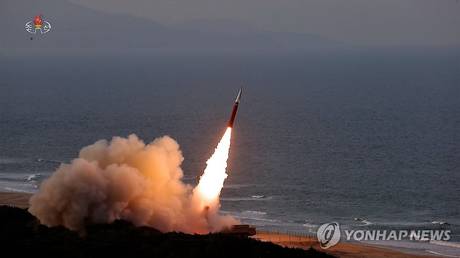
Pyongyang just raised the stakes. North Korea tested a new weapon system explicitly designed to slip past existing missile defense shields. Leader Kim Jong Un watched the launch firsthand from an undisclosed observation post, surrounded by military engineers and his teenage daughter. State media released the details days afterward, using stark, aggressive terminology to describe the strategic threat posed to regional rivals.
The phrasing chosen by state organs was deliberate. An incurable headache. That exact expression lays bare how Pyongyang views its ongoing technological progression. It wants to inject maximum operational uncertainty into Seoul, Tokyo, and Washington. Every test is a psychological message wrapped in hardware.
Inside the September Launch
The test occurred on a Sunday morning. South Korean military sensors picked up multiple short-range ballistic missiles lifting off from coastal areas near Wonsan. Analysts immediately began dissecting photographs published by the Korean Central News Agency.
The visual evidence pointed toward an upgraded short-range platform topped with a hypersonic glide vehicle. This concept is not entirely unprecedented, but the engineering maturity is advancing rapidly. North Korea is solving manufacturing bottlenecks that typically stall developing defense industries.
Traditional ballistic missiles follow a predictable parabolic arc. They climb into space before plunging downward toward their target at high speeds. That predictability allows advanced radar systems to calculate intercept points well in advance. Hypersonic weapons break that rulebook entirely. They fly lower, move at extreme velocities, and retain aerodynamic maneuverability throughout flight.
The Mathematics of Interception Failure
Defense architecture relies heavily on physics and prediction. Patriot batteries, Aegis combat systems, and THAAD installations calculate a missile's trajectory milliseconds after detection. Interceptors are then launched to collide with the incoming threat at a calculated intercept point.
When a warhead can alter its flight path mid-trajectory inside the upper atmosphere, those calculations break down. The interceptor aims for where the target was supposed to be, not where it maneuvers to next. Seoul and Washington face a stark tactical problem. Existing regional shields were engineered for ballistic arcs. They struggle mightily against unpredictable gliding profiles.
State media photographs showed Kim inspecting detailed maps of flight trajectories alongside regional commanders. This imagery serves a dual function. It broadcasts technical confidence internally while signaling military deterrence outward.
Engineering Innovations in the Hwasong Lineage
This test marks another step in a systematic modernization effort. Pyongyang has spent years refining the Hwasong-11 series, combining solid-fuel propulsion with advanced maneuverable warheads.
Solid fuel offers massive tactical advantages over liquid fuel. Liquid-fueled rockets require lengthy preparation times on the launchpad. Crews must pump volatile propellants immediately before firing, leaving them vulnerable to satellite reconnaissance and preemptive strikes. Solid-fuel rockets arrive pre-fueled. They sit inside hardened underground silos or mobile transporter-erector-launchers, ready to fire with minimal warning.
By mating solid-fuel boosters with hypersonic glide payloads, North Korea shortens its decision loop while expanding the target set for its adversaries. Warning times shrink from minutes to seconds.
Strategic Messaging and Alliance Dynamics
Timing in military testing is rarely accidental. This launch coincided with high-level diplomatic visits and tense regional summits. Pyongyang frequently uses weapons demonstrations to punctuate political friction.
Washington and Seoul maintain joint security drills, though defense postures adjust constantly. Pyongyang views these exercises as hostile rehearsals. The weapons development programs proceed regardless of diplomatic freezes, stalled talks, or international sanctions.
Observers watching the official imagery note the continued presence of Kim Ju Ae. Her inclusion at major military milestones signals dynastic continuity. The regime ties its internal legitimacy directly to technological achievements in strategic weaponry.
The Broader Geopolitical Backdrop
North Korea's defense sector operates within a wider network of international friction. Recent years have seen deeper military cooperation with foreign partners, providing Pyongyang with valuable testing data, financial backing, and technological exchanges.
This external support accelerates domestic research and development. Engineers can iterate faster when sharing resources and manufacturing capabilities with allies engaged in modern conflicts.
For South Korea, the challenge is structural. Urban density leaves little room for error. Seoul sits within artillery and short-range missile range, meaning defensive systems must operate with near-perfect reliability. Every successful test by the North forces defense planners to revise their operational models.
Adapting to an Unstable Future
The technological gap is narrowing. As guidance systems improve and thermal protection materials advance, maneuverable warheads become harder to defend against. Investments in space-based infrared sensors, directed-energy weapons, and multi-layered interception networks are accelerating across allied nations.
Yet hardware takes years to build and deploy. For now, the reality on the peninsula remains tense. Pyongyang possesses a growing arsenal engineered specifically to defeat existing regional shields.
Watch this Kim Jong Un missile test footage to examine the official media framing and visual evidence released after the launch.


