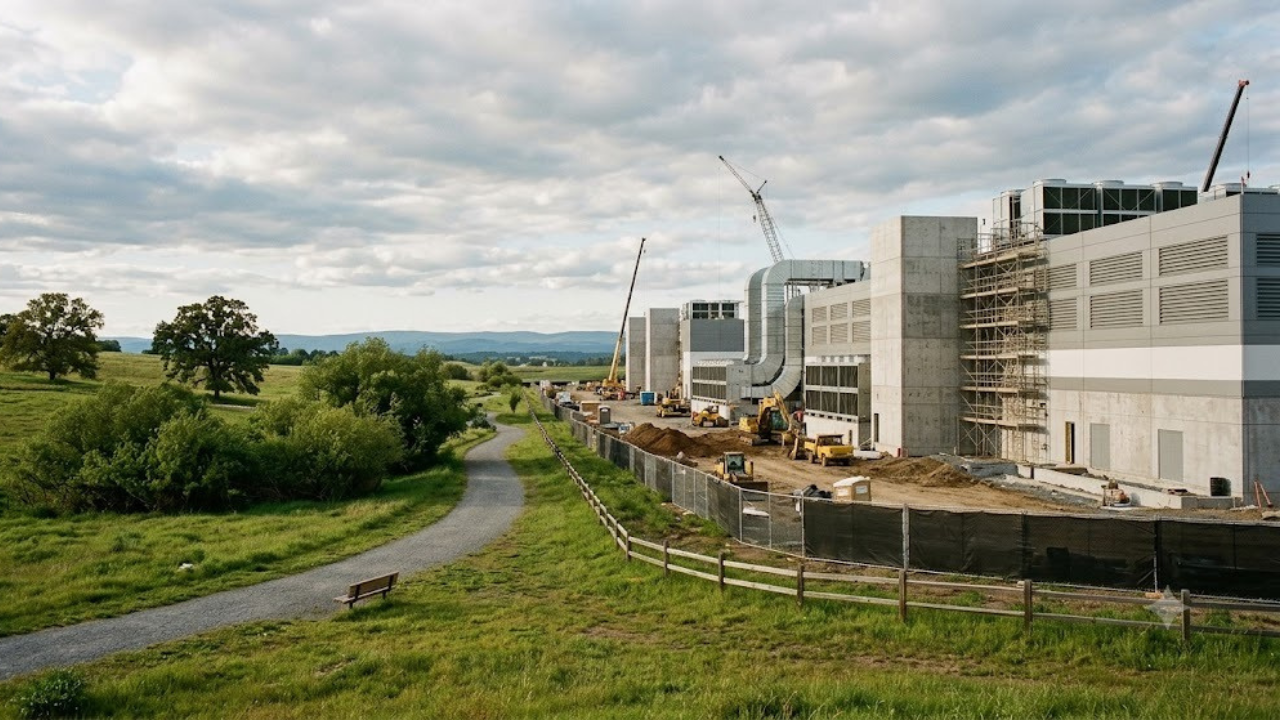
The internet loves a good moral panic, especially when it involves a dead farmer, a $10 land donation from 1999, and a massive technology company swooping in to build a data center.
The local headlines write themselves. They scream about the "loss of green space," the "betrayal of a legacy," and the corporate takeover of public goods. It is a neat, emotionally manipulative narrative that pits greedy city officials against the ghost of a benevolent agriculturalist.
It is also entirely wrong.
The lazy consensus surrounding municipal land preservation is financially illiterate. It treats public land as a holy, untouchable relic rather than what it actually is: a highly illiquid asset on a city’s balance sheet that costs money to maintain and generates exactly zero dollars in economic velocity.
Selling 87 acres of underutilized parkland for $10 million upfront and securing $30 million in recurring tax revenue isn't a betrayal of public trust. It is a masterclass in fiduciary responsibility.
The Myth of the "Free" Public Park
Let’s dismantle the premise that keeping this land as a park is a cost-free win for the community.
When a city accepts a land donation, it isn't getting a freebie. It is inheriting a permanent liability. Parks do not maintain themselves. They require mowing, landscaping, trash removal, policing, lighting infrastructure, and liability insurance.
I have spent years looking at municipal budgets, and the story is always the same. Cities consistently over-leverage themselves on deferred maintenance. They accept land donations during economic booms, only to let the grass grow wild and the playground equipment rust when the next recession hits.
By holding onto 87 acres of raw land out of pure sentimentality, a city is actively burning capital.
- Opportunity Cost: The value of the land isn't what the farmer sold it for in 1999 ($10). The value is what the market is willing to pay for it today ($10 million).
- The Maintenance Trap: Every dollar spent filling potholes on a park trail is a dollar taken away from underfunded public schools, crumbling water treatment plants, or strained emergency services.
- Zero Velocity: A park does not generate commerce. It does not create high-paying construction jobs. It does not inject capital into the local ecosystem.
Holding onto an asset that yields a negative financial return while facing a massive liquidity injection is bad business. If a private fund manager ran an investment portfolio this way, they would be fired by their board before lunch.
The Brutal Reality of Data Center Economics
Critics love to claim that data centers are bad neighbors. They cry about energy consumption, water usage, and the fact that they don't employ thousands of retail workers.
This argument completely misunderstands how modern municipal finance works.
Cities do not need more retail jobs that pay minimum wage and require heavy utilization of public infrastructure. Cities need tax base density. They need entities that pay massive property and utility taxes while demanding almost nothing from the city's costliest services.
The Tax-to-Demand Ratio
| Asset Type | Tax Revenue Generated | Demand on Public Schools | Demand on Emergency Services | Infrastructure Wear and Tear |
|---|---|---|---|---|
| Residential Subdivisions | Moderate | Extremely High | High | High |
| Traditional Retail / Mall | Moderate-Low | None | High (Crime/Traffic) | Moderate |
| Public Park | Negative (Cost) | None | Moderate | Low |
| Data Center | Extremely High | None | Extremely Low | Negligible |
Look at that breakdown. A data center does not send children to local schools, meaning it doesn't add a single dime of burden to the local education budget—typically the largest line item in any municipality. It doesn't generate massive traffic gridlock, reducing road maintenance costs. It requires minimal policing compared to a commercial shopping district or a public park where illicit activity often clusters after dark.
A data center is a financial ghost in the machine. It sits quietly, hums, processes data, and cuts massive checks to the local treasury.
The $30 million in projected tax revenue from this specific deal can fund the modernization of the entire city's existing park system. It can repair bridges, hire more first responders, and lower the property tax burden on actual living residents. Trading 87 acres of grass for the financial stability of an entire town isn't a sacrifice. It's a premium upgrade.
Dismantling the "People Also Ask" Delusions
When news of these deals breaks, the public asks the wrong questions because they are operating on emotion rather than economic principles. Let's fix that.
"Didn't the farmer want this to stay a park forever?"
Probably. But dead men don't pay municipal bonds. A deed restriction is a legal mechanism, not a holy covenant. If the original transfer lacked a ironclad, legally binding reversionary clause stating the land must revert to the heirs if it ceases to be a park, then the city has the legal right—and the moral obligation to its current taxpayers—to maximize the asset’s value when conditions change. The economic realities of 2026 are vastly different from those of 1999.
"Can't we just find another piece of land for the data center?"
No. Data centers cannot just go anywhere. They require proximity to high-voltage transmission lines, fiber-optic trunk lines, and specific zoning buffer zones. If a city plays hardball and tries to force a tech giant onto an unsuitable parcel out of a desire to save a park, the company will simply take its $10 million check and its $30 million in future tax revenue to the next county over. The park remains, the city stays broke, and the neighbors get nothing.
The Flaw in My Own Argument
To be completely transparent, there is a downside to this contrarian approach. When you sell public land for industrial or commercial use, it is a one-way street. You cannot easily un-build a data center. The green space is gone for good.
If a city mismanages the $10 million windfall—using it to plug short-term budget deficits rather than investing it into long-term capital projects or an endowment—they will find themselves broke again in five years, minus a park.
But the risk of government incompetence is not an argument against economic progress. It is an argument for better governance.
Stop Treating Municipalities Like Charities
The core issue here is a fundamental misunderstanding of what a city is. A city is not a historical preservation society. It is not a charity. It is a corporation whose shareholders are the taxpayers.
When those shareholders are struggling with inflation, rising municipal utility rates, and crumbling infrastructure, holding onto a multi-million dollar asset because of a transaction that happened nearly thirty years ago is a luxury the community cannot afford.
The farmer got his wish for nearly a generation. The city kept the land green for 27 years. But eventually, every asset must be marked to market.
Take the $10 million. Secure the $30 million. Fix the roads. Fund the schools. Build three better, safer, more accessible parks in neighborhoods that actually need them.
Stop crying over raw land and start running your city like it actually wants to survive.