The soccer establishment is running out of metaphors.
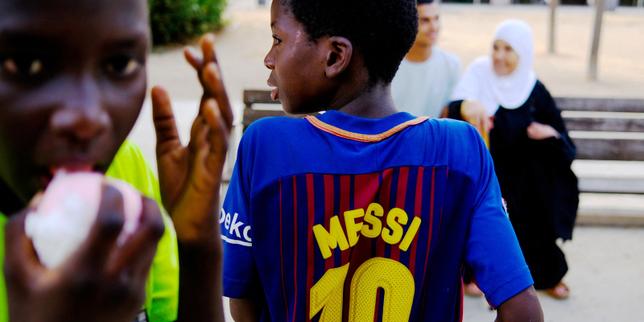
As Spain prepares to face Argentina at MetLife Stadium for the 2026 World Cup final, the narrative machine has already locked in its favorite angle. They call it a passing of the torch. They point to that iconic 2007 photo of a twenty-year-old Lionel Messi bathing a four-month-old Lamine Yamal. They scream that ninety minutes in New Jersey will define the teenage winger's career.
It is a seductive story. It is also completely wrong.
The idea that a single match can define a nineteen-year-old player is the laziest consensus in modern sports journalism. It reduces a complex, systemic team sport down to a simplistic Hollywood script. If Spain wins, the media crowns him the new king. If Spain loses, the cynics will label him a big-game ghost who could not handle the pressure of the absolute peak.
Both conclusions are intellectual garbage. I have watched sports media build up teenage prodigies for over two decades just to dismantle them the second they show a hint of human limitation. This final will not define Lamine Yamal. It cannot.
The Fallacy of the Single Game Verdict
Evaluating a player based entirely on the outcome of a single international final ignores how soccer actually works. A player can deliver a masterclass, compress the entire opposition defense, create four clear-cut chances, and still lose because a center-back slips or a referee misses a handball. Conversely, a winger can spend eighty-five minutes losing possession, tap in a deflected cross, and be lauded as a savior.
We saw this exact trap in 2014 with Mario Götze. He scored the winning goal in a World Cup final at age twenty-two. The world decided that moment defined his greatness. In reality, it became an anchor that dragged down the rest of his career, setting an impossible standard that ignored his subsequent structural role changes and health struggles.
Lamine Yamal has already completed his real test. He did it across seven grueling matches in this tournament, driving Luis de la Fuente’s side forward with terrifying consistency. Look at the semifinal against France. It was not a flashy individual showcase where he dribbled past five players; it was a tactical demonstration. He tracked back, won possession from Lucas Digne, and initiated the sequence that led to Mikel Oyarzabal’s crucial penalty.
Spain has reached this final because they are a functional machine. They have kept six clean sheets in seven matches. They have built an environment where two nineteen-year-olds—Yamal and Pau Cubarsí—can start a World Cup semifinal and look like seasoned veterans. This is a triumph of system design, not a solo crusade. To frame the final as Yamal’s personal trial by fire completely misunderstands the collective brilliance of La Roja.
The Insane Comparison Trap
The obsession with comparing Yamal to Messi or Kylian Mbappé in 2018 is structurally flawed.
When Pelé scored twice in the 1958 final at seventeen, he was playing in a completely different tactical era. When Mbappé scorched Croatia in Moscow, he was operating inside a hyper-conservative Didier Deschamps system designed to maximize counter-attacking isolation.
Yamal is playing in a rigid positional framework. His role requires extreme discipline. He is tasked with stretching the pitch, maintaining width, and executing precise pressing triggers. He is not a roaming free-radical like Messi was in his prime. If Argentina manages to double-team Yamal and choke his service, it will not mean he failed. It will mean Lionel Scaloni committed defensive assets to neutralize him, opening up space for Dani Olmo or Nico Williams to exploit the center.
If you want to judge Yamal, stop looking at the scoreboard at the final whistle. Look at his structural choices:
- Field Tilt Contribution: How effectively does his presence force Argentina's left-back into a low block?
- Rest Defense Positioning: Is he occupying the correct half-space to prevent quick Argentinian counters when Spain loses the ball?
- Decisiveness Under Pressure: Does he release the ball in two touches when the double-team arrives, or does he force the dribble?
These are the metrics that matter to coaches. They are entirely invisible to casual viewers who only care about who holds the golden trophy at midnight.
The Risks of Early Apotheosis
Admitting the downside to this contrarian view is fair. If Yamal scores a stunning winner, the immediate narrative momentum will be unstoppable. He will be favored for the Ballon d'Or. The commercial pressure will skyrocket.
But history tells us that early apotheosis often breaks young athletes. When a teenager achieves everything before their twentieth birthday, the psychological motivation shifts. The sport stops being an evolution and becomes a desperate defense of status.
Imagine a scenario where Spain loses 1-0 on a messy, deflected goal, and Yamal hits the post in the final minute. The media will run pieces questioning his clinical edge. They will say he lacked the legendary composure of Messi. They will ignore the fact that at nineteen, he has already done more on an international stage than most world-class wingers achieve in a lifetime.
We need to stop using finals as binary entry exams for footballing immortality. The tournament in North America has already proven Yamal is a generational talent. Win or lose, his developmental arc is just beginning. The final is a chapter, not the book.
Stop looking for a Hollywood ending. Watch the structural execution. Appreciate the tactical machinery. Leave the lazy scripts to the people who do not understand the sport.