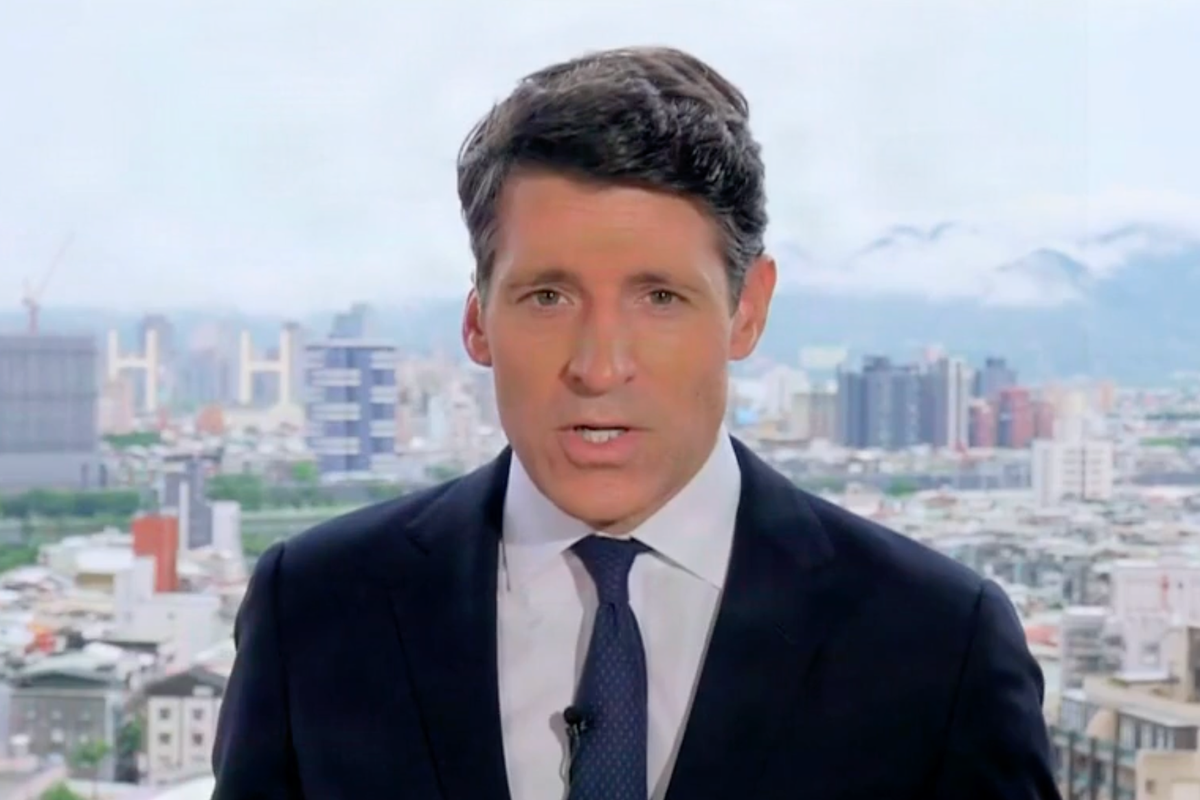
The collapse of a live broadcast is rarely a failure of a single individual; it is the realization of systemic risk inherent in high-stakes field operations. When CBS News anchor Tony Dokoupil’s live segment from Beijing was abruptly terminated following a cameraman’s medical emergency, the incident exposed the thin margins of safety in remote newsgathering. In a professional environment where "the show must go on" is the governing ethos, an on-air termination signals a total breach of the secondary and tertiary fail-safes designed to maintain broadcast continuity. Understanding this event requires a decomposition of the technical, physiological, and logistical variables that govern modern international reporting.
The Architecture of Field Broadcast Vulnerability
A live remote broadcast from a location like Beijing functions as a closed-loop system with three critical nodes: the talent (anchor), the technical crew (camera and audio), and the transmission uplink. The CBS incident demonstrates a failure in the human component of the technical node, which creates an immediate "single point of failure" (SPOF) scenario. Unlike a controlled studio environment where multiple robotic cameras or redundant crew members can compensate for a localized issue, field reporting often relies on a "lean crew" model to maximize mobility and reduce the logistical footprint in restrictive environments. For another perspective, read: this related article.
The failure mechanics in this instance follow a predictable sequence of systemic degradation:
- Physiological Stressor: The operator experiences a sudden medical event, likely exacerbated by the physical demands of operating heavy equipment, jet lag, or localized environmental factors (air quality or temperature).
- Loss of Stabilization: The primary visual feed loses integrity. In broadcast standards, a "dropped" or erratic camera is more damaging to brand authority than a black screen.
- Communication Latency: The anchor, positioned in front of the lens, is often the last person to understand the severity of a behind-the-camera crisis. This creates a cognitive gap where the talent continues to perform for an audience that is witnessing a mechanical or human breakdown.
Quantitative Pressures on International News Crews
To analyze why a medical emergency led to a total broadcast blackout rather than a seamless pivot, one must examine the operational cost functions of modern journalism. The "Manpower-to-Output Ratio" in foreign bureaus has been aggressively optimized over the last decade. Similar coverage regarding this has been shared by TIME.
The Lean Crew Constraint
In many international assignments, a standard "two-man" team consists of an anchor and a multi-link operator (MLO) who handles camera, lighting, and satellite transmission simultaneously. This creates a 100% dependency on the physical health of one individual. If that individual becomes incapacitated, the transmission logic dictates a hard stop. The "Redundancy Tax"—the cost of flying, housing, and clearing visas for a third "relief" technician—is often deemed too high for standard news segments, leaving no buffer for unexpected medical variance.
The Beijing Variable
Operating in China introduces specific friction points that amplify physical and mental fatigue. Visas for journalists and technical staff are strictly controlled, and movement within the city often involves navigating complex bureaucratic checkpoints. These "Friction Coefficients" increase the baseline stress on a crew before the camera even turns on. When the body encounters a medical anomaly under these heightened conditions, the recovery window is narrowed, and the likelihood of a catastrophic failure increases.
The Physiology of the Lens The Physical Burden of Field Production
A broadcast-grade camera rig, including the battery, lens, and wireless transmitter (such as a Dejero or LiveU backpack), typically weighs between 25 and 45 pounds. Supporting this weight while maintaining a static frame for a 3-to-5-minute "hit" requires significant isometric muscle engagement and cardiovascular stability.
The physiological demand is categorized by:
- Orthostatic Load: Standing for long durations in a fixed position can lead to blood pooling in the lower extremities, potentially triggering syncopal (fainting) episodes.
- Thermal Regulation: Technical gear generates significant heat, which, when combined with outdoor ambient temperatures, creates a localized microclimate that can lead to heat exhaustion or dehydration.
- Cognitive Load: The operator is not merely holding a camera; they are monitoring audio levels, checking signal strength for the cellular bonding unit, and listening to the producer in New York through an earpiece.
When Dokoupil stopped speaking to check on his colleague, he broke the "fourth wall" of broadcast journalism. This action, while humanly necessary, confirms that the technical node had reached a state of "unrecoverable error."
Strategic Frameworks for Broadcast Continuity
The CBS incident provides a data point for a broader risk-assessment framework that news organizations must adopt to prevent on-air collapses. This involves transitioning from "Best Effort" delivery to "High Availability" (HA) standards.
The N+1 Redundancy Model
To achieve High Availability, organizations must implement the N+1 principle: for every critical role (N), there must be at least one backup (+1) available. In the context of a foreign broadcast:
- N (Technical): The primary camera operator.
- +1 (Technical): A static "B-cam" on a tripod or a secondary technician capable of taking over the feed.
CBS’s failure to maintain the feed suggests they were operating at a 1:1 ratio, providing no margin for human error or biological unpredictability.
The "Dead Man's Switch" Protocol
In technical systems, a dead man's switch triggers an automated response if the operator becomes incapacitated. In broadcast, this is mirrored by "Back-to-Studio" protocols. The delay between the cameraman's collapse and the studio's takeover highlights a lag in situational awareness between the field and the control room. High-performance organizations utilize an "Always-On" secondary audio link where the producer can hear the ambient environment of the field crew, allowing for an immediate cutaway the moment a distress signal—verbal or physical—is detected.
The Information Gap Fact vs. Hypothesis
While the public record confirms a "medical emergency," the specific nature of the event remains a known unknown. However, the mechanism of the broadcast's end tells us more than the medical diagnosis would. The fact that the camera did not simply tilt, but the feed was eventually cut, indicates that the technical infrastructure remained functional while the human operator did not.
This leads to a critical distinction:
- Known Fact: The broadcast ended prematurely due to a crew member's health event.
- Known Fact: Tony Dokoupil prioritized the safety of the crew over the delivery of the script.
- Hypothesis: The crew was operating under a "Minimal Viable Team" structure, which lacked the depth to absorb a physical shock to the system.
Logistical Recovery and Reputational Management
The immediate aftermath of such an event involves a complex recovery phase. The crew must navigate the local healthcare system in a foreign jurisdiction—in this case, Beijing—which involves insurance clearances, translation services, and potential government oversight. For CBS, the challenge shifts from broadcast production to crisis management and employee duty of care.
From a strategic standpoint, the incident serves as a "Stress Test" for the network's contingency planning. The speed with which the network can deploy a replacement crew or resume operations from that bureau is a direct metric of their operational resilience. A failure to resume within a 24-hour window indicates a brittle supply chain for technical talent in the region.
The Operational Pivot
The lesson of the Beijing broadcast failure is that human biological variance is a hard constraint on technical systems. To mitigate this, news organizations must shift their strategy from Efficiency-Maximized (fewer people, lower cost) to Resilience-Maximized (redundant roles, higher safety).
The following strategic adjustments are necessary for high-stakes international reporting:
- Mandatory Tripod Integration: For segments exceeding two minutes, the use of stabilization hardware should be mandatory to reduce the physical load on the operator, even if it slightly reduces shot fluidity.
- Remote Monitoring Buffers: Implementing a 5-to-10-second broadcast delay for live field hits allows the control room to intercept a visual collapse before it reaches the consumer, preserving the professional integrity of the feed.
- Cross-Training Talent: On-air talent should be trained in basic "Safe-Shutdown" procedures for field gear. If an operator goes down, the anchor should be capable of switching the transmitter to a static "Emergency" slide or a wide-angle backup.
The incident in Beijing was not a freak accident; it was a predictable outcome of a system operating at 100% capacity with 0% redundancy. Future operations must price "Human Failure" into the logistical model, or they will continue to suffer public, unforced errors in their most critical moments of global coverage. The final strategic move for any network in this position is a total audit of foreign bureau staffing levels, moving away from the "One-Man-Band" philosophy in favor of a robust, tiered support structure.


