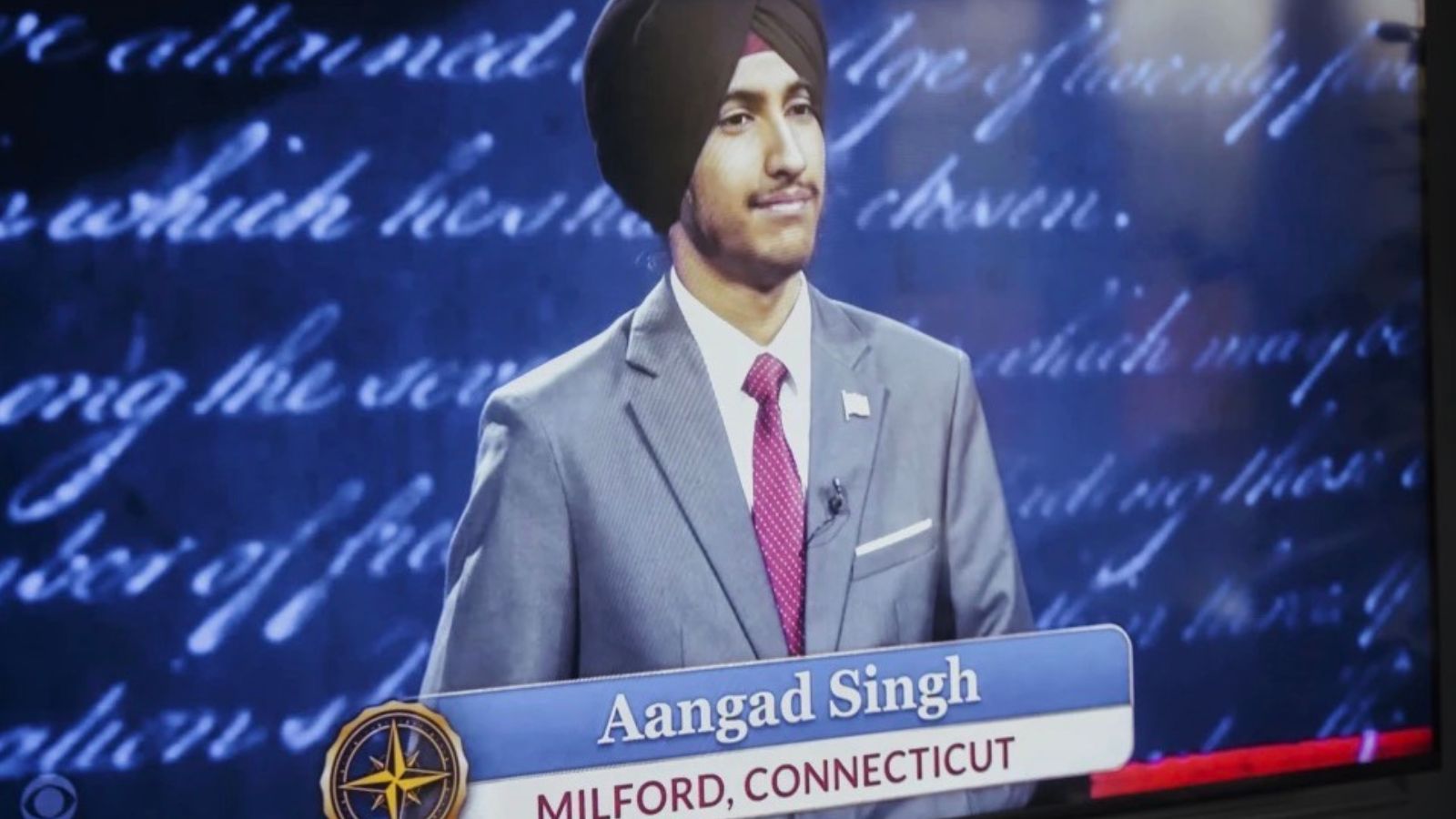
The narrative is almost too easy to write: an ambitious minority teenager excels in a high-stakes national civic essay contest, misses out on the top prize under a politicized grading system, and the family alleges bias. It triggers immediate tribal reactions across the political spectrum. Critics point to the administration in power; defenders cite standard judging rubrics. Both sides scream, the internet moves on, and nothing changes.
They are missing the entire point.
The controversy surrounding civic contest scoring isn't about hidden agendas, administrative spite, or demographic bias. The real breakdown happens the moment we assume subjective essay competitions were ever designed to function as objective, ironclad meritocracies.
We love the myth of the clean, quantifiable score. We want to believe that civic knowledge, rhetoric, and patriotic analysis can be fed into a rubric, processed like an SAT math section, and spat out as an undeniable ranking.
It cannot. And pretending it can is precisely why these debacles keep happening.
The Illusion of the Perfect Rubric
I spent years judging national student writing panels and reviewing standardized educational frameworks. I have watched educated adults argue for forty-five minutes over whether an essay deserved an 88 or a 91 based on vaguely defined criteria like "depth of understanding" or "civic clarity."
Here is the dirty secret of subjective evaluation: rubrics do not eliminate human bias. They merely hide it behind a veneer of pseudo-scientific scoring.
When an administration—whether Republican or Democrat—overhauls civic education rubrics, they alter the definition of what constitutes "good citizenship." Under one administration, civic excellence might mean critique, systemic analysis, and constitutional evolution. Under another, it might mean strict originalism, historical exceptionalism, and institutional deference.
When a student writes an essay that aligns perfectly with analytical rigor but collides with the political philosophy of the grading rubric, the score drops. Is that bias? Or is it simply the system functioning exactly as designed?
The family questioning the scoring process is asking the wrong question. They are asking, Did the judges grade my child fairly according to the rules?
The real question is: Who built the rules, and why did anyone expect a political institution to grade political thought impartially?
Stop Expecting Political Bodies to Be Neutral Arbitrators
When government-backed civic initiatives run competitions, they are not evaluating pure logic in a vacuum. They are promoting an ideal narrative of the state.
When you submit an entry to a nationally sponsored civics competition, you aren't taking an AP Physics exam where gravity operates identically regardless of who sits in the White House. You are entering a platform built to mirror the ideological values of the organizing authority.
Consider the mechanics:
- Prompt Architecture: Prompts are engineered with embedded assumptions. A prompt asking "How does the Constitution secure liberty?" yields vastly different top-tier essays than one asking "How has the Constitution been expanded to protect marginalized groups?"
- Evaluator Selection: Judges are recruited based on alignment with organizational standards. You do not get neutral algorithms; you get human beings with ingrained worldviews.
- The Nuance Penalty: Highly sophisticated essays that acknowledge institutional flaws often get penalized by panels looking for celebratory rhetoric, while overly simplistic essays get penalized by academic panels looking for critical theory.
If a student brings nuanced historical critique to a panel looking for patriotic cheerleading, the student loses. Not because of a vast conspiracy, but because of a fundamental mismatch between the author's intent and the judge's mandate.
The Flawed Questions Everyone Keeps Asking
Look at the public discussions surrounding these contest disputes. The questions being thrown around show just how deep the misunderstanding goes.
"Why can't we just make civic essay scoring 100% objective?"
Because human thought is not binary. To make writing 100% objective, you have to strip away everything that makes writing valuable: original synthesis, stylistic flair, and persuasive rhetoric. You end up grading multiple-choice recall tests. If you want a test that measures pure memorization of dates and amendment numbers, build a scantron. But do not call it a civic art form.
"Should political administrations be allowed to change contest rubrics?"
Elections have consequences, and policy shifts directly impact federal agencies, educational grants, and public initiatives. Expecting a presidential administration to maintain the political optics and educational philosophy of its predecessor is naive. The problem isn't that rubrics change; the problem is that participants pretend these changes don't inherently shift the target.
"How do high-performing students win in subjective competitions?"
You adapt to the audience. In the real world, persuasion requires knowing precisely who holds the red pen. If you write a brilliant libertarian treatise for a progressive panel—or a radical critique for a conservative board—you may be morally consistent, but you are strategically foolish.
The Hard Truth About High-Stakes Competitions
We tell young people that if they work hard, follow the rules, and master the material, the system will recognize them. It is a comforting narrative. It is also an incomplete one.
Hard work and raw talent get you to the table. Strategic positioning determines whether you win.
When students enter the national arena, they aren't just competing against their peers; they are navigating the political machinery of the institution hosting them. If we want to prepare young writers and future leaders for reality, we need to stop feeding them the fairytale of pure, unadulterated meritocracy in subjective arts.
Teach them how to analyze the institution. Teach them how to read the judges. Teach them to recognize when a game is worth playing and when the deck is stacked before the first card is dealt.
The solution to a controversial contest score isn't to demand an audit of a broken, inherently subjective rubric. The solution is to recognize the game for what it is, stop treating political contests as sacred arbiters of student worth, and build platforms where real intellectual rigor doesn't require a political stamp of approval.