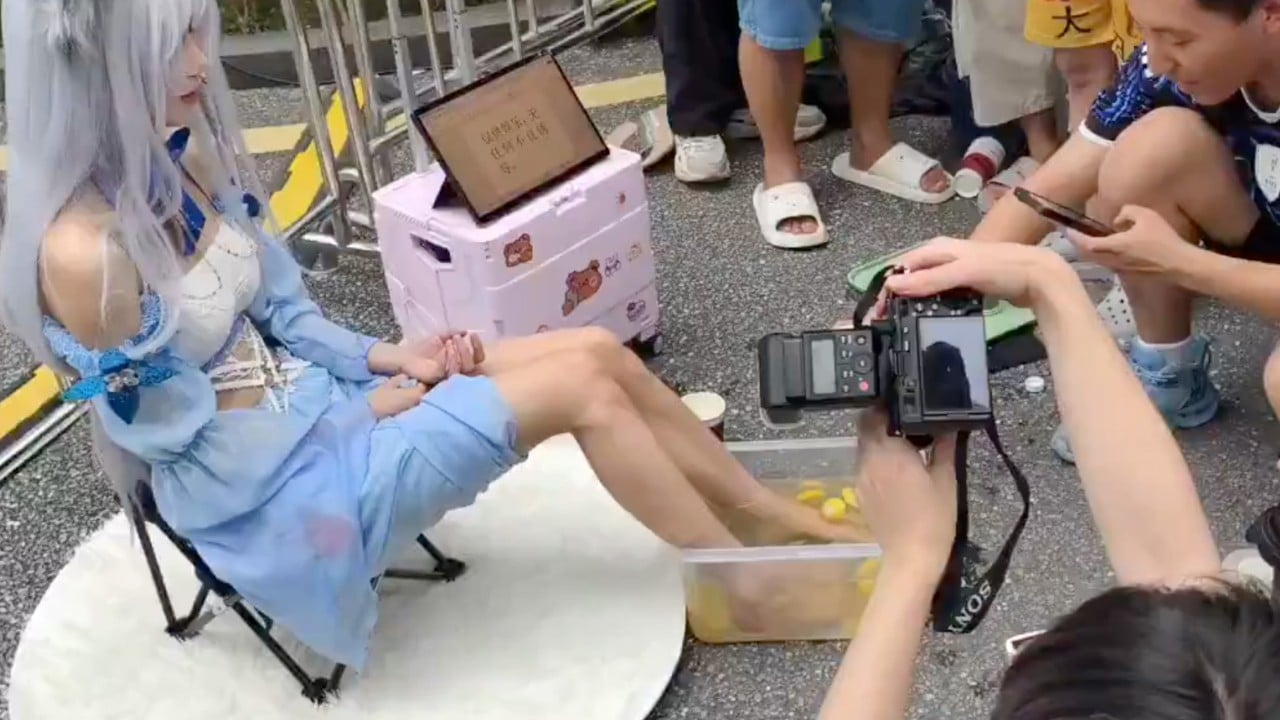
The internet spent the past forty-eight hours clutching its collective pearls over a Chinese cosplayer who sold lemonade by having her bare feet playfully interact with the preparation process. Cue the viral outrage. Headlines shrieked about hygiene violations, bizarre fetishes invading the public square, and the moral decay of modern convention spaces. Commentators lined up to wag their fingers at what they diagnosed as a desperate cry for attention gone wrong.
They are entirely, breathtakingly wrong.
What happened at that convention center was not a health code disaster or a pathetic stunt. It was a masterclass in guerrilla marketing, hyper-segmentation, and raw economic efficiency. While mainstream observers saw a gimmick, I saw a creator squeezing every ounce of economic value out of an attention economy that normally rewards bland conformity. I have watched brands flush millions down the toilet on programmatic ad spend that generates zero recall, while a single human being with a prop, a pair of sandals, and an understanding of internet tribalism generated massive real-time foot traffic and global reach for the cost of a few lemons and some sugar.
Stop looking at the beverage. Look at the balance sheet.
The Lazy Moral Panic Of The Media Class
The lazy consensus among mainstream journalists and pearl-clutching commentators is that public stunts involving niche subcultures must be evaluated through the lens of traditional retail safety standards. This is a category error of massive proportions.
A convention floor is not a suburban strip-mall Starbucks. It is a high-density, attention-starved marketplace where thousands of vendors are screaming for eyeballs. Standard product quality is table stakes; nobody goes to a comic convention for the artisanal quality of the citrus. They go for the narrative. They go for the spectacle.
When critics frame this stunt as a sanitary crisis, they reveal a profound misunderstanding of how modern fandom operates. The transaction was never about the liquid in the cup. The liquid was merely a physical token for a participatory joke. The buyers knew what they were engaging with. The consent was mutual, enthusiastic, and dripping with ironic self-awareness.
Treating a performance-art beverage booth like a municipal water treatment plant is the kind of bureaucratic literalism that kills culture. Let us define terms. In the attention economy, the opposite of love is not hate; it is indifference. This cosplayer did not court indifference. She engineered total polarization, and polarization is the only currency that scales.
Attention Arbitrage In A Saturated Market
Let us look at the economics. Traditional booths at major pop culture expos cost thousands of dollars for floor space. Vendors spend weeks building elaborate backdrops, hiring staff, and printing glossy brochures that end up in the nearest recycling bin by 4:00 PM.
This creator bypassed the corporate friction entirely.
- Zero Acquisition Cost: The props were standard household items.
- Viral Amplification: Attendees did the distribution work for free by filming and posting the interaction to TikTok, X, and Weibo.
- Maximum Margin: The perceived value of the product skyrocketed because of the exclusivity and the performance attached to it.
Imagine a scenario where a traditional beverage brand tries to manufacture this exact level of viral engagement. They would hire an expensive creative agency, run focus groups with middle-aged executives, approve a watered-down social media campaign, and spend fifty thousand dollars on sponsored posts that users scroll past in half a second. The cosplayer spent zero dollars on media placement and achieved higher organic reach than a regional beverage franchise.
I have seen companies blow millions on influencer campaigns that felt corporate and hollow, yielding an engagement rate that wouldn't clear a rounding error. Meanwhile, a lone operator understood the mechanics of meme propagation better than an entire marketing department with degrees from Ivy League institutions.
The Downside Of The Chaos Engine
To maintain intellectual honesty, I must admit the glaring risk inherent in this approach. This strategy is not for the faint of heart, and it comes with structural hazards that can tank a career overnight.
Playing in the gray areas of public decency means you are one uptight local health inspector or panicked venue manager away from getting permanently banned from convention spaces. The margin for error is razor-thin. If the narrative slips out of your control—shifting from playful, ironic subversion to actual health hazard or non-consensual discomfort—the mob turns on a dime. Cancel culture does not care about nuance once the mainstream media picks up the story and strips away the context.
Furthermore, this model cannot be easily institutionalized. You cannot scale a lemonade stand built entirely on the personal brand and shock value of a single performer without it quickly mutating into something sterile or creepy. It relies entirely on individual audacity. The moment a corporation tries to replicate it, the magic dies, replaced by the unmistakable stench of a focus-grouped boardroom trying desperately to look youthful and edgy.
The Real Question You Should Be Asking
People keep asking: How is this sanitary?
That is the wrong question. It is the kind of pedestrian inquiry that keeps you trapped in a loop of mediocre thinking.
The question you should be asking is: Why are traditional brands failing so completely at capturing cultural attention that a lone individual with a bucket of lemons can out-market a multinational corporation with a single afternoon setup?
The answer is that modern consumers crave friction, personality, and authenticity—even when that authenticity is messy, provocative, and deliberately absurd. We are drowning in a sea of sanitized, brand-safe corporate sludge. Every advertisement looks the same. Every product launch follows the exact same playbook. Every influencer uses the same tired vocal fry and editing style.
Into this wasteland walks a creator willing to break the unspoken rules of polite society for twenty minutes of pure market disruption.
She did not lower the bar. She exposed how boring the bar was to begin with.
Stop worrying about the lemonade. Start worrying about why your own strategy requires a safety net just to be noticed.