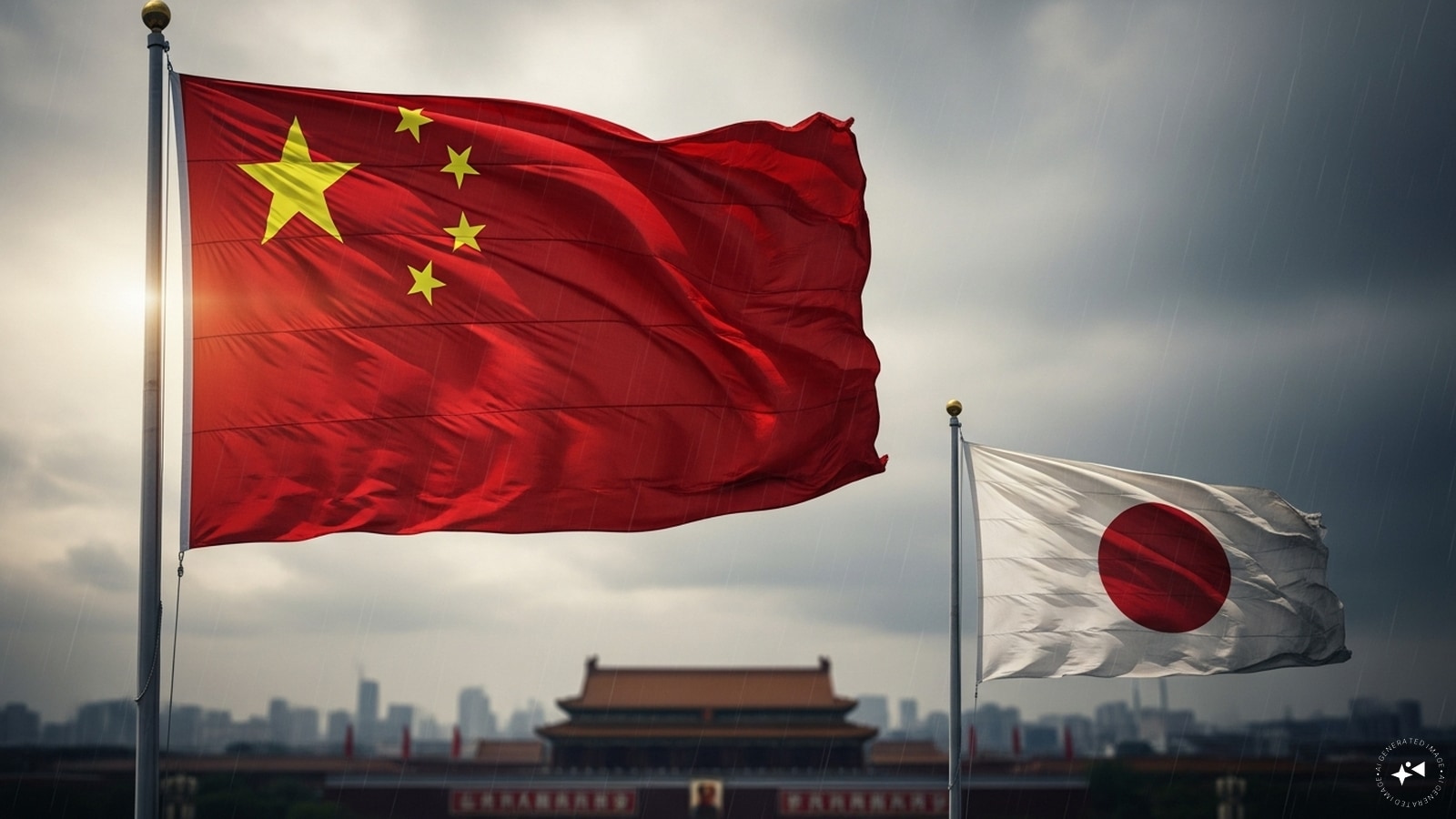
The deployment of a Chinese carrier strike group into the Western Pacific, flanked by advanced destroyers and shadowed by Japanese surveillance, marks a permanent shift in regional power dynamics. While surface-level reports focus on the immediate tension between Beijing and Tokyo, the reality is far more clinical. We are witnessing the physical manifestation of a "Blue Water" navy that has moved past the experimental phase. China is no longer just signaling its intent to dominate the First Island Chain; it is practicing the logistics of a prolonged, high-intensity naval blockade.
This isn't about a single drill or a temporary spat over the Senkaku Islands. It is about the systematic testing of Japanese and American reaction times. Every time a Type 055 Renhai-class cruiser passes through the Miyako Strait, Beijing collects data on how the Japan Maritime Self-Defense Force (JMSDF) scrambles its assets. They are measuring the friction.
The Type 055 and the Logic of Overmatch
To understand why these maneuvers have Tokyo on edge, one must look at the hardware currently cutting through Pacific swells. The Type 055 destroyer is not a standard escort. With 112 vertical launching system (VLS) cells, it carries a larger missile payload than the U.S. Navy’s Arleigh Burke-class destroyers. This isn't just a numbers game. It is a fundamental shift in how naval battles are calculated.
These ships are designed for "saturation attacks." In a hypothetical conflict, the goal is to fire more missiles than an opponent’s Aegis combat system can physically track or intercept. By deploying these assets into the Philippine Sea, China is proving it can project this overwhelming force well beyond the reach of its land-based coastal batteries. This forces Japan to rethink its entire defensive posture, moving away from localized island defense toward a broader, more expensive blue-water capability.
The Intelligence War Under the Surface
While the headlines follow the visible warships, the real battle happens in the deep. Every major surface exercise serves as a loud, distracting curtain for submarine movements. As the Liaoning carrier group moves through international waters, it provides acoustic cover for Jin-class ballistic missile submarines to slip into deeper trenches where they are harder to track.
Japan’s response has been to increase its fleet of Taigei-class diesel-electric submarines. These are some of the quietest boats in the world. Their mission is simple: stay hidden and wait. The Pacific is becoming crowded with sensors, sonar arrays, and "gliders" that map water temperature and salinity—data points that are vital for hiding a submarine or finding an enemy one.
The gray zone is expanding. China uses its coast guard and "maritime militia"—fishing vessels that double as surveillance platforms—to harass Japanese shipping and official vessels. This creates a constant state of low-level fatigue for the JMSDF. It is a strategy of exhaustion. By maintaining a near-constant presence, Beijing forces Tokyo to spend its defense budget on fuel and maintenance rather than the next generation of high-tech weaponry.
The Silicon Shield and the Aegis Gap
Technology is the silent arbiter of this conflict. Japan’s decision to upgrade its destroyers with the Aegis System and the latest SPY-7 radar isn't a luxury; it is a desperate attempt to maintain parity. The technical challenge is the speed of modern threats. Hypersonic glide vehicles, which China has tested extensively, move at speeds that make traditional interceptors nearly obsolete.
If a missile moves at Mach 5 or higher, the window for detection, tracking, and firing is measured in heartbeats. Japan’s reliance on U.S. technology creates a tight integration with American forces, but it also creates a massive target. If the data links between Japanese ships and American satellites are severed by electronic warfare, the fleet becomes blind.
China knows this. Their drills increasingly focus on "informationization"—the ability to jam enemy communications while maintaining their own. This is why we see high-altitude long-endurance (HALE) drones accompanying these naval groups. They aren't just looking for ships; they are relaying signals and mapping the electromagnetic environment.
The Economic Shadow Over the Strait
We cannot view these naval movements in a vacuum. The Pacific is the world’s most vital commercial artery. A significant portion of Japan’s energy and food supply passes through the very waters where these warships are currently operating. The implicit threat is clear: what is a drill today could be a "customs enforcement zone" tomorrow.
If China can demonstrate the ability to close the Miyako Strait or the Bashi Channel at will, the economic leverage over Japan becomes absolute. Tokyo’s recent push for "Economic Security" is a direct response to this vulnerability. They are trying to diversify supply chains and reduce dependence on Chinese manufacturing, but you cannot move a geographic location. Japan remains an island nation dependent on the sea, while China is a continental power building a maritime empire.
Why Diplomacy is Stalling
Traditional diplomacy relies on the idea that both sides want to maintain the status quo. That assumption is dead. Beijing views the current maritime borders as a historical unfairness, a relic of a time when China was weak. Tokyo views those same borders as the foundation of its sovereignty and the post-war international order.
There is no middle ground when both sides are playing for keeps. When Japan’s Ministry of Defense releases photos of Chinese ships, it isn't just for the press. It is a signal to its own population that the era of pacifism is over. The "Peace Constitution" is being reinterpreted in real-time to allow for "counter-strike capabilities"—a polite way of saying Japan is buying long-range Tomahawk missiles to hit back at mainland targets if provoked.
The Logistics of a Long War
Warships are expensive to build but even more expensive to run. The current drills are a test of endurance. China’s shipbuilding capacity now dwarfs that of the United States and Japan combined. They can lose ships and replace them; Japan cannot. This reality dictates Japan’s strategy: it must be so technologically superior and so well-integrated with the U.S. that an attack becomes too costly to contemplate.
However, the "cost" is a moving target. As China’s economy faces internal pressures, the leadership in Beijing may see a foreign distraction as a political necessity. Conversely, a strong military presence might be the only thing preventing such a move. It is the classic security dilemma: every step one side takes to feel safe makes the other side feel more threatened.
The New Front Line
The focus has shifted from the South China Sea to the East China Sea and the Philippine Sea. This is the "Second Island Chain" strategy in action. By operating on the far side of Taiwan, China is signaling that it can intercept any reinforcements coming from Guam or Hawaii. These drills are a rehearsal for a total blockade.
Japan’s move to fortify its southern islands—Ishigaki, Miyako, and Yonaguni—with anti-ship missile batteries is a direct counter-move. They are turning these small tropical islands into "unsinkable aircraft carriers." The goal is to make the passage through these straits a lethal gauntlet for any invading or transiting fleet.
The End of Strategic Ambiguity
For decades, the region relied on "strategic ambiguity"—the idea that the U.S. might or might not intervene, keeping everyone on their best behavior. That ambiguity is evaporating. The scale of China's naval expansion has reached a point where localized forces can no longer manage the threat alone.
We are entering an era of "Integrated Deterrence." This means Japan isn't just an observer; it is a primary actor. The drills we see today are the new baseline. There will be no return to the quiet seas of the 1990s. The Pacific is now a theater of constant, high-stakes competition where a single navigational error or a hot-headed commander could trigger a cascade that no diplomat can stop.
The hardware is in place. The sensors are active. The maps are being redrawn not with ink, but with the wake of carrier strike groups. Tokyo and Beijing are no longer just talking past each other; they are staring each other down through the optics of long-range missile systems.
The real danger isn't a planned invasion, but the inevitable friction of two massive machines operating in the same small space. When warships play chicken in the Miyako Strait, the margin for error disappears. Japan is betting that its high-tech alliances will hold. China is betting that its sheer mass will eventually force a retreat. Neither side shows any sign of flinching, and the water is only getting more crowded.