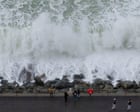
Salt tastes different when it is forced into your mouth at forty miles an hour.
Normally, along the California coast, salt is a background note. You smell it on the morning fog rolling over Highway 1 in Big Sur, or taste it on your lips after an afternoon session at Steamer Lane. It is benign, decorative, and priced into the real estate. We pay millions of dollars to live within spitting distance of the Pacific because we have convinced ourselves that the ocean is a scenic backdrop rather than an active, violent geological engine. You might also find this related article interesting: The Architecture of the UK EU Reset Deal and Why Partial Agreements Create Structural Friction.
Then comes a winter swell that breaks the contract.
Picture a hypothetical coastal homeowner—let’s call him Arthur—standing in his living room in Stinson Beach just after high tide on a December morning. Arthur bought his cedar-shingled bungalow in 1998. He knows the rhythm of the tides better than his own pulse. He has watched king tides lap at the base of his wooden seawall for twenty-five years, never once breaching the threshold. Today, though, the water doesn’t lap. It detonates. A wall of dark, silt-heavy Pacific water—driven by a massive low-pressure bomb cyclone spinning two thousand miles offshore in the Gulf of Alaska—slams into the seawall, vaults ten feet into the air, and drops onto his redwood deck with the weight of a falling freight train. Within six seconds, the sliding glass doors bow inward and shatter. Within ten, his living room rug is floating. As discussed in recent coverage by USA Today, the implications are widespread.
Arthur’s story is a composite, a hypothetical scenario built from the real emergency dispatch logs and insurance claims that have piled up from Humboldt County to Imperial Beach during recent historic swell events. When the National Weather Service issues high surf warnings for waves reaching forty to sixty feet—the biggest swells California has seen in years—local news outlets dutifully report the numbers. They list the closed piers, the flooded coastal highways, and the rescues made by shivering lifeguards in dry suits.
They give you the meteorology. They rarely give you the reckoning.
The Architecture of a Monster Swell
To understand why these waves feel so personal when they arrive, you have to understand how far they have traveled just to ruin your Tuesday.
A wave is not moving water. That is the first great illusion of the ocean. If you watch a cork bobbing beyond the break, it moves up and down in a circle, staying roughly in the same place while the wave passes beneath it. A wave is pure energy—a kinetic pulse traveling through a medium, no different in physics from the sound of a bass drum vibrating through a drywall partition.
Out in the North Pacific, during winter, massive storms form where freezing Arctic air collides with warmer subtropical currents. When these storms stall, they generate what oceanographers call "fetch"—an uninterrupted stretch of open ocean over which hurricane-force winds blow in a single direction for days at a time. The wind grabs the surface of the water, transferring raw atmospheric fury into liquid momentum.
Think of it like pushing a child on a swing. One push does very little. A hundred timed pushes in the exact same direction sends the swing arcing dangerously high over the crossbar. Across thousands of miles of open water, the storm pushes the Pacific until individual ripples merge into long-period groundswells.
Period is the secret killer. A wind swell generated locally might have a wave period of eight seconds—choppy, messy, and easily absorbed by the shoreline. A long-period groundswell arrives with twenty to twenty-four seconds between crests. Because the energy extends hundreds of feet below the surface, these waves don't slow down until they slam directly into California’s abrupt, rocky continental shelf. When that deep-water energy hits shallow ground, it has nowhere to go but up.
Suddenly, a six-foot bump in the open ocean rears up into a forty-foot vertical wall of water at Mavericks, or a thirty-foot shorebreak hammering the pilings of the Ventura Pier.
Living on the Crumple Zone
I have stood on the bluffs above Pacifica during a twenty-foot swell and felt the earth vibrate beneath my boots. Not a tremor. A dull, rhythmic thudding, like someone swinging a wrecking ball against the foundation of the town every nineteen seconds. You watch chunks of sandstone the size of delivery vans shear off the cliff face and disappear into the whitewater, and you realize something deeply uncomfortable: we didn't build our coastal cities on solid ground. We built them on the crumple zone.
California’s coastline is geologically young, unstable, and actively eroding. For thousands of years, the beaches acted as shock absorbers. Rivers carried sand down from the mountains, depositing it along the shore to form wide, sloping buffers that bled the energy out of winter storms.
Then we spent a century damming the rivers, starving the beaches of sand, and building seawalls, condos, and train tracks right up to the high-tide line.
Consider what happens next when a generational swell coincides with a king tide—those predictable winter events when the gravitational pull of the sun and moon align to lift sea levels higher than normal. Normally, a beach absorbs a storm wave gradually over a hundred yards of wet sand. Without that buffer, the full, unspent kinetic force of the ocean strikes vertical concrete and soft sandstone bluffs directly.
The math is brutal. A single cubic yard of seawater weighs roughly 1,700 pounds. A medium-sized breaking wave can easily carry hundreds of tons of water moving at twenty miles per hour. When that mass hits a seawall, it doesn't just push against it; it forces water into microscopic cracks at pressures exceeding several thousand pounds per square inch, acting like a hydraulic wedge that pries reinforced concrete apart from the inside out.
In Santa Cruz, massive swells have torn entire sections of wooden piers into splinters, turning historic landmarks into battering rams that smash against neighboring sea cliffs. In Capitola, waves have surged straight through beachfront restaurants, stripping away kitchens, dining rooms, and decades of family livelihoods in a single afternoon. Along the Embarcadero in Morro Bay and down through Sunset Cliffs in San Diego, the ocean isn't creeping inland. It is taking bites.
The Spectacle Trap
There is a strange psychological phenomenon that occurs every time the National Weather Service uses words like "life-threatening" and "historic" in a surf forecast. People grab their phones and drive toward the water.
Call it the spectacle trap. We are wired to stare at sublime power, especially when we believe we are standing safely behind an invisible line. We treat a forty-foot swell like an IMAX movie—something dramatic to film from a jetty or a low seawall for twenty seconds before heading back to the car for a hot coffee.
Lifeguards and harbor patrols hate these days more than any others, and it isn't because of the surfers. Big-wave surfers in Mavericks or Todos Santos have jet-ski support, inflation vests, and years of specialized breath-hold training. The people who die during historic swells are almost always spectators.
They fall victim to sneaker waves.
Because long-period swells travel in sets—groups of larger waves separated by deceptive lulls—the ocean can look remarkably calm for ten or fifteen minutes at a time. A family walks down onto a wide, dry stretch of beach in Half Moon Bay or Humboldt County to take photos of the distant whitewater. They don't know that three miles offshore, a rogue set of waves generated by overlapping storm tracks is converging.
When that set hits the beach, the water doesn't break and retreat. It surges up the sand like a fast-moving river, climbing fifty yards higher than any wave from the previous half hour. By the time the water hits your ankles, it is already too late to outrun it. As the massive volume of water drains back toward the sea, it creates a suction force that knocks adults off their feet, drags them under, and pulls them out into churning rip currents where water temperatures hover in the low fifties. Cold water shock triggers an involuntary gasp reflex within seconds. Panic sets in. Heavy winter coats and boots become anchors.
Every major California swell event carries a grim, predictable footnote: the search-and-rescue helicopters scanning the gray foam at dusk for someone who never intended to get wet.
The Invisible Bill
Even when nobody gets hurt, a massive winter swell leaves behind a financial bill that stretches far beyond the beachfront zip codes. Most Californians living thirty miles inland in Sacramento, Fresno, or Pasadena view coastal storm alerts as somebody else’s problem—a dramatic weather segment on the evening news before the sports report.
That is a profound miscalculation.
Look at the infrastructure hugging the California coast. Highway 1 isn't just a scenic route for tourists in convertibles; it is a vital artery for coastal agriculture, emergency services, and local commerce. Every time a winter swell undercuts a cliffside retaining wall in Big Sur or floods low-lying stretches in Ventura and Malibu, Caltrans spends tens of millions of emergency taxpayer dollars trucking in boulders, rebuilding roadbeds, and clearing debris.
Then look at the rail corridor running through San Clemente in Orange County. The LOSSAN rail corridor—the second-busiest intercity passenger rail line in the entire United States, carrying millions of riders and billions of dollars in freight between San Diego, Los Angeles, and San Luis Obispo—runs directly along the edge of eroding coastal bluffs. Over the last few years, battering waves and saturated cliffs have forced repeated, months-long shutdowns of the line. Emergency crews have had to dump hundreds of thousands of tons of riprap boulders onto the beach just to keep the tracks from sliding into the surf.
When the waves hit the coast, the economic ripples hit everyone’s wallet. State disaster funds get drained. Municipal bond ratings in coastal towns take a hit as tax bases erode into the sea. And home insurance—already in a full-blown crisis across California due to wildfire risk—becomes even harder to find and more expensive to keep, as insurers quietly recalculate what "coastal exposure" actually means in an era of rising baseline sea levels.
We are paying a staggering, recurring subscription fee to maintain the illusion that the coastline is permanent.
What the Water Remembers
Scientists who study coastal dynamics at institutions like the Scripps Institution of Oceanography point out an unsettling trend: the waves themselves appear to be getting bigger.
A landmark analysis of decades of buoy data and wave records along the California coast revealed that average winter wave heights have increased significantly since the 1970s, driven by warming ocean temperatures that fuel more intense North Pacific storms. At the same time, sea levels along the California coast have risen roughly eight inches over the past century—and are projected to rise another foot or more within the next few decades.
Eight inches sounds trivial. You can step over eight inches without breaking stride.
In coastal physics, eight inches of baseline sea level rise is a force multiplier. It acts as a permanent launchpad, lifting every winter storm surge and every king tide higher up the beach profile, allowing waves to reach cliffs, seawalls, and infrastructure they couldn't touch thirty years ago. It turns a once-in-a-decade storm into an annual emergency. It turns a routine winter swell into a structural failure.
I think back to that hypothetical homeowner in Stinson Beach, or the very real shop owners in Capitola sweeping six inches of wet sand and shattered glass out of their storefronts while the tide retreats. There is a specific kind of silence that falls over a coastal town right after a massive swell peaks. The sirens fade. The onlookers drive back over the coastal hills to dry living rooms. What remains is the smell of wet rot, snapped pilings jutting out of the surf like broken teeth, and the slow, grinding realization that the Pacific Ocean does not negotiate, does not care about property lines, and never loses patience.
For generations, California sold the world a dream built right on the edge of the continent—sunlit decks, oceanfront promenades, and endless horizons. The ocean played along for a while, lulling us into believing we had tamed the edge of the map.
Now the tide is coming back in, and the water remembers where the shoreline used to be.


