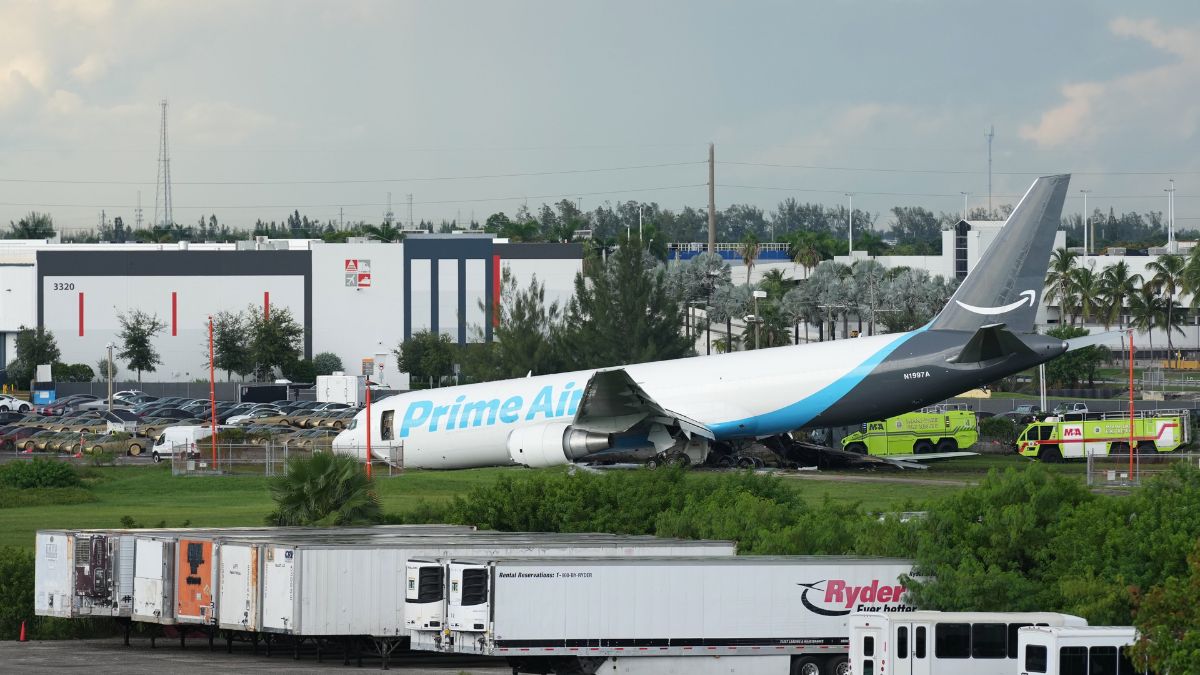
Planes don't usually end up crossing perimeter roads and smashing into civilian vehicles at major international hubs. Yet that is precisely what happened when an Amazon-branded cargo flight went sideways at Miami International Airport.
The incident involved a 32-year-old Boeing 767-300 freighter operating as 21 Air Flight 7598. Arriving from San Juan, Puerto Rico, the aircraft barreled past the end of the runway, plowed through the airport's razor-wire fence, crossed an adjacent road, and burst into flames. Five people lost their lives, leaving emergency responders scrambling to deal with a multi-agency catastrophe.
When video footage surfaced showing the plane's late touchdown, internet commentators immediately pointed fingers at the flight crew. Aviation mechanics, retired pilots, and armchair experts flooded social platforms with hot takes. But real accident investigation isn't a social media poll.
The Reality of Floating Down the Runway
Footage circulating online reveals a critical detail about the final moments of Flight 7598. Former Department of Transportation Inspector General and pilot Mary Schiavo noted that the aircraft appeared to float down the runway for an extended duration without initiating a proper flare.
Instead of planting the main landing gear firmly in the designated touchdown zone—typically the first 3,000 feet of the strip—the jet kept flying horizontally, eating up valuable stopping distance.
Why did it float? Every pilot knows the dangers of a floating aircraft. Ground effect can trap a cushion of air beneath the wings, causing a heavy plane to refuse to settle. When you burn through thousands of feet of usable runway trying to force a gentle landing, you dramatically shrink your margin for error.
Yet blaming the pilots entirely ignores the systemic variables at play.
Weather and Mechanical Factors
Severe weather was active in the area when the Boeing 767 made its final approach. National Weather Service data logged thunderstorms and wind gusts reaching up to 30 mph around Miami International Airport during that window.
A sudden wind shear or crosswind can alter an aircraft's energy state instantly. If a microburst pushes a plane down or causes a sudden airspeed fluctuation, the cockpit crew faces a split-second dilemma. Do they force a substandard landing onto a shrinking strip of concrete, or do they execute a go-around?
Executing a go-around sounds simple on paper. In practice, spooling up heavy engines on a wet, contaminated runway while wrestling a crosswind requires absolute precision. We don't yet have the black box data to confirm whether mechanical thrust reversers failed, whether braking systems suffered hydraulic issues, or how hydroplaning factored into the equation.
The Danger Zones Beyond the Tarmac
A runway overrun is terrifying, but it rarely becomes fatal on its own. Modern airports utilize Engineered Materials Arresting Systems (EMAS)—beds of crushable concrete designed to swallow the momentum of a runaway jet and bring it safely to a halt.
Miami International, like many older urban hubs, features perimeter roads running extremely close to the asphalt edge. When an aircraft leaves the concrete boundary entirely and hits a public road, the physics change instantly. The plane didn't just stop in a safety zone; it struck civilian vehicles, transforming an aviation mishap into a deadly ground tragedy.
The National Transportation Safety Board, led by Chairwoman Jennifer Homendy, deployed an investigative team to unearth the exact sequence of events. They will pore over flight data recorders, cockpit voice communications, maintenance logs for the 32-year-old airframe, and air traffic control transcripts.
Until those official readouts land, avoid buying into simplistic narratives. Aviation disasters are rarely caused by a single mistake. They are almost always the result of a brutal chain reaction where weather, mechanics, human choices, and airport infrastructure all collide at the worst possible second.


