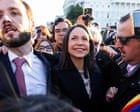
"I am here. With you."
Four words posted on X on October 25, 2026. That's all it took for María Corina Machado to blow up the carefully choreographed political truce in Caracas.
If you've only skimmed the headlines, you might think this is a simple victory lap. A Nobel Peace Prize laureate comes home after nearly eleven months in exile, hugs crying supporters inside a church in Barquisimeto, and marches toward the capital to claim her crown.
It isn't that simple. Not even close.
Machado didn't return to a liberated country. She walked straight into a high-stakes standoff between an interim regime led by Delcy Rodríguez, a Washington administration prioritizing oil and economic stability over immediate regime change, and millions of exhausted Venezuelans who want elections yesterday. Understanding what happens next requires looking past the celebratory crowd photos in Lara state and examining the messy power dynamics on the ground.
Why María Corina Machado Returned to Venezuela Now
Timing in politics isn't accidental. Machado spent almost a year outside Venezuela after fleeing in late 2025 to accept the Nobel Peace Prize—a departure that followed months in hiding and a brief detention after January 2025 protests. For months, her absence created an awkward vacuum.
Then came January 2026. U.S. forces captured and removed Nicolás Maduro from power, fundamentally altering the board. Many observers expected Washington to hand the keys directly to Machado and Edmundo González, whose coalition widely proved it won the disputed 2024 presidential election. Instead, Delcy Rodríguez stepped into the role of acting president, striking pragmatic arrangements with the Trump administration while replacing top military commanders in March 2026.
Machado tried to get back in multiple times. Her team reported seven thwarted attempts—including an effort after the devastating June 24 double earthquakes and another plan involving a flight to Curaçao that was blocked when landing permits vanished. Every week she stayed abroad, she risked becoming an outside commentator rather than the center of gravity inside Venezuela.
By late October, the calculus shifted. U.S.-backed reconciliation talks between the interim government and opposition representatives had begun in July, yet no firm presidential election date existed. Flying from Panama to Colombia and crossing into Venezuela by land, Machado forced herself back into the physical room. You can't negotiate a country's democratic transition while sidelining the person polling at 61% favorability.
The Awkward Triangle Between Caracas, Washington, and the Opposition
Most coverage treats Venezuela's current moment as a two-sided battle between Chavismo and the opposition. In reality, three distinct agendas are colliding at once.
Delcy Rodríguez's Balancing Act
Acting President Delcy Rodríguez wants legitimacy without surrendering control. When Machado reappeared at the Sanctuary of the Divine Shepherdess in Barquisimeto, Rodríguez dismissed the homecoming as a "show" and insisted she was indifferent to how Machado entered the country. Behind that cool exterior lies a real dilemma. Rodríguez has promised to overhaul the National Electoral Council and eventually hold elections, yet she refuses to lock in a calendar date. She's also demanded "repentance" from opposition figures who backed international sanctions, signaling that her administration still views Machado's movement as an adversary rather than an equal partner.
Washington's Pragmatic Pivot
If you're looking for ideological consistency from the White House, stop looking. After Maduro's capture, U.S. officials focused heavily on economic stabilization, energy deals, and curbing regional migration. When reporters asked President Donald Trump about Machado's return on October 25, his response was telling. He said he didn't know anything about it, called her "a very nice woman" because she had given him her Nobel Prize, and added, "we're doing very well in Venezuela."
Secretary of State Marco Rubio offered a sharper diplomatic framing, noting that Machado's return stemmed from U.S.-supported reconciliation talks and calling those negotiations Venezuela's best shot in thirty years at an enduring democracy. Still, the contrast is obvious. Washington wants stability and cooperative oil agreements first, while Machado wants an immediate electoral timetable.
Machado's Street Power
Machado holds the one asset neither Rodríguez nor Washington can manufacture—authentic domestic mass support. An AtlasIntel survey for Bloomberg News in late October 2026 found that 52% of Venezuelans would vote for Machado in a hypothetical presidential race, compared to just 19% for Rodríguez. Within days of her return, the Unitary Platform opposition coalition formally ratified her as its presidential candidate and designated her "the leader of the process."
She's also played her hand smarter than critics expected. Rather than boycotting the U.S.-backed dialogue, Machado announced she is ready to meet directly with Rodríguez—provided there's a concrete agenda. That move puts the burden squarely on the interim government. If Rodríguez refuses to sit down, she looks like the obstacle to peace.
What Life Actually Looks Like on the Ground Right Now
It's easy to get swept up in political speeches while missing the daily reality facing ordinary Venezuelans. Anyone who has tracked Venezuela's economy over the past decade knows that macro headlines rarely match what happens at the corner grocery store.
Walk through cities like Barquisimeto or Caracas today and you'll see a strange contradiction. New car dealerships selling Chinese, Japanese, and European vehicles have popped up on corners that felt deserted a couple of years ago. Restaurants are open. Thousands of Venezuelans deported from abroad or exhausted by life as migrants are trickling back home, including exiled Machado aides like Magalli Meda.
Scratch beneath that surface, though, and the structural rot hasn't gone anywhere.
- Infrastructure is still broken. Frequent electricity blackouts and chronic water shortages continue to punish families and small business owners daily.
- Wages remain brutally disconnected from living costs. Venezuelans deported from the United States talk openly about earning $150 a day abroad versus needing an entire month of odd jobs in Maracay to make that same amount.
- Political prisoners haven't been freed. According to the Venezuelan human rights group Foro Penal, more than 300 political prisoners remain behind bars in November 2026.
That last point explains why Machado made a high-profile stop outside a Venezuelan prison shortly after returning, demanding freedom for every detainee, justice for victims, and reparations for families. For families like that of Yanire Calderón—whose brother-in-law has spent over six years in prison on a 30-year sentence while needing cancer treatment—economic normalization without human rights accountability feels like an insult.
Three Misconceptions About Venezuela's Transition
When major geopolitical stories break, bad assumptions spread fast. Here's what people consistently get wrong about Machado's comeback.
Misconception 1: Maduro's removal meant Chavismo collapsed.
Removing one man doesn't dismantle a 25-year institutional apparatus. The military high command, the courts, and the electoral bureaucracy remain firmly in the hands of Chavista loyalists. Rodríguez spent early 2026 reshuffling top military brass specifically to consolidate her grip. Machado isn't stepping into a vacuum; she's operating inside a system still controlled by her opponents.
Misconception 2: The 2024 election results will simply be reinstated.
In an ideal world, Edmundo González would take the oath of office based on the 2024 tally sheets showing roughly 70% support. Realpolitik killed that path months ago. Neither Washington nor Caracas is working toward a retroactive inauguration. Instead, the emerging consensus revolves around overhauling the National Electoral Council, declaring a presidential vacancy, and triggering a fresh six-month election cycle—potentially putting a new vote on the calendar by mid-2027. Even González, still in exile, has framed Machado's return around leading this new process rather than demanding immediate installation.
Misconception 3: Machado's safety is guaranteed.
Because U.S. officials state she has the right to enter her country, many assume she's untouchable. Venezuelan exiles in South Florida and analysts in Washington worry about the exact opposite. Prominent opposition activists were still being detained hours after releases earlier in 2026. Operating openly in Venezuela without formal state protection exposes Machado to legal disqualifications, harassment, or worse if negotiations sour.
What to Watch Over the Coming Months
If you want to know whether Venezuela's transition is real or just another stalled negotiation cycle, ignore the press conferences and track four concrete benchmarks between now and early 2027:
- The National Electoral Council (CNE) overhaul. Watch who gets appointed to the revamped electoral board. If independent observers and opposition nominees get real representation, mid-2027 elections become plausible. If loyalists dominate the board again, the timeline is a stall tactic.
- Foro Penal's prisoner count. Real political openings in Venezuela always show up in prison release logs before anywhere else. Track whether the number of roughly 300 political detainees drops meaningfully without revolving-door rearrests.
- Lifting Machado's political ban. Being ratified by her coalition means little unless the courts and electoral authorities officially clear her to appear on a presidential ballot.
- Edmundo González's return. González promised he would join Machado on Venezuelan soil "very soon." If he lands in Caracas without incident, it proves the security guarantees behind the reconciliation talks actually hold weight.
Follow verified reporting from independent outlets like El País, Associated Press, and human rights monitors like Foro Penal rather than relying on partisan social media rumors. Venezuela's next chapter won't be decided by a single dramatic homecoming, but by whether those four milestones actually materialize on the ground.