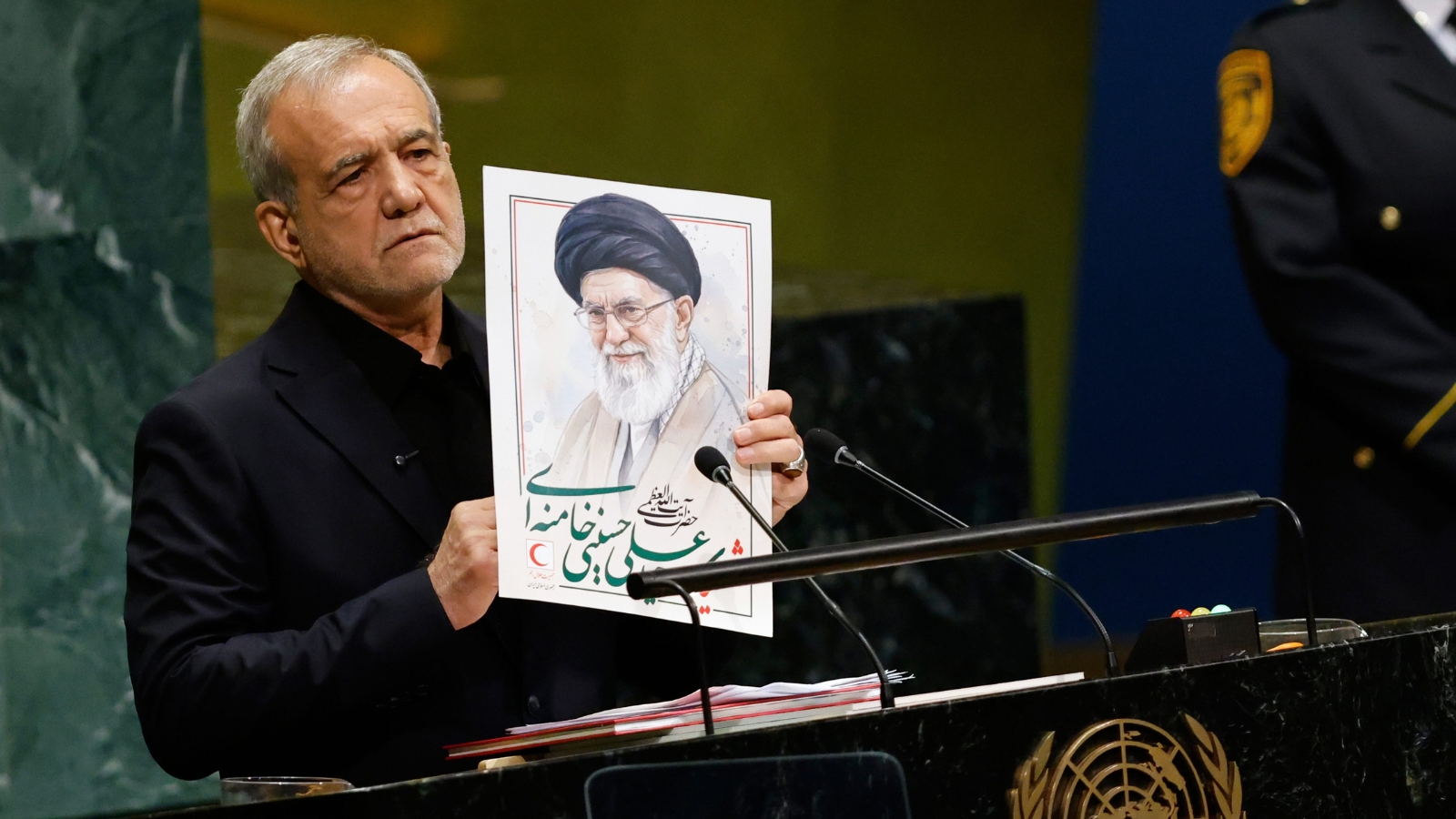
Diplomats at the United Nations General Assembly usually spend twenty minutes saying nothing at all. They hide behind polite abstractions, vague appeals to multilateralism, and carefully scrubbed talking points designed not to offend anyone in the room.
Then Iranian President Masoud Pezeshkian stepped up to the podium in New York, looked out at the hall, and dropped the diplomatic filter entirely.
He didn't use coded language. He didn't refer to "certain Western powers" or "previous administrations." Pezeshkian called out Donald Trump by name, accusing him of crippling Iran's economy, assassinating its top military commander, and expecting Tehran to simply roll over. His core message was blunt: "We did not bend the knee."
If you only caught the ten-second clip circulating on cable news, you probably saw it as just another round of predictable anti-American theater from Tehran. That's a mistake. Having followed Iranian foreign policy and UN diplomacy closely for years, I can tell you that Pezeshkian's speech wasn't just routine bluster—it was a calculated tightrope walk aimed at three completely different audiences at the exact same time.
Why Pezeshkian Named Trump Directly
Breaking the unwritten UN rule against naming sitting or former leaders directly is always intentional. You don't accidentally put a specific name into a translated General Assembly address that has been vetted by the Supreme National Security Council in Tehran.
Pezeshkian was elected in 2024 as a reformist-leaning heart surgeon who campaigned on fixing Iran's broken economy and easing international isolation. His domestic critics—specifically the hardline principlists who dominate Iran's parliament and judiciary—have spent his entire presidency waiting for him to look weak.
By naming Trump directly and declaring that Iran refused to "bend the knee," Pezeshkian bought himself political armor back home. He needed to prove to the Islamic Revolutionary Guard Corps (IRGC) and Supreme Leader Ali Khamenei that being open to talks doesn't mean surrendering.
Here's what he was actually referencing when he laid into Trump's record:
- The 2018 JCPOA withdrawal: Trump unilaterally pulled the United States out of the Joint Comprehensive Plan of Action—the 2015 nuclear deal—despite international inspectors confirming Iran was complying with its terms.
- The "maximum pressure" campaign: Reimposed sanctions choked off Iran's oil exports, tanked the rial, and drove domestic inflation above 40% for years on end.
- The assassination of Qasem Soleimani: The January 2020 drone strike in Baghdad that killed the head of the IRGC's Quds Force remains an open wound in Tehran's security establishment.
Pezeshkian wasn't just dredging up old grievances for the sake of drama. He was establishing a baseline: any future negotiation with Washington has to account for the fact that the U.S. broke the last deal first.
The Audience Nobody Talks About
Most Western coverage framed Pezeshkian's remarks as an attack on American politics. Honestly, Washington was only half the target.
The real audience sat in the domestic living rooms of Tehran, Isfahan, and Mashhad, alongside the hardline factions watching his every syllable from the Majlis.
In Iranian politics, a president doesn't control nuclear policy or regional military strategy. Those files sit squarely with Supreme Leader Khamenei. What a president does control is the public framing of Iran's diplomatic posture. If Pezeshkian goes to New York sounding too conciliatory, hardliners immediately accuse him of preparing a "second JCPOA" that will leave Iran vulnerable without guaranteeing sanctions relief.
So he used the language of defiance. "We did not bend the knee" translates cleanly into the revolutionary vocabulary that Khamenei's base expects to hear. Yet if you read the full transcript of his UN speech rather than just the viral soundbite, the tone shifts dramatically.
Right alongside the sharp critique of Trump, Pezeshkian explicitly stated that Iran is ready to engage with the parties to the 2015 nuclear deal. He emphasized that Iran isn't seeking nuclear weapons and wants constructive relations with its neighbors and the wider world.
That's the classic Tehran two-step. Talk tough on the podium to satisfy the hardliners at home, then quietly signal openness to negotiations in the hallways of Turtle Bay.
What the Viral Clip Left Out About Regional Escalation
Context matters enormously here. Pezeshkian wasn't speaking in a vacuum; he was standing at the UN podium while the Middle East sat on the brink of a wider regional war.
Israel's military campaigns in Gaza and Lebanon, paired with cross-border strikes involving Hezbollah and Houthi attacks in the Red Sea, had pushed tensions between Tehran and Washington to their highest point in decades. Earlier in 2024, Iran and Israel had traded direct missile and drone strikes for the first time in history.
Against that backdrop, Pezeshkian used his speech to accuse Israel of committing "genocide" in Gaza and dragging the region toward catastrophe, while blaming American backing for enabling it.
Critics of the Iranian government rightly point out the glaring contradiction in Pezeshkian's framing. Tehran presents itself at the UN as a victim of foreign aggression and economic warfare, while simultaneously funding, arming, and coordinating the "Axis of Resistance"—Hezbollah in Lebanon, Hamas in Gaza, the Houthis in Yemen, and various militias in Iraq and Syria.
You can't analyze this speech honestly without acknowledging both sides of that ledger. Yes, U.S. sanctions inflicted severe hardship on ordinary Iranian civilians who had nothing to do with their government's foreign policy. And yes, Iran's regional proxy network has destabilized neighboring states and fueled deadly conflicts across the Levant. Both things are true at the same time.
How This Plays Into US Election Politics
Calling out Donald Trump by name at the United Nations also injected Tehran directly into the bloodstream of American campaign coverage.
Was Pezeshkian trying to influence U.S. voters? Probably not directly—Iranian officials are smart enough to know that an endorsement or an attack from Tehran rarely moves American swing voters in the way outsiders assume.
What they do care about is setting terms before a new administration takes office. Iranian diplomats remember how chaotic the 2017–2021 period was, when they struggled to read Washington's red lines. By calling Trump out publicly while signaling willingness to talk to the Biden-Harris administration or European partners, Pezeshkian tried to draw a sharp contrast between diplomacy and confrontation.
Of course, Trump's camp immediately seized on the remarks as proof that his "maximum pressure" policy had Tehran rattled and on the defensive. In political messaging, a single quote can serve two completely opposite narratives. Tehran hears heroic resistance; Mar-a-Lago hears proof that sanctions worked.
What Actually Happens Next With US-Iran Diplomacy
Strip away the rhetoric, and you're left with a hard geopolitical reality. Neither Washington nor Tehran wants a full-scale direct war, yet neither side has found a credible off-ramp.
Iran's nuclear program is vastly more advanced today than it was when Trump left the JCPOA in 2018. According to International Atomic Energy Agency (IAEA) assessments, Tehran has enriched uranium up to 60% purity—just a short technical step away from weapons-grade 90%—and operates thousands of advanced centrifuges that weren't running a few years ago.
That changes the math completely. You can't simply copy-paste the 2015 nuclear deal back into existence because the technical reality on the ground has moved past it.
If you want to track where this goes from here without getting distracted by UN podium theatrics, watch three concrete indicators over the coming months:
- IAEA inspector access: Rhetoric in New York means nothing if Tehran continues restricting UN nuclear monitors from verifying centrifuge production and enriched uranium stockpiles.
- Omani and Qatari backchannels: Real U.S.-Iran diplomacy never happens at the General Assembly. It happens quietly in Muscat and Doha through intermediary diplomats passing written messages.
- Iran's domestic economic pressure: With inflation stubbornly high and energy infrastructure straining under sanctions, Pezeshkian's political survival depends on delivering tangible economic relief—something he simply cannot achieve without easing Western sanctions.
Pezeshkian got his headline by telling the world Iran didn't bend the knee. Now comes the harder part for his government: figuring out how to get off its economic knees without crossing the Supreme Leader's red lines.


