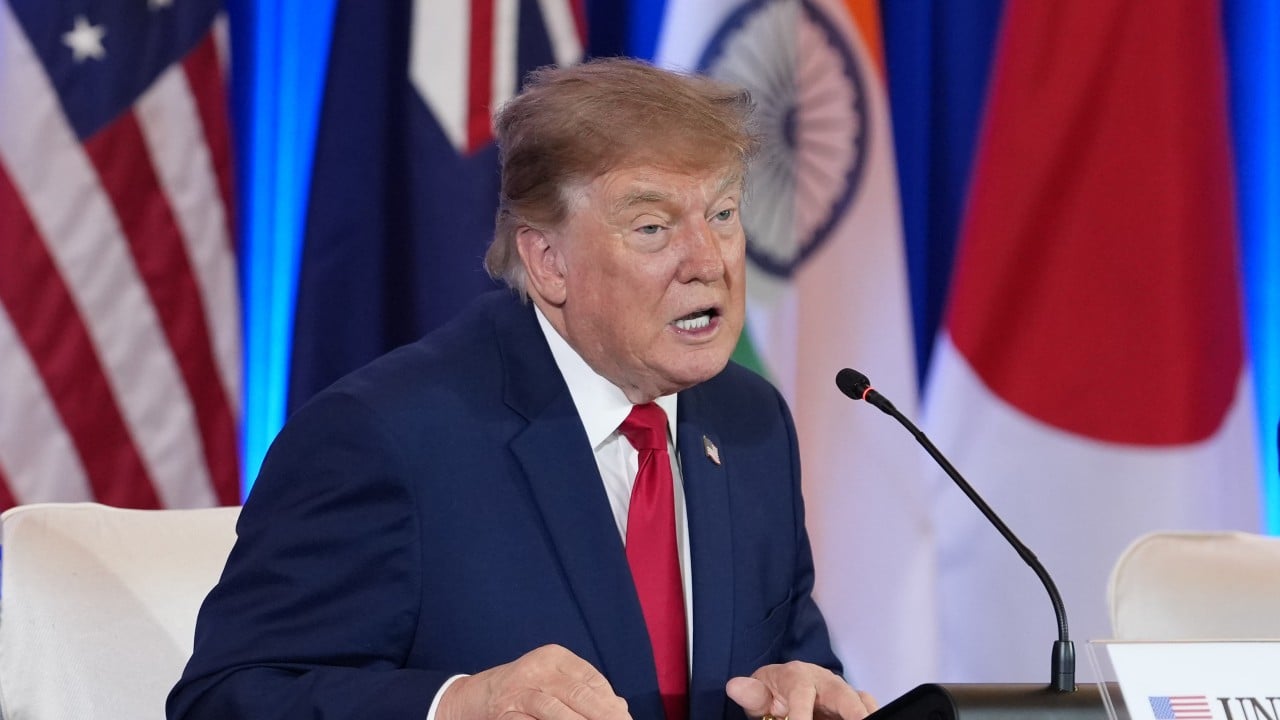
Most headlines about the November 17, 2026, Quad Leaders' Summit in Manila focused on two flashy numbers. An $85 million "super intelligence" pact and a brand-new set of joint maritime drills.
If you only skimmed the breaking news alerts, you probably walked away thinking the United States, Australia, India, and Japan just built a massive AI lab and launched a new naval armada. Neither of those things happened. The reality behind Donald Trump's Manila announcements is far more calculated, slightly bureaucratic, and way more interesting than the soundbites suggest.
Why "Super Intelligence" Is Actually a Regulatory Quirky Footnote
Let's clear up the biggest misconception right away. When President Trump stood alongside Australian Prime Minister Anthony Albanese, Indian Prime Minister Narendra Modi, and Japanese Prime Minister Sanae Takaichi in Manila and announced more than $85 million for the Quad Super Intelligence Accelerator, he wasn't talking about building sentient machines or artificial general intelligence.
He was talking about regular artificial intelligence.
Look closely at the official White House joint press release from November 17, 2026. There's an asterisk right next to the phrase "Super Intelligence." The footnote explicitly clarifies that in Australia, India, and Japan, "Super Intelligence" simply means "artificial intelligence." In fact, India's Ministry of External Affairs and Australia's Department of the Prime Minister and Cabinet published their versions of the joint statement using the standard term "AI Accelerator."
Why did the U.S. government insist on the sci-fi branding? It goes back to Executive Order 14434, signed by Trump on September 29, 2026, which officially rebranded federal AI policy terminology to "Super Intelligence" (or SI).
Understanding that distinction changes how you view the $85 million price tag. In the private sector, $85 million barely covers a single frontier model training run or a handful of top-tier engineering salaries in Silicon Valley. For a government-backed multilateral accelerator, though, it's targeted seed money. The funds—originally hashed out by Quad foreign ministers including U.S. Secretary of State Marco Rubio in Atlanta on October 31, 2026—aren't meant to outspend OpenAI or Google. They're designed to subsidize trusted AI deployment, technical assistance, and secure computing ecosystems across developing Indo-Pacific nations so those countries don't rely on subsidized Chinese tech stacks.
What the New Quad Maritime Drills Actually Look Like
The second big headline out of Manila was the launch of the Indo-Pacific Maritime Surveillance Collaboration. Some commentators immediately framed this as an Asian NATO flexing muscle in the South China Sea. That's a stretch.
Here's what the four nations actually agreed to do. Starting in early 2027, maritime patrol aircraft from all four countries—specifically P-8 Poseidon and P-3C Orion surveillance planes—will fly together in a coordinated exercise for the very first time under the Quad banner.
Notice what's missing from that announcement. Aircraft carriers. Amphibious assault ships. Live-fire destroyer drills.
Instead of heavy kinetic warships, the Quad is pooling eyes in the sky. P-8s and P-3Cs are submarine hunters and ocean-tracking workhorses packed with radar, acoustic sensors, and electronic surveillance gear. By linking their flight data and sensor feeds, Washington, Canberra, New Delhi, and Tokyo are building a shared, real-time picture of who is moving through Indo-Pacific shipping lanes.
This matters for two practical reasons:
- Gray-zone tracking: It makes it much harder for foreign fishing militias, unflagged vessels, or covert survey ships to operate undetected in exclusive economic zones.
- Political palatability: India has historically resisted turning the Quad into a formal military alliance, preferring to maintain strategic autonomy. Framing the 2027 drills around maritime domain awareness and surveillance aircraft lets New Delhi participate fully without crossing its own diplomatic red lines.
As Trump put it during the summit, the goal is "keeping the peace through our strength," while Prime Minister Albanese emphasized that what these four democracies represent together is greater than the sum of their individual parts. Ten years after the late Japanese Prime Minister Shinzo Abe first articulated the vision of a free and open Indo-Pacific in 2016, the Quad is finally wiring its surveillance networks together.
The Quiet Infrastructure Plays Nobody Talked About
Because AI buzzwords and military aircraft grab eyeballs, almost everyone glossed over the other two pillars unveiled in Manila. Frankly, these might have a bigger day-to-day impact on the region than the $85 million tech fund.
First, there's the Quad Business Leaders' Forum, scheduled to hold its inaugural meeting in the United States in early 2027. For years, critics argued the Quad was all diplomatic talk and zero commercial muscle. Bringing private-sector executives directly into the summit architecture—alongside fresh agreements on critical minerals and rare earth supply chains—targets China's biggest economic weapon. When one country controls the processing of critical minerals, diplomatic statements mean very little. Giving Western and Indo-Pacific companies a formal deal-making table changes the commercial math.
Second, the leaders expanded the Quad Partnership for Cable Connectivity and Resilience alongside a new Quad Cybersecurity Cooperation framework. Australia is expanding its Cable Connectivity and Resilience Centre to focus specifically on undersea electricity cables, complementing new undersea fiber-optic cable projects planned for the Indian Ocean.
Think about how vulnerable modern economies are. Over 95% of international data travels through undersea cables, and regional power grids are increasingly linked across borders. Protecting those physical pipes on the ocean floor while sharing threat intelligence to stop cyberattacks on critical infrastructure isn't glamorous work. You won't see dramatic photo ops of undersea cable repair ships. Yet without secure cables and rare earth supply chains, "super intelligence" initiatives are just empty press releases.
Why the Manila Timing Matters After a Two-Year Gap
To appreciate why these deals happened now, you have to look at the calendar. Before November 17, 2026, Quad leaders hadn't held an in-person summit since September 21, 2024, in Wilmington, Delaware. During that two-year gap, leadership changed in both Washington and Tokyo, with Trump returning to the White House and Sanae Takaichi taking office as Japan's Prime Minister.
Many foreign policy watchers wondered whether Trump's transactional approach to alliances would sideline multilateral groups like the Quad in favor of strictly bilateral deals. Manila answered that question. By hosting the summit on the sidelines of wider regional meetings and reaffirming unwavering support for ASEAN centrality, the administration signaled that the Quad remains its primary diplomatic vehicle in the Indo-Pacific—provided it delivers tangible security and commercial returns.
How to Track What Happens Next
Political summits are famous for big promises that quietly stall in committee rooms. If you're watching Indo-Pacific geopolitics, tech policy, or defense markets, don't judge the Manila summit by the speeches. Watch three specific milestones over the next six months:
- The early 2027 P-8 and P-3C flight schedules: Look for official defense ministry readouts confirming when and where the first joint Quad maritime patrol exercise takes place, and whether Southeast Asian observers are invited to share the surveillance data.
- Grant disbursements from the $85M Accelerator: Watch which regional startups, telecom operators, or government agencies in Southeast Asia and the Pacific Islands actually receive funding from the Quad Super Intelligence Accelerator, and whether U.S. cloud providers dominate those contracts.
- The inaugural Quad Business Leaders' Forum agenda: Check the attendee list when the forum convenes in the U.S. in early 2027—specifically looking for rare earth mining firms, semiconductor suppliers, and undersea cable contractors signing binding commercial agreements rather than non-binding memorandums of understanding.