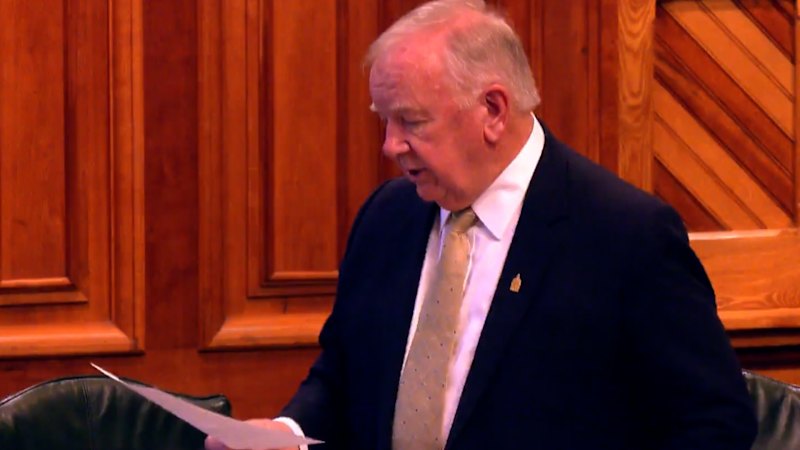
It was supposed to be a routine legislative session. Instead, New Brunswick politician Bill Oliver managed to write a masterclass in how not to use modern tech. Standing up to deliver remarks on a proposed energy advocate position, Oliver read lines straight off a page that had clearly been generated by a chatbot. Not just any lines, mind you—he accidentally read the chatbot's meta-instructions out loud to the room.
"Here's a more natural flowing version of that section..." he stated, entirely unfazed, before later tossing in another prompt artifact about how a section was roughly structured. The internet did what the internet does best. The clip went viral instantly, jumping from Reddit to international news outlets, turning a quiet provincial debate into global meme material. If you found value in this piece, you might want to read: this related article.
While it is easy to laugh at the sheer absurdity of reading prompt text out loud into a live microphone, this blunder highlights a much larger, uncomfortable truth about modern governance. Politicians are leaning heavily on automated tools to do the heavy lifting of thinking, writing, and policy drafting. And frankly, they are getting sloppy.
Why Politicians Are Hooked on Shortcuts
Let us be honest about why this happens. Lawmakers face immense pressure. They have endless paperwork, tight deadlines, constituent emails, committee meetings, and endless speeches to prepare. Time is the ultimate bottleneck. For another look on this development, see the recent update from MIT Technology Review.
Turning to a language model to draft a 40-minute address sounds like efficient time management on paper. Why spend three hours agonizing over phrasing when an algorithm can spit out structured paragraphs in three seconds?
The temptation is obvious. But the execution is frequently disastrous. When you outsource your voice to an algorithm, you lose the authenticity that voters supposedly care about. Worse, you stop engaging with the material yourself. If Oliver had actually read and edited his own notes before stepping up to the podium, those conversational AI breadcrumbs would have been caught immediately. Instead, the copy-paste workflow took the wheel.
The Real Cost of Lazy Tech Adoption
Critics were quick to jump on the incident, and for good reason. Green MLA Megan Mitton pointed out the obvious: taxpayers do not elect people to have artificial intelligence write long-winded legislative speeches.
Beyond the embarrassment factor, relying blindly on AI creates tangible legislative bottlenecks. Lengthy, generic, machine-written text clogs up the system. It drags out debates with fluff instead of sharp, focused arguments. When politicians prioritize word count over genuine substance, actual governance grinds to a crawl.
There is also the deeper issue of accountability. A speech in a legislature is supposed to reflect the deeply held convictions and arguments of an elected representative. If the words belong to a server farm in another state, who is actually speaking? When policies are built on automated generalizations, the public gets short-changed.
Where the Boundaries Should Be
Nobody is arguing that politicians should write everything on a manual typewriter. Staffers use templates, researchers pull data, and speechwriters have always existed. But there is a massive gulf between human collaboration and complete cognitive outsourcing.
Speechwriters have editorial judgment. They understand local context, political nuance, and human speech patterns. Large language models just predict the next likely token based on probabilistic averages. They write in corporate-speak or bureaucratic filler unless they are heavily restrained and edited.
When you treat a chatbot like an autonomous ghostwriter rather than a glorified spellchecker, you invite disaster. Oliver later admitted that it was a learning experience, noting that AI should never replace personal conviction. True enough. But the fact that it happened at all shows a profound lack of basic editorial hygiene.
If public figures want to keep using these tools, they need to adopt basic safeguards. Read what you sign. Edit what you print. And for goodness' sake, look up from the page long enough to realize when the computer is talking to you instead of through you.
Take control of your workflow, check your drafts before they go public, and never let an algorithm do your thinking for you.
Moment Canadian politician accidentally reads AI prompt during speech
This short clip captures the exact moment the New Brunswick politician accidentally reads the AI prompt aloud on the legislative floor.