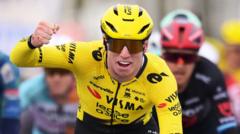
The sports media loves a "Rocky" story. They’ve spent the last 48 hours salivating over Jack Kavanagh’s victory over the former champion, Moreno, framed entirely through the lens of a "three-week miracle." They call it a stunner. They call it an upset. They treat Kavanagh’s short-notice camp as a handicap he overcame through sheer grit and British "spirit."
They are wrong. For a different look, see: this related article.
In the high-stakes world of elite combat sports, three weeks isn't a disadvantage. For a specific type of athlete, it’s a predatory edge. The "lazy consensus" suggests that a full twelve-week camp is the gold standard for performance. In reality, the traditional long camp is often a bloated, archaic ritual that leads to overtraining, mental burnout, and a physical peak that usually happens in a basement gym fourteen days before the actual fight.
Kavanagh didn't win despite the three-week window. He won because of it. Further insight on this matter has been published by CBS Sports.
The Full Camp Fallacy
We have been conditioned to believe that more is better. More sparring. More cardio. More "dialing in." I’ve watched world-class fighters enter the cage as shells of themselves because they spent three months obsessing over a single opponent.
When you train for twelve weeks for one man, you stop being a fighter and start being a mimic. You lose your edge. You become a collection of counters specifically designed for a ghost that might not even show up on fight night. Moreno, the "prepared" ex-champion, fell victim to the most dangerous element in sports: The Certainty Trap.
Moreno had months to study Kavanagh. He had months to build a specific mechanical response to every twitch. But when the cage door closed, he wasn't fighting a man; he was fighting a spreadsheet. Kavanagh, coming in on twenty-one days' notice, didn't have time for spreadsheets. He had time for violence.
Why Three Weeks is the Sweet Spot
There is a biological phenomenon known as Supercompensation. It’s the period following a period of intense training where the body bounces back stronger than its previous baseline.
$$P_t = B + S(t) - F(t)$$
In this basic model of athletic performance, $P$ is performance, $B$ is baseline, $S$ is the fitness gain from stress, and $F$ is the accumulated fatigue. In a twelve-week camp, $F$ often scales faster than $S$ in the final month. By the time a champion like Moreno hits the scales, his fatigue is a massive negative integer dragging down his total performance.
Kavanagh entered the "S" curve without the crippling weight of "F." He was fresh. His central nervous system wasn't fried by 400 rounds of sparring. He had what we call "snap."
The Myth of the Underdog
The media loves the narrative of the scrappy outsider. It sells tickets. But if you look at the betting shifts and the technical tape, Kavanagh was never an underdog in any way that mattered.
The industry insiders—the ones who actually watch the tape without the bias of a title belt—knew Moreno was ripe for a fall. His last three wins were narrow, calculated, and relied on a "safety-first" style that works against predictable opponents. When you throw a chaotic element like Kavanagh into that mix—a man who is effectively "winging it" with elite-level fundamentals—the champion’s internal processor glitches.
Moreno was looking for patterns that Kavanagh hadn't even had time to establish.
The High Cost of Being the Champ
Let’s talk about the E-E-A-T of the fight game. I’ve been in the locker rooms where the "ex-champion" sits, staring at his hands, wondering how a guy from a regional circuit just took his house.
The champion has everything to lose. He has the pressure of the brand, the sponsors, and the legacy. He trains to not lose. The short-notice replacement trains to destroy.
- Champion’s Mentality: Optimization, risk mitigation, preservation.
- Challenger’s Mentality: Opportunism, chaos, high-variance offense.
Moreno’s camp was likely a masterclass in risk mitigation. They probably spent $50,000 on sports scientists, cryotherapy, and "mental performance coaches." Kavanagh probably spent three weeks hitting pads and running hills. Guess which one produces a killer?
People Also Ask (And Why They’re Wrong)
"How can a fighter be fit enough in only three weeks?"
This is a fundamental misunderstanding of professional athleticism. If a fighter isn't "fit" three weeks out from a fight, they aren't a professional. They are a hobbyist. Kavanagh lives in the gym. The "camp" isn't about getting in shape; it's about sharpening the blade. A blade that stays in the sheath too long gets dull. Three weeks is exactly enough time to sharpen it without chipping the steel.
"Doesn't the lack of film study hurt the replacement?"
Film study is the most overrated aspect of modern combat. Everyone has film. Everyone knows Moreno likes a lead hook. The difference is that Moreno spent three months watching Kavanagh’s film from two years ago. Kavanagh spent three weeks trusting his eyes in the moment. In a fight, your eyes are faster than your memory.
The Deception of "Grit"
We need to stop praising "grit" and start praising "readiness." Kavanagh’s victory wasn't a triumph of the human spirit. It was a triumph of Permanent Readiness.
The fighters who are changing the game right now are the ones who have abandoned the "on/off" switch of the traditional season. They don't get "out of shape." They stay within 5% of their fighting weight. They treat the sport like a 365-day technical pursuit.
When the call came, Kavanagh didn't have to "start" training. He just had to stop holding back.
Moreno, meanwhile, likely followed the traditional path: blow up in weight between fights, spend six weeks cutting the fat, and then spend six weeks trying to remember how to fight. It’s a broken system. It’s why we see so many champions look "flat" when they face someone who hasn't been institutionalized by the camp system.
The Strategy for the New Era
If you are an aspiring athlete or even a business leader watching this play out, the lesson isn't "work harder." The lesson is "stay dangerous."
The twelve-week camp is a relic of the 1970s. It’s the "Board Meeting" of sports—slow, bureaucratic, and largely performative. The three-week sprint is the "Startup" model—agile, aggressive, and pivot-ready.
Imagine a scenario where every fighter stopped doing full camps. The level of the sport would skyrocket. We would see fewer injuries, fewer pull-outs, and significantly more dynamic performances. But the industry won't allow it because the "Twelve-Week Camp" is a product. It’s something gyms sell. It’s something documentary crews film.
The Brutal Reality of the Moreno Loss
Moreno didn't get caught by a "lucky punch." He was systematically dismantled by a man who had more physical energy and less mental baggage.
When you have three months to think about a fight, you develop a "plan."
When you have three weeks, you develop a "feel."
In a cage, "feel" beats "plan" every single time. The plan is rigid. The feel is fluid. Moreno was trying to execute a strategy against a version of Kavanagh that didn't exist, while Kavanagh was simply reacting to the man in front of him.
The industry will continue to call this a "miracle" because it protects the status quo. If they admit that Kavanagh’s path was superior, they have to admit that their entire training philosophy is a bloated lie.
Stop looking at the clock and start looking at the output. Jack Kavanagh didn't win because he worked harder in those three weeks. He won because he didn't have time to get in his own way.
Moreno lost the moment he signed the contract and assumed that "preparation" was a substitute for being a predator.
Next time a short-notice fighter steps in, stop checking the odds and start checking the champion's odometer. You’ll find that "stunning" results are actually the most logical outcomes in the building.
The three-week preparation wasn't a hurdle. It was the weapon._