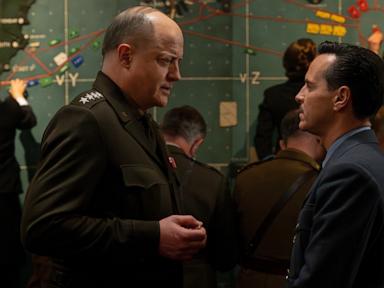
We've all seen the blood-soaked sands of Omaha Beach on film. Cinema has spent decades conditioning us to believe that World War II was won entirely by teenage boys with rifles and stoic generals staring at maps. But Anthony Maras's new historical drama, Pressure, pivots away from the front lines to look at something much more terrifying.
A bad weather forecast.
The film focuses on the 72 hours leading up to June 5, 1944—the original date set for D-Day. It centers on Dr. James Stagg, a Scottish meteorologist tasked with telling General Dwight D. Eisenhower that the most massive seaborne invasion in human history is about to sail directly into a catastrophic Atlantic storm.
Andrew Scott plays Stagg, and honestly, he's the best part of the movie. Instead of his signature charm, Scott locks himself into a performance defined by a rigid, dour chill. He has to look a room full of military icons in the eye and tell them their plan is absolute garbage.
The War Between Historical Data and Real-Time Reality
The core conflict of Pressure isn't between the Allies and the Germans. It's a bitter ideological war between two weathermen with completely different methodologies.
Stagg collects raw, messy, real-time data from barometers and naval ships, tracking an unpredictable, volatile weather system moving across the Atlantic. His chief rival is Irving Krick, played with a wonderfully smug, boogie-woogie energy by Chris Messina. Krick is Eisenhower’s trusted guy. His method relies on historical analog techniques—essentially looking at decades of past weather patterns to gamble on what should happen next.
Krick promises sunshine because the history books say June usually brings good weather. Stagg looks at the glass falling in his instrument room and sees a wall of rain and wind that will flip landing crafts and send thousands of soldiers straight to the bottom of the English Channel.
People who love procedural dramas will appreciate how the movie treats science like a high-stakes thriller. Stagg doesn't have a modern weather app. He doesn't have satellite imagery. He has a pencil, paper charts, and a telephone line to a few remote observation stations. The film does a great job showing how terrifying it is to hold the lives of 150,000 men in your hands when your only weapon is an atmospheric pressure reading.
Brendan Fraser and the Weight of Command
Brendan Fraser steps into the boots of General Dwight D. Eisenhower, and he plays him as a man completely crushed by the scale of his responsibility. This isn't a flawless, legendary hero carved out of marble. Fraser's Eisenhower is exhausted, stressed, and visibly haunted by past military disasters like Operation Tiger.
He's caught in a terrible vice. If he delays the invasion, the Allies risk losing the element of surprise, giving the Nazis time to reinforce the coast and potentially dragging out the war for years. If he pushes ahead into a storm, the invasion fails on day one.
Fraser brings a heavy, lumbering physicality to the role that contrasts perfectly with Scott's wire-taut anxiety. Watching them square off in the ornate rooms of Southwick House is where the movie shines. You have Damian Lewis leaning into a snide, blustering performance as General Bernard "Monty" Montgomery, barking at Stagg for lacking combat experience. Then you have Kerry Condon as Kay Summersby, Eisenhower's secretary, trying to act as the diplomatic buffer between massive egos.
The script, which Maras co-wrote with David Haig based on Haig's original stage play, captures the brutal isolation of being the only person speaking an unpleasant truth. In one of the best scenes in the film, Stagg drops all diplomatic filters and tells the assembled military brass that their current plan is "horsesh-t" because nature doesn't care about their strategic timelines.
Where the Film Loses Its Nerve
For its first two acts, Pressure functions as a tight, claustrophobic boardroom drama. Director Anthony Maras and cinematographer Jamie D. Ramsay make the smart choice to reject the trendy, desaturated grey palette that ruins most modern historical films. The rooms are richly saturated. The khaki and brown uniforms feel heavy, and Stagg stands out in a crisp, sharp blue dress shirt—a visual reminder that he is completely isolated from the military machine surrounding him.
But the film stumbles when it tries to become a traditional war movie.
In the final act, the narrative leaves the map rooms to show the actual Normandy landings. It's easy to see why the filmmakers felt the need to show the stakes, but the sequence inevitably falls flat. You can't compete with the opening twenty minutes of Saving Private Ryan. By attempting a lower-budget imitation of that visceral beach horror, Pressure betrays its own strengths. It abandons the unique, sweaty tension of the meteorology room for a standard montage of combat footage we've seen a hundred times before.
The movie also tries to force a ticking-clock personal crisis involving Stagg's pregnant wife back home. It's a cheap screenwriting trick meant to give him "vulnerability," but it feels entirely unnecessary. Knowing that a wrong forecast will cause the deaths of thousands of soldiers and lose the war against fascism is already enough narrative pressure. We don't need a melodramatic hospital subplot to understand that the guy is stressed.
The Real Lesson Behind History's Most Important Weather Report
Despite its structural flaws in the final stretch, Pressure succeeds because it values truth over performance. It shows that real leadership isn't about standing on a hill and yelling inspiring speeches. It's about sitting in a quiet room, listening to a difficult expert tell you news you absolutely hate, and having the courage to change your plans based on reality rather than wishful thinking.
If you're tired of historical movies that treat war like a predictable superhero story, Pressure is well worth your time. It is a sharp, stubborn, and mostly gripping look at the unglamorous paperwork and stressful math that actually decided the fate of the free world.
If you plan to watch it, pay close attention to how the film handles the transition from June 5 to June 6. Take a look at the real history of Group Captain James Stagg after the credits roll. His ability to spot a brief, narrow window of improved weather inside a massive storm system is the exact reason why the D-Day landings happened at all.