The Long Flight of the Red Delicious
Deep in the Yakima Valley of Washington State, Peter Miller looks at his trees. The branches bend under the weight of thousands of deep-red apples. For generations, his family knew exactly where those apples would go. They would be packed into crisp cardboard boxes, loaded onto container ships, and sent across the Pacific Ocean to Mumbai.
Then the spreadsheets changed. For an alternative view, consider: this related article.
Thousands of miles away, in a bustling wholesale market in New Delhi, a fruit vendor named Rajesh balances a wooden scale. He prefers American apples because his customers like the deep color and the crisp bite. But lately, the math does not work. A retaliatory tariff, born from political sparring over steel and aluminum, turned a simple piece of fruit into a luxury item.
This is not a story about global economics. It is a story about how decisions made in pristine, air-conditioned rooms in Washington and New Delhi ripple outward, altering the daily survival of ordinary people. Related insight on this matter has been published by The Motley Fool.
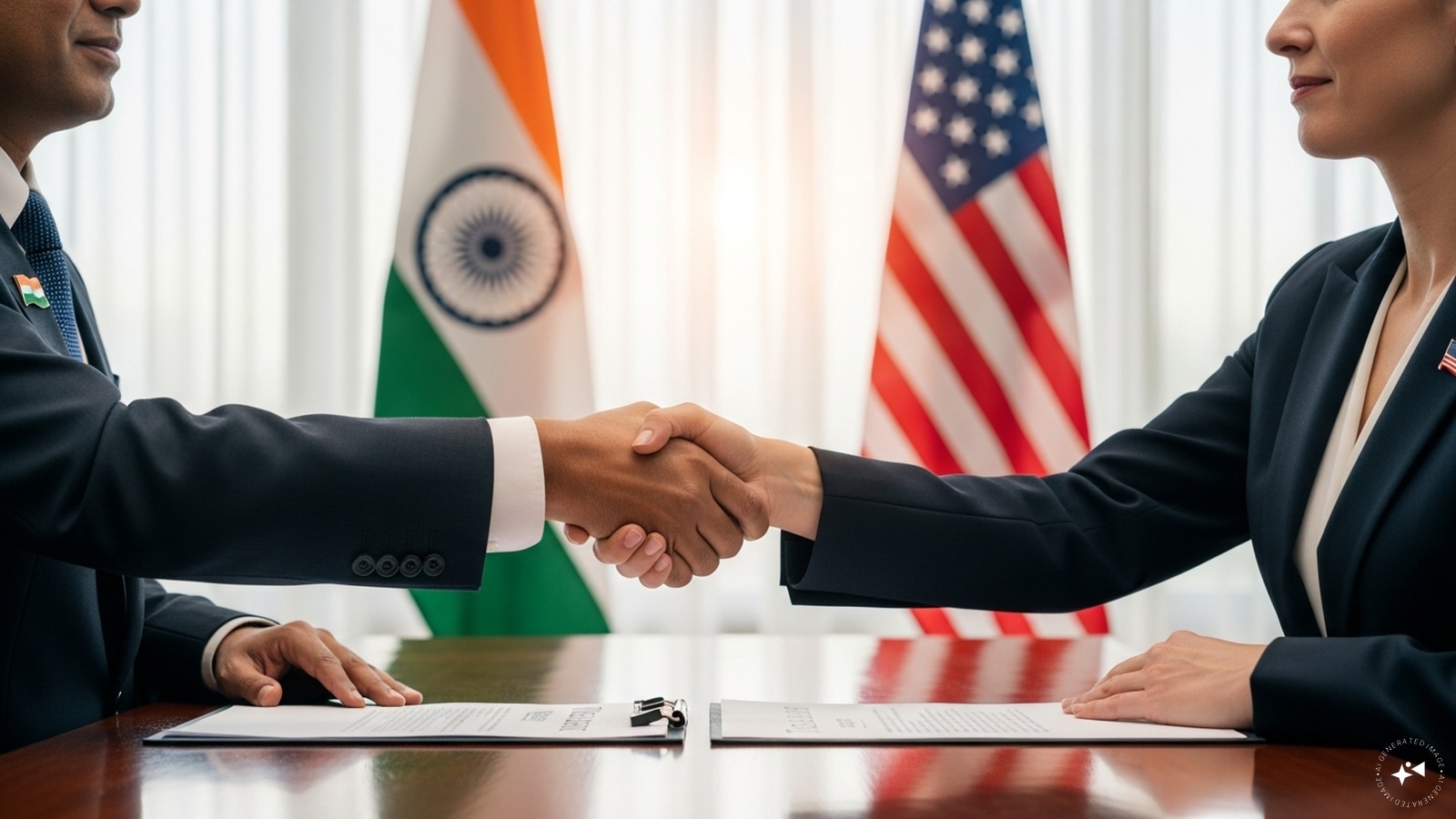
Right now, diplomats are huddled over thick stacks of paper, hammering out the final details of a sweeping trade agreement. The news tickers report it with dry, clinical language: "market access," "tariff rationalization," and "bilateral frameworks."
But look closer.
Between the lines of those dry reports lies a fierce struggle over who gets to sell what, who gets to work where, and how much a family pays for bread, medicine, and technology.
The Invisible Wall of the Percentage
Trade deals sound abstract until you realize they are fought over decimals. Consider a hypothetical medical device manufacturer in Minnesota. They make a highly specialized pacemaker that could save lives in rural India. But when that pacemaker hits the Indian port, it faces a wall of import duties and price caps meant to protect domestic manufacturers.
The Minnesota factory owner sees a barrier. The Indian government sees a shield to protect its own young industries and keep healthcare affordable for millions of low-income citizens.
Both sides have a point. That is what makes these negotiations so excruciatingly slow.
For years, the relationship between these two economic titans felt like an awkward dance. The United States wanted India to lower its notoriously high tariffs on everything from Harley-Davidson motorcycles to California almonds. India, meanwhile, wanted the return of its special trade status under the Generalized System of Preferences, a program that allowed billions of dollars of Indian goods to enter America duty-free until it was stripped away during a previous political administration.
When that status vanished, small-scale textile weavers in Surat and engineering firms in Chennai felt the chill immediately. Margins shrunk. Staff were let go.
Now, the pendulum is swinging back. The pressure to close the deal is immense, driven not just by economics, but by a shared geopolitical anxiety. Both nations know they need each other to balance the shifting weights of global power.
The Negotiation Table in the Mind
What does a trade negotiation actually look like? It is not a dramatic boardroom showdown from a movie. It is an exercise in profound exhaustion.
Imagine two teams sitting across from each other for fourteen hours. The coffee is stale. The air is dry. They are arguing over the definition of a specific type of dairy product. The U.S. wants India to open its massive dairy market. India refuses, pointing out that millions of its citizens rely on tiny, family-owned dairy cooperatives with just two or three cows. If cheap American milk floods the market, those families lose everything.
The American negotiator thinks of the dairy farmers in Wisconsin who are losing their farms to bankruptcy. The Indian negotiator thinks of the smallholder in Uttar Pradesh who uses dairy money to pay for her daughter’s schoolbooks.
Every concession is a wound to someone back home.
This tension explains why the talk of a "near-complete" deal has lingered in the air for months. It is easy to agree on ninety percent of the terms. The final ten percent is where the blood, sweat, and political capital live.
The Human Cost of a Visa
The debate extends far beyond physical cargo. The modern economy travels on laptops and in the minds of engineers.
In Bengaluru, a young software developer named Ananya waits for news. Her career trajectory hinges on the availability of H-1B visas, the documents that allow highly skilled foreign workers to live and work in the United States. For years, India has pushed for more predictable visa policies, arguing that its tech talent is the engine that keeps American Silicon Valley firms dominant.
American labor groups argue differently, claiming that large tech firms use these visas to bring in cheaper labor, suppressing domestic wages.
When the trade deal nears completion, Ananya reads the news with a pounding heart. To a bureaucrat, a visa quota is just a number on a ledger. To Ananya, it is the difference between building a life with her partner in California or watching her dreams stall out due to a bureaucratic lottery.
The Balance on the Scales
We often view trade as a zero-sum game, a match where one country wins and the other loses. The reality is far more fragile. It is an ecosystem of mutual dependence where a tremor in one corner creates an earthquake in another.
Consider what happens next: if the United States lowers its barriers on Indian steel, American steel mills face stiffer competition. But American construction companies get cheaper materials, allowing them to build more affordable housing. If India lowers its tariffs on Washington apples, Peter Miller can hire more workers in the Yakima Valley, and Rajesh can sell fresh, affordable fruit to families in New Delhi.
Every line item in a trade agreement is a trade-off between the consumer and the producer.
The negotiators are currently trying to find a delicate point of balance where both sides can return home and claim victory to their respective voters. They are dealing with a complex puzzle of agricultural access, electronic tariffs, intellectual property rights for life-saving drugs, and e-commerce regulations.
The text is almost ready. The ink is dry on the pens.
But as the final announcements loom, the real story remains far away from the press conferences and the flashing cameras of the international press. The true test of this massive geopolitical architecture will be written in the quiet places: in the ledger books of the Washington orchard, on the wooden scales of the Delhi fruit stall, and in the anxious wait of a young engineer looking at a visa portal.
Their lives are about to change because of a few signatures on a piece of parchment. They will likely never know the names of the diplomats who wrote the words, but they will feel the weight of their decisions every single day.