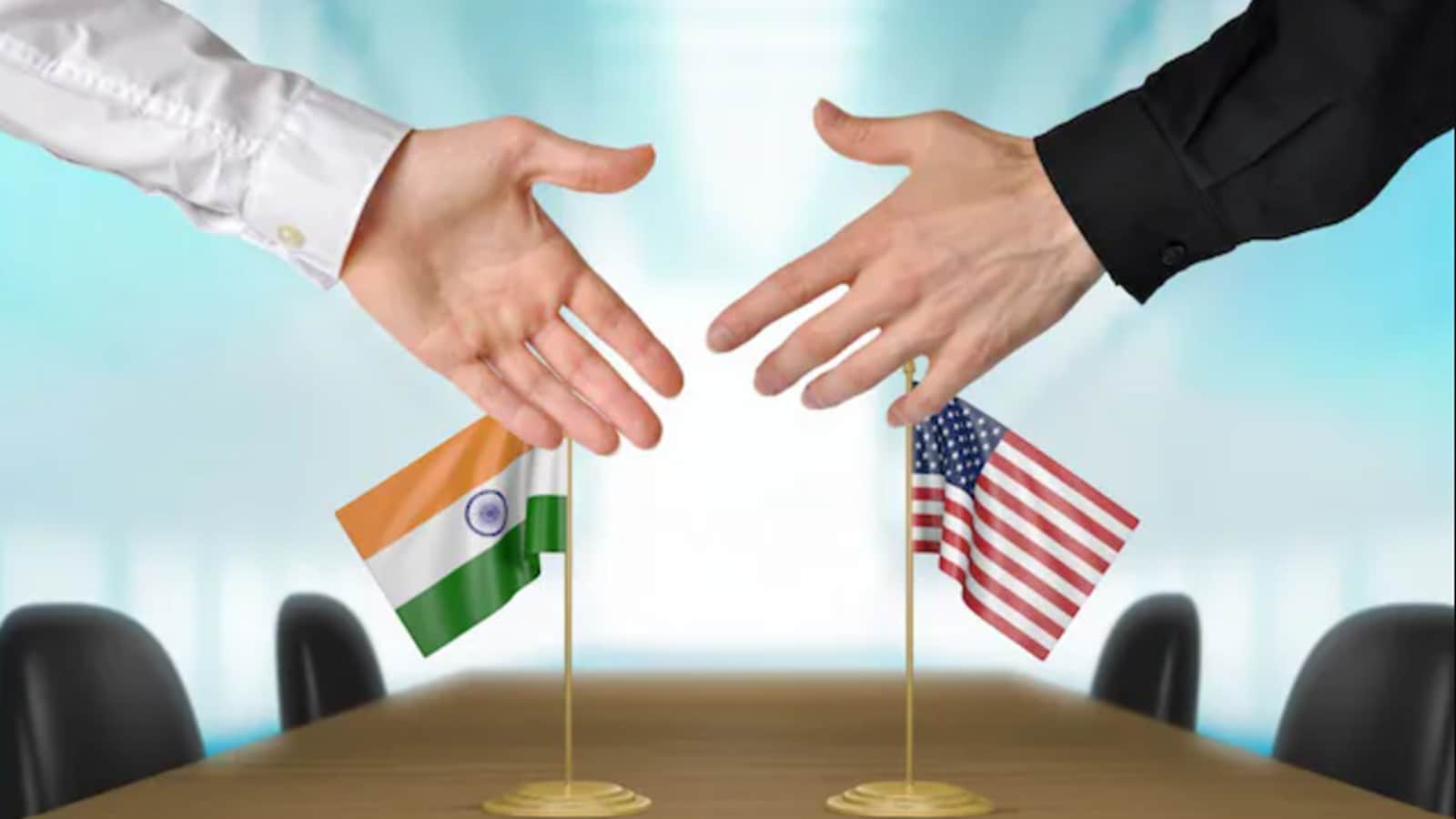
The ink dries slowly in the humidity of New Delhi, but it evaporates instantly under the air conditioning of Washington.
For months, trade negotiators have sat across from one another in windowless rooms, surrounded by half-empty coffee cups and towers of binder clips. A July deadline looms like a storm cloud over the Potomac. To the casual observer tracking the news cycle, this is a story of percentages, tariffs, and macroeconomics. It is a technical puzzle to be solved by bureaucrats. You might also find this connected article useful: Inside the Historic Winery Crisis Exposing Germany’s Economic Rot.
That view is entirely wrong.
Trade deals are not written in numbers. They are written in human anxiety. Behind every decimal point shifted in a trade agreement sits a person whose livelihood is about to change forever. When the United States and India try to hammer out a commercial alliance, they are not just trading almond quotas for tech visas. They are colliding two entirely different ways of living. As extensively documented in detailed coverage by The Wall Street Journal, the implications are widespread.
The Milk Bucket and the Boardroom
Consider Ramesh. He is a hypothetical composite of the roughly 80 million dairy farmers scattered across the Indian countryside. Every morning at 4:30 AM, long before the sun hits the dust of his village in Uttar Pradesh, Ramesh is awake. He milks three cows by hand. The silver bucket clangs against the dirt floor. His entire family’s economic survival depends on the local cooperative buying those few liters of milk at a predictable price.
Now shift the focus ten thousand miles away to a gleaming corporate office in Wisconsin. A dairy executive looks at a spreadsheet. The American dairy industry produces a massive surplus of milk powder and cheese. They need new consumers, and India’s massive middle class is the ultimate prize.
If Washington gets its way, American dairy products will flow into Indian supermarkets with minimal duties. To the American economist, this is efficiency. To Ramesh, it looks like an existential threat. American industrial farming operations operate on a scale that makes his three-cow livelihood look like an ancient relic. If cheap, subsidized foreign milk floods his local market, the cooperative price drops. If the price drops, his children do not go to the private school down the road.
This is the first invisible wall holding up the July agreement. India protects its farmers because farming is not just an industry there; it is a social safety net. You cannot negotiate away a country's safety net during a working lunch.
The Battle for the Digital Soil
The friction does not stop at the farm gate. It moves directly into the silicon chips in our pockets.
For years, global technology giants have viewed India as an open frontier. Think of an executive at a major Silicon Valley firm. Let's call her Claire. Claire’s job is to maximize user data acquisition because data is the fuel of the twenty-first century. For a long time, the rules were simple: harvest user data from hundreds of millions of smartphone users in Mumbai, Bangalore, and Delhi, beam it back to servers in Virginia or California, process it, and sell targeted ads.
Then New Delhi flipped the script.
Indian regulators started demanding data localization. They want the servers to physically sit within Indian borders. They want Indian data stored on Indian soil, governed by Indian laws.
To Claire and her legal team, this feels like a bureaucratic nightmare. It splits the global internet into national fiefdoms. It requires building massive, expensive server farms locally. It disrupts the smooth flow of information that Western tech companies have built their fortunes on.
But look at it from the perspective of a policymaker in New Delhi. They see data as a national resource, much like oil or gold. Why should the digital footprint of an Indian citizen enrich a company in California without New Delhi having a say in how that data is protected, taxed, or accessed?
This is not a minor disagreement over regulatory paperwork. It is a fundamental philosophical clash over who owns the digital reflection of human lives.
Medical Miracles and the Cost of Survival
Step into a hospital corridor in Hyderabad. A cardiologist holds an angiogram up to the light. A patient needs a coronary stent to keep an artery open and a heart beating.
For an American medical device manufacturer, that stent represents millions of dollars in research, development, and clinical trials. They want to sell it at a premium to recoup costs and satisfy shareholders. They argue that high prices fund the innovations of tomorrow.
The Indian government views that same piece of mesh through a different lens. They see a country where the vast majority of healthcare costs are paid out of pocket by families who might earn less in a year than the stent costs to manufacture. To keep its population alive without bankrupting them, New Delhi placed strict price caps on medical devices and heavily incentivized local generic alternatives.
The American trade representatives argue that these price caps are unfair trade barriers that discriminate against foreign innovation. The Indian negotiators counter that affordable healthcare is a human right.
How do you find a middle ground when one side is talking about return on investment and the other side is talking about human survival? You don't. At least, not easily, and certainly not by a random Tuesday in July.
The Ghost of Harley-Davidson
We must also look at the symbols that carry more emotional weight than actual economic value. The prime example is a motorcycle.
For years, Washington has obsessed over India's high tariffs on heavy motorcycles. It became a political talking point, a shorthand for how difficult it is to do business with New Delhi. To an American politician, a bike built in York, Pennsylvania, represents the American working class. Seeing it taxed at exorbitant rates at an Indian port feels like a personal insult to American craftsmanship.
But flip the perspective. India has its own massive domestic two-wheeler industry, employing hundreds of thousands of factory workers in Chennai and Pune. These factories build scooters and commuter bikes that keep the country moving. Indian negotiators see the American focus on luxury motorcycles as an eccentric obsession that ignores the realities of India's domestic manufacturing priorities.
When negotiations stall over motorcycles, it is rarely about the money. It is about pride. It is about showing voters back home that you did not back down.
Moving Beyond the Deadlines
The negotiators will likely miss the July target, or they will sign a skeletal agreement that leaves the real issues for another day. Commentators will call it a failure. They will blame political stubbornness or protectionist instincts.
But the delay is actually a sign of something much deeper. It is proof that both nations finally understand the stakes.
A real trade agreement requires reconciling the daily realities of the Wisconsin dairy farmer with the daily realities of the Uttar Pradesh villager. It means balancing the profit margins of Silicon Valley with the digital sovereignty of an emerging superpower. It requires realizing that a medical device is both an expensive product and a literal lifeline.
The hold-up is not a glitch in the system. The hold-up is the system functioning exactly as it should: forcing two giants to realize that behind every line of legalese lies a human life that cannot be traded away.