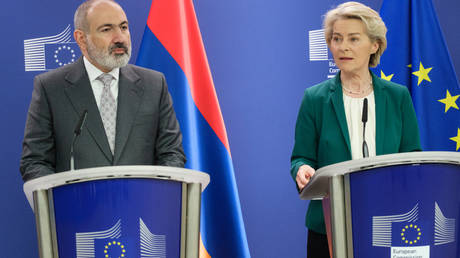
The European Union has deployed a fifty million euro emergency financial package to Armenia, an immediate injection of capital aimed at insulating the South Caucasus nation from severe Russian trade blockades just days before a definitive parliamentary election. European Commission President Ursula von der Leyen confirmed the financial package following a direct call with Armenian Prime Minister Nikol Pashinyan, explicitly condemning Moscow's aggressive import bans on Armenian agricultural goods and floral exports as blatant economic coercion. While the emergency funding aims to stabilize a reeling economy before voters head to the polls on Sunday, the nominal sum exposes a profound geopolitical miscalculation, offering a minor financial band-aid for a country attempting a historic, high-stakes break from decades of Russian security and economic dependency.
The Flower War and the Emergency Cash Injection
Geopolitical friction rarely manifests so vividly as it does in the sudden quarantine of agricultural freight. Over the past week, Russian customs regulators halted millions of dollars in Armenian agricultural exports, citing sudden, highly suspect sanitary violations in shipments of fresh produce and commercial flora. The timing is far from coincidental. With Armenia scheduled to hold high-stakes parliamentary elections this coming Sunday, Moscow chose to tighten its grip on the state's economic arteries, demonstrating exactly what happens when a former Soviet republic attempts to drift out of its orbit. If you found value in this article, you might want to look at: this related article.
The European response was swift in rhetoric but modest in scale. Brussels announced it is front-loading the financial aid package, promising to disburse thirty-four million euros directly to Yerevan within fifteen days. To demonstrate immediate solidarity, European officials organized a highly symbolic alternative trade route, diverting an stranded shipment of ten thousand Armenian roses directly to Latvia.
While the imagery of Armenian flowers blooming in the Baltics makes for excellent diplomatic public relations, the cold data tells a different story. Fifty million euros represents less than one percent of Armenia's annual gross domestic product. It is a drop in the ocean compared to the massive financial fallout of a sustained economic rupture with the Russian Federation, which currently absorbs over forty percent of all Armenian exports and dictates the country's domestic energy pricing. For another perspective on this event, see the recent coverage from Al Jazeera.
The Anatomy of Structural Dependence
To understand why the European Union intervention is structurally insufficient, one must examine the absolute nature of Armenia’s economic integration with Russia. Decades of post-Soviet policy have left Yerevan deeply tied to Moscow through overlapping layers of energy, trade, and infrastructure ownership.
- The Energy Stranglehold: Russia’s state-owned energy giant Gazprom owns the entirety of Armenia's domestic gas distribution network. Moscow has historically manipulated gas prices to reward political compliance or punish diplomatic drift.
- Logistical Bottlenecks: The Upper Lars border crossing through Georgia remains the sole functioning overland trade artery connecting Armenia to the broader Eurasian market. A single bureaucratic slowdown by Russian border officials can leave hundreds of Armenian freight trucks stranded for weeks along the mountain passes.
- Remittance Channels: Hundreds of thousands of Armenian citizens work seasonally inside the Russian Federation. The money they send back home forms a vital financial safety net for rural communities, a pipeline that Moscow can restrict at any moment by altering financial transmission rules or tightening migrant visa enforcement.
Brussels has promised to loosen its own tariffs and import restrictions on Armenian agri-food products to encourage a structural trade pivot toward the West. But shifting systemic trade infrastructure requires years of regulatory alignment, cold-storage development, and supply-chain reorganization. Armenian farmers cannot alter their production standards or find alternative buyers in Frankfurt or Paris over a single weekend.
High Stakes at the Ballot Box
The immediate objective of the European cash injection is psychological. It is designed to signal to the Armenian electorate that a vote for Pashinyan’s pro-Western platform will not result in total economic isolation. The political landscape in Yerevan is deeply fractured, polarized by the traumatic loss of the Nagorno-Karabakh territory and a growing domestic debate over national security architecture.
Opposition factions, some backed by long-standing pro-Moscow political networks, have seized on the current economic disruption to argue that Pashinyan’s foreign policy pivot is an act of economic suicide. They claim that alienating Moscow endangers both national security and the livelihoods of ordinary citizens. European officials speaking anonymously have acknowledged the precarious nature of their financial gamble. They confirmed that if the upcoming election yields a government that abandons the Western track and repairs ties with Moscow, the financial assistance and trade privileges will be suspended immediately.
This transactional dynamic puts Armenian voters in an incredibly difficult position. They must choose between the long-term, highly uncertain promise of European integration and the immediate, brutal reality of Russian economic retaliation.
The Connectivity Illusion
Long-term European strategy relies heavily on turning Armenia into a regional transit hub. European planners point to the recent opening of localized trade routes with Türkiye, including vital railway links running through Georgia, as proof that Armenia can diversify its options. The ultimate vision is a grand transport corridor linking Europe through the South Caucasus directly to Central Asia.
This ambitious plan faces immediate geographical and political obstacles. Every major transport initiative in the region requires the explicit cooperation or compliance of neighbors who are deeply hostile or highly skeptical of Western intervention. Azerbaijan remains a volatile neighbor, with peace negotiations over border demarcation still unresolved despite recent progress on trade transit frameworks. Meanwhile, the United States is attempting to bolster the region via the Transport and Regional Infrastructure Project Partnership, but these legal frameworks take years to manifest as actual asphalt, steel, and rail lines.
The Cost of Stepping into the Vacuum
The true problem with Europe's strategy is the mismatch between its geopolitical ambitions and its willingness to bear the associated risks. Brussels is encouraging a vulnerable state to alienate a dangerous, deeply entrenched regional hegemon, yet it offers only minimal financial support and no hard security guarantees in return.
Fifty million euros can temporarily balance a state budget or compensate a few hundred industrial flower growers and fruit exporters. It cannot rebuild an energy grid, replace a primary export market, or defend a nation's borders. If the European Union wishes to genuinely challenge Russian dominance in the South Caucasus, it must move past symbolic shipments of flowers and minor financial aid. Until Europe is prepared to offer deep economic integration and concrete security assurances, its financial interventions will look less like a genuine strategic lifeline and more like a cheap political intervention in a theater of war where someone else pays the ultimate price.



:max_bytes(150000):strip_icc()/how-many-types-of-dwarfism-are-there-2860725-v1-8dae2c531b4b47d9ae36ae404d3308a0.png)