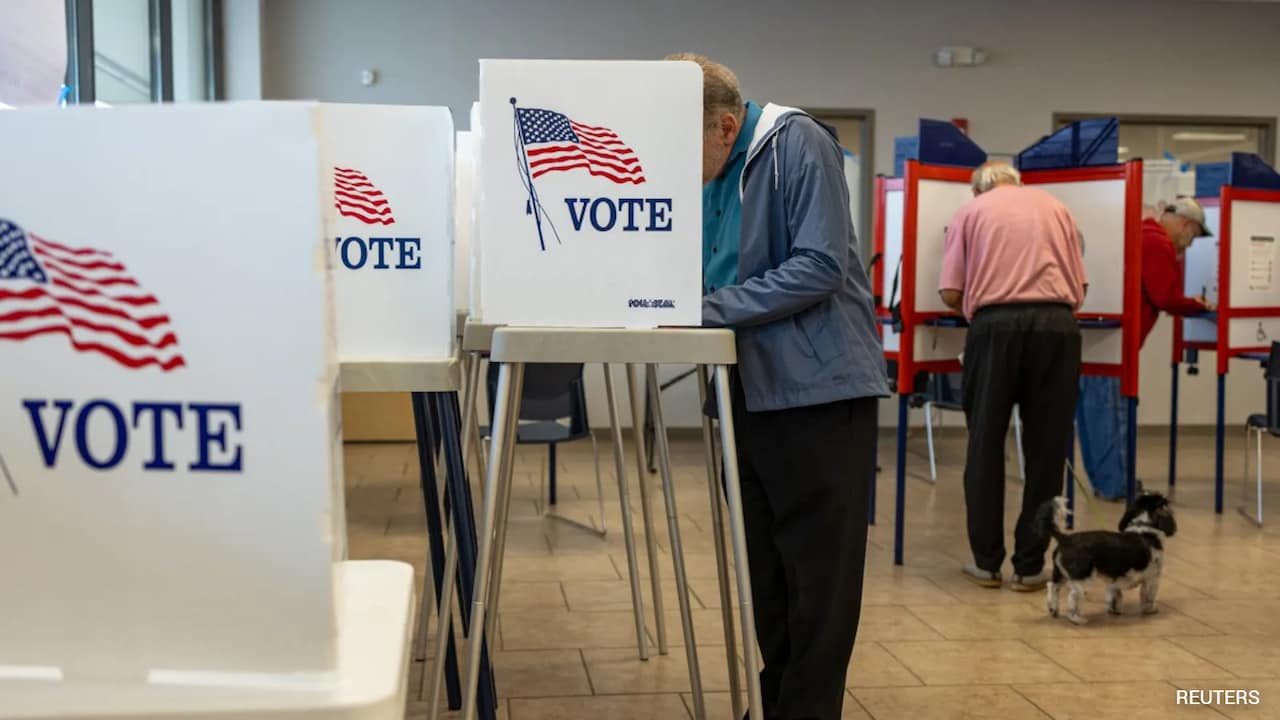
The fluorescent lights in an elementary school gymnasium make a specific, low-frequency hum at six in the morning. It is the sound of metal folding tables being dragged across lacquered pine, the smell of burnt coffee from a Styrofoam cup, and the heavy, rhythmic thud of a precinct captain stamping a stack of paper ballots before the doors unlock.
Most people experience an American election as a scoreboard. They watch red and blue bars creep across a television screen while anchors with immaculate hair talk about margins of error, suburban realignment, and historical headwinds. They treat the first Tuesday after the first Monday in November like a championship game played by distant athletes in Washington. Discover more on a similar issue: this related article.
That is a comforting illusion. It turns citizenship into a spectator sport.
To understand what actually happens on Election Day, you have to step away from the television glow and look at the invisible machinery moving beneath the surface. You have to look at the six pressure points where a nation’s abstract anxieties collide with physical reality. Because when the polls open, the outcome is rarely decided by the loudest speeches on the campaign trail. It is decided by quiet arithmetic, local friction, and the small, unglamorous choices made by millions of ordinary people before dinner. Additional analysis by The Guardian explores related views on the subject.
The Myth of the Monolith
Consider a hypothetical voter named Elena. Let’s put her in a brick colonial outside of Philadelphia, or perhaps a ranch house in the sprawling suburbs of Phoenix. Elena works in hospital administration. She is forty-two, exhausted by the price of groceries, deeply skeptical of both political parties, and fiercely protective of her daughter’s public school curriculum.
Political pundits love to put Elena in a neat demographic box. They call her a "suburban swing voter," a tidy label that suggests she wakes up every four years and weighs grand ideological philosophies over her morning toast.
She doesn't.
When Elena walks into her polling place, she is carrying a messy, contradictory ledger of personal grievances and hopes. She might vote for a conservative fiscal candidate at the top of the ticket because her property taxes jumped twelve percent last year, and then turn right around and vote for a progressive ballot measure protecting reproductive rights or raising the local minimum wage.
This split-ticket reality is the first thing to watch when the returns begin trickling in. For decades, American politics operated like a bundle of cable channels—if you wanted sports, you had to pay for the home-shopping network, too. Voters accepted the entire party platform as a package deal. Today, that bundle is fraying. Across the country, state-level ballot initiatives—on everything from healthcare access to marijuana legalization to minimum wage hikes—consistently outperform the partisan candidates championing them.
Watch the gap between the top of the ticket and the bottom of the ballot. If a state votes overwhelmingly for a conservative presidential or gubernatorial candidate while simultaneously passing a progressive constitutional amendment, you are witnessing the true, unvarnished shape of the American electorate. Voters are no longer buying the whole store. They are walking down the aisles, picking up individual items, and leaving the rest on the shelf.
The Geography of the Margin
If Elena represents the complexity of the individual mind, the map she lives on represents the brutal math of representation.
Imagine an old-fashioned balance scale. On one side, you pile heavy iron weights. On the other, you drop feathers. In American elections, tens of millions of votes are cast in states and districts where the outcome was effectively decided years ago by shifting demographics or partisan redistricting. A million extra votes in deep-blue California or deep-red Texas change the national popular vote total, creating impressive headlines, yet they do not move the electoral needle by a single millimeter.
The entire weight of the federal government rests on a razor-thin sliver of geography.
In recent cycles, control of the White House and both chambers of Congress has hinged on a few hundred thousand votes scattered across a handful of battleground counties. Think about the sheer improbability of that. A neighborhood in Waukesha County, Wisconsin, or a strip of fast-growing subdivisions in Gwinnett County, Georgia, holds more practical leverage over national policy than entire regions of the country.
When watching the returns, ignore the sweeping national maps that flash across the screen at seven o'clock Eastern Time. Those are theater. Instead, zoom in on the collar counties—the rings of suburban and exurban communities surrounding major metropolitan areas.
For half a century, the political alignment of America was simple: cities were blue, rural areas were red, and the suburbs were reliably conservative enclaves of manicured lawns and commuter trains. That dynamic has fractured. The inner-ring suburbs have drifted steadily toward the Democrats, while working-class rural towns have hardened into impenetrable Republican fortresses. The battle now lives in the outer rings—the places where new subdivisions meet old farmland, where the Amazon distribution center sits two miles down the road from a fourth-generation dairy farm. Watch the margins in those transitional counties. If a candidate is losing an outer-ring suburb by five points instead of the ten points their party lost it by four years ago, the ground is shifting beneath their feet.
The Invisible Gatekeeper
There is a question that haunts every campaign manager from the moment they take the job, a question far more terrifying than whether voters like their candidate: Will they actually show up?
Turnout is the great, unpredictable ghost of American democracy. Pollsters spend millions of dollars trying to model the "likely voter," using complex algorithms based on past participation, magazine subscriptions, and consumer data. Yet human behavior refuses to obey a spreadsheet.
To understand turnout, picture a Tuesday in November when a cold, sideways rain begins falling in Detroit at four in the afternoon. Or picture a sudden, inexplicable printer malfunction at a polling site in Maricopa County that stretches a fifteen-minute wait into a two-hour ordeal.
Voting is not a frictionless act. It is a physical task competing against sick toddlers, double shifts at the warehouse, broken-down cars, and sheer exhaustion. When turnout surges, it rarely happens because millions of apathetic citizens suddenly fell in love with a politician. It happens because an invisible network of neighbors, church leaders, union organizers, and terrified or furious citizens decided that staying home was no longer an option.
Look closely at the early voting numbers, and then look at the Election Day lines. Over the past decade, the way Americans cast their ballots has split along stark partisan lines. Democrats have increasingly embraced mail-in voting and early in-person polling, banking their votes weeks before the final Tuesday. Republicans, largely skeptical of mail-in systems, have concentrated their firepower on Election Day itself.
This creates a mirage that fools casual observers every single cycle.
In states that count mail-in ballots first, the early returns often look like a progressive landslide. In states that legally prohibit election workers from even opening mail-in envelopes until the polls close on Tuesday night, the early returns look like a conservative blowout. Neither picture is real. They are simply two halves of a puzzle being assembled in different orders. The true story only emerges when the late-night tallies from urban precincts—heavy with mail-in ballots—collide with the rural Election Day totals. Patience is not just a virtue on election night; it is an analytical necessity.
The Pocketbook Paradox
Ask ten economists how the American economy is doing, and they will hand you a binder full of charts showing gross domestic product, unemployment rates, and wage growth. Ask ten people standing in line at a grocery store in Ohio how the economy is doing, and they will hold up a carton of eggs and a receipt for car insurance.
This disconnect—the chasm between macroeconomic data and lived financial reality—is the beating heart of modern political anxiety.
Voters do not experience the economy through quarterly government reports. They experience it through friction. They feel it when they have to put a pack of ground beef back in the cooler because the price jumped three dollars since last spring. They feel it when their adult children cannot afford a down payment on a starter home because mortgage rates have doubled.
Historically, the party holding the White House pays the price for economic discomfort, regardless of whether a president actually controls global supply chains or interest rates. It is a blunt, unforgiving rule of politics: if people feel poorer than they did four years ago, they fire the management.
Yet there is a complicating twist to watch this time around. While inflation cools on paper, the cumulative cost of living remains permanently elevated. Prices haven't gone back to what they were; they have simply stopped rising as fast. For a family living paycheck to paycheck, a slower rate of price increases does not feel like relief. It feels like being stuck at the bottom of a steep hill. Watch how voters in working-class precincts—particularly Black, Hispanic, and white non-college-educated voters—respond to this pressure. If economic frustration overrides traditional party loyalty, long-standing coalitions can crack overnight.
The Ghosts in the Courtroom
While the presidential race and the battle for Congress suck all the oxygen out of the room, the most consequential fights on the ballot are often happening in races that receive a fraction of the media coverage.
Consider the state supreme courts and local district attorneys.
For generations, judicial elections were sleepy affairs. Voters skipped right past them or picked names at random at the bottom of the ballot. Not anymore. Following the Supreme Court’s decision to overturn Roe v. Wade, power over some of the most intimate, explosive questions in American life—abortion access, voting laws, congressional district maps, environmental regulations—snapped back to the states like a released rubber band.
Suddenly, a seat on the state supreme court in Wisconsin, Pennsylvania, or North Carolina carries more immediate power over a citizen's daily life than a seat in the U.S. House of Representatives.
Let’s trace how this plays out in the real world. Suppose a state legislature passes a strict new voting law or redraws congressional boundaries to lock in a partisan advantage for the next decade. That law is immediately challenged. It moves through the lower courts until it lands on the desks of five or seven state supreme court justices. A single vote on that bench decides whether millions of people can use a drop box, whether a clinic stays open, or whether a state’s congressional delegation leans left or right for ten years.
When you look at the results, pay attention to the down-ballot judicial races and statehouse majorities. National politics is often a game of gridlock, where slim majorities prevent either side from passing sweeping legislation. State politics is where the brakes are off. A party that holds a "trifecta"—control of the governor’s mansion and both chambers of the state legislature—can rewrite the rules of society in a single legislative session.
The Clockwork of Doubt
There is one final thing to watch on Election Day, and it has nothing to do with polls, demographics, or policy. It has to do with time.
In a world where we can order a pair of shoes on our phones and have them arrive on our porch before sunset, waiting three days to find out who won a Senate race feels unnatural. It feels broken. To a mind conditioned by instant gratification, a slow count looks suspicious.
It isn't. It is simply the sound of a massive, decentralized machine doing careful work.
Unlike many democracies that run a single, standardized national election overseen by a central ministry, the United States runs more than ten thousand separate local elections simultaneously. Every county has its own rules, its own ballots, its own machines, and its own laws governing when counting can begin. In states like Florida, election workers are allowed to process and verify mail-in ballots weeks before Election Day, which is why their results appear almost instantly after the polls close. In states like Pennsylvania and Wisconsin, state legislatures have historically barred workers from touching those envelopes until Tuesday morning, guaranteeing a slow, agonizing count that stretches well into the week.
Understanding this mechanical reality is the best armor against the inevitable wave of confusion and rumors that floods social media around midnight on election night. When a county pauses counting at two in the morning so exhausted poll workers can go home and sleep, it is not a conspiracy. It is biology. Human beings cannot verify signatures and feed paper through scanners for twenty-four hours straight without making mistakes.
The Weight of the Paper
I once spent an entire Election Day sitting at a folding table in a drafty community center in the Midwest, checking names off a paper ledger and handing out stickers.
At around seven-thirty in the evening, just before the doors were scheduled to lock, a man walked in wearing paint-splattered work boots and a heavy canvas jacket. He looked exhausted, the kind of bone-deep tiredness that comes from ten hours on your feet. He apologized for cutting it close, took his ballot, and stepped behind the cardboard privacy screen.
He stood there for nearly ten minutes. He didn't rush. He held the black felt-tip pen with a strange, deliberate care, reading every single line down to the local water district board, filling in the ovals one by one. When he finally fed the paper into the optical scanner and watched the little digital counter tick up by one, he let out a long breath, nodded at the poll workers, and walked back out into the dark.
That is the entire enterprise. Strip away the billion-dollar ad buys, the screaming cable news panels, the algorithmic rage, and the breathless predictions. What remains is a quiet room, a piece of paper, and a citizen deciding what kind of future they are willing to live in.
When the returns begin rolling in, watch the margins in the suburbs, watch the split-ticket ballot measures, watch the state courts, and watch the slow, steady rhythm of the count. Just remember that behind every decimal point shifting across your screen, there is a pair of paint-splattered boots standing behind a cardboard screen, holding a pen, trying to get it right.