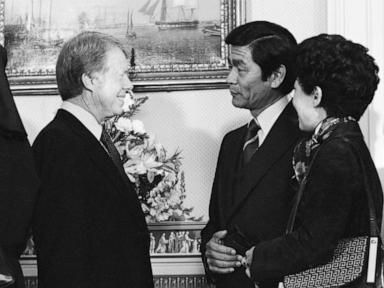
George Ariyoshi died at the age of 100 on April 19, 2026, marking the end of a century that defined the political trajectory of the Pacific. As the first American of Asian descent to serve as a state governor, his passing does not merely close a chapter on a life of public service; it signals the final sunset for the Nisei generation that engineered Hawaii’s transformation from a plantation outpost into a globalized state. He was a man who preferred spreadsheets to soundbites and cautious consensus to political theater, a temperament that allowed him to hold the governorship for twelve years—a record that stands as a fortress against the volatility of modern electoral cycles.
The news of his death forces a reappraisal of what it actually meant to hold power in the islands during the late twentieth century. To understand Ariyoshi is to understand the specific, pressurized conditions of Hawaii in the 1970s. He was not a product of backroom deals alone, nor was he the charismatic face of a movement in the way John F. Kennedy or even his predecessor, John A. Burns, were. Ariyoshi was something else entirely: a technocrat who believed that the messiness of rapid growth and uncontrolled development could be tamed, or at least categorized, through rigorous, centralized planning.
The Rise of the Nisei Generation
To appreciate the gravity of his 1974 election, one must look backward to the socio-political climate that birthed his career. The Democratic Revolution of 1954 was not a single event but a slow-motion tectonic shift. Before this movement, Hawaii was the fiefdom of the "Big Five" corporations, a rigid hierarchy where power was measured in sugar tonnage and pineapple acreage. The Nisei, the children of Japanese immigrants who had been drafted into the 442nd Regimental Combat Team or served in the Military Intelligence Service during the Second World War, returned home with a different expectation of citizenship.
Ariyoshi was the personification of this ambition. He did not arrive with the swagger of a revolutionary. He arrived with a law degree and an understanding that the machinery of the state was the only tool capable of dismantling the old oligarchy. While others in his cohort pushed for radical land reform, Ariyoshi focused on the mechanics of governance. By the time he ascended to the governorship following the incapacitation of John A. Burns, the state was already beginning to groan under the weight of its own success. Tourism was booming, land prices were escalating, and the delicate balance between environmental preservation and economic expansion was beginning to tilt.
His election to the governorship in his own right was a statement of arrival. It proved that a Japanese American could steer the ship of state, but more importantly, it signaled the transition of Hawaii from a territorial mindset to a statehood reality. He carried the burden of this representation with a visible, often remarked-upon humility. He was not interested in the flash of the office. He was interested in the structure of the budget.
The State Plan and the Art of Control
Perhaps the most significant, yet frequently misunderstood, achievement of his tenure was the Hawaii State Plan. In the late 1970s, the archipelago faced an existential crisis: growth was happening to the islands, not for them. Foreign capital was flowing in, beachfront property was being subdivided at a frantic pace, and the fear was that the very identity of the islands would be eroded by unplanned, sprawling development.
Ariyoshi responded with an initiative that many contemporaries viewed as intrusive, while others saw it as necessary survival. The State Plan was an attempt to impose logic on the chaos of real estate speculation. It was an ambitious, perhaps overly optimistic, effort to dictate where growth should happen and where it should be strictly prohibited. He wanted a blueprint for the future.
The criticism was immediate and often sharp. Critics argued that the plan was an act of administrative overreach, a stifling of the free market that would inevitably chill investment. They saw the hand of a bureaucrat trying to control the uncontrollable. Yet, looking back, the intent was clearly driven by a sense of guardianship. Ariyoshi operated under the assumption that the islands were finite. In a world increasingly defined by exponential consumption, he was one of the few executives who prioritized the long-term integrity of the physical landscape over short-term revenue spikes.
This approach defined his economic philosophy. He navigated the state through the early shocks of post-statehood recession, maintaining a posture of fiscal caution that would today be described as deeply conservative. He was not interested in the glitz of speculative bubbles. He was interested in solvency. When he left office in 1986, the state treasury was on solid footing, a rarity in an era of ballooning public debt.
The Machinery of Politics
No analysis of the Ariyoshi era would be complete without acknowledging the complexities of the political machine he operated within. The Democratic Party in Hawaii during those years was a monolithic force. It controlled the legislature, the unions, and the narrative. To be governor was to act as the primary broker of interests within this closed system.
Ariyoshi managed this machine with a lawyer’s precision. He was a creature of the system, not an outsider attacking it. This often led to accusations of insularity. There were, at various times, murmurings regarding the influence of private interests and the consolidation of power. However, to focus solely on the accusations is to miss the broader pattern of his conduct. He maintained a disciplined, almost monastic separation between his personal life and the grinding gears of state administration. He was remarkably adept at absorbing pressure without cracking, a trait he likely developed during his time in the Military Intelligence Service.
There is a weary confidence in the way he managed his political survival. He never lost an election. He understood the nuances of the local electorate—the shifting loyalties of the public sector unions, the rising influence of the tourism sector, and the enduring sentiment of the older generations. He balanced these competing forces not by forcing a singular vision on everyone, but by ensuring that everyone felt the system was sufficiently reliable to continue functioning. It was stability as a political product.
A Legacy of Institutionalism
The question that remains, as his obituary is written and the flags are lowered, concerns the durability of his institutionalism. Did his focus on long-range planning actually save Hawaii, or did it merely provide a veneer of control over a system that was always going to succumb to market forces?
History suggests a middle path. The State Plan likely slowed the rate of degradation rather than stopping it. The fiscal conservatism he championed created a buffer that allowed subsequent administrations to operate from a position of relative strength. He built institutions that were meant to outlast his own tenure, focusing on committees, boards, and councils that would perpetuate his vision of regulated growth.
The tragedy of the modern political era is the absence of this specific brand of quiet, unglamorous administration. We have traded the long-term planner for the short-term campaigner. We have replaced the architect who measures the foundation with the orator who sells the view. Ariyoshi belonged to an age that valued the permanence of the structure over the immediacy of the gain.
The Final Transition
In his later years, Ariyoshi became a figure of historical curiosity. He was the last living link to a time when the Democratic Revolution was still a fresh memory. He watched as his successors navigated a state that had grown far more complex, far more expensive, and far more disconnected from the agrarian roots of his youth. He did not offer scathing critiques from the sidelines; he offered the observations of someone who had once held the levers of power and knew exactly how much effort it took to keep them moving.
His death is not just the passing of a centenarian. It is the end of the Nisei authority. The generation that rebuilt Hawaii following the catastrophe of war is now almost entirely gone. They were a generation defined by the discipline of the battlefield and the pragmatism of the courtroom. They sought order in a world that had been violently disrupted.
When the history of the Pacific in the twentieth century is eventually stripped of its myths and analyzed for its structural outcomes, Ariyoshi will remain a central figure. Not because he was the loudest voice in the room, but because he was the one who insisted that, before anyone built anything, they should draw a map of where they were going. As the current administration faces the inevitable pressures of housing shortages, environmental degradation, and the search for a new economic identity, the absence of his steady, planning-focused hand feels acutely significant.
He leaves behind a state that is still wrestling with the questions he posed decades ago. The struggle to balance growth, resources, and community is not a problem to be solved; it is a condition to be managed. George Ariyoshi understood this better than most. He spent his life trying to institutionalize the discipline required to keep the house standing. Whether that house endures in the face of the next century remains the task of those he left behind, who are now tasked with maintaining a structure they did not build.


:strip_icc()/pic2513216.jpg)