The keycard clicks.
The heavy oak door swings shut with a soft, pneumatic sigh, sealing out the fluorescent hum of the hallway, the distant chime of an elevator, and the relentless, ticking clock of someone else’s needs. Inside, the room is cool. The duvet is pulled taut across the mattress, crisp and white and untouched by small, sticky hands. There are no plastic toys wedged beneath the armchair. There is no faint, sour scent of spilled milk on the carpet, no Slack notifications pulsing on a secondary monitor, no small voice calling out from down the hall because a shadow on the wall looks like a monster.
She takes off her shoes. She sits on the edge of the bed. And for the first time in three years, nobody asks her for anything.
This is not a business trip. There is no conference waiting downstairs in the ballroom, no illicit affair hiding behind closed curtains, no suitcase packed for a week in Paris or Tokyo. She lives twenty minutes away. Her husband is at home with their toddler. Her mother-in-law is in the kitchen. And she has just paid four hundred yuan—roughly fifty-five US dollars—for the radical, decadent, terrifying privilege of staring at a ceiling in total silence for twelve hours.
Welcome to the quietest revolution in modern China.
Across the sprawling metropolises of Shanghai, Beijing, Shenzhen, and Chengdu, a growing wave of exhausted working mothers is quietly checking into mid-range hotels alone. Not to cheat. Not to run away forever. Just to sleep. Just to breathe. Just to remember what their own thoughts sound like when they aren't being interrupted every four minutes by a demand for snacks, a work email, or the low-grade static of perpetual guilt.
The Architecture of Invisible Exhaustion
To understand why a woman with a perfectly good bed at home would pay to sleep in a beige room next to a highway, you have to understand the specific, suffocating geometry of her daily life.
Consider a hypothetical composite—let’s call her Lin—whose routine mirrors the documented realities of millions of urban Chinese women born in the late 1980s and 1990s. Lin works in marketing at a tech firm in Hangzhou. Her alarm goes off at 6:15 AM, though she has already been awake since 5:30, mentally rehearsing the day’s logistics. Before she even opens her laptop, she has supervised breakfast, negotiated the diplomatic crisis of mismatched socks, packed a daycare bag, and coordinated pickup schedules with her retired mother, who lives with them to help with childcare.
Then comes the nine-to-six shift—which, in the lingering shadow of China’s notorious "996" work culture, rarely ends at six. By 7:30 PM, she is back in the apartment. The second shift begins immediately. Bath time. Story time. Cleaning up the kitchen while answering messages from a boss who expects instant replies until midnight. By the time her head hits the pillow at 11:30 PM, she has made roughly four thousand micro-decisions, absorbed everyone else’s emotional turbulence, and spent exactly zero minutes existing as an independent human being.
And then, at 2:00 AM, the baby cries.
If you have ever lived through prolonged, fragmented sleep, you know it doesn't just make you tired. It alters your neurology. It strips away the insulation around your nerves until every minor inconvenience feels like an existential threat, every spilled cup of water feels like a personal betrayal, and the person you love most in the world—your own child—begins to feel like a tiny, adorable warden holding you hostage in your own home.
I remember the exact night I broke. It wasn't during a major crisis. It was a Tuesday. I was standing in a dimly lit kitchen at 3:00 AM, holding a lukewarm bottle, staring at a stack of unwashed dishes, and realizing with a cold, terrifying clarity that I could no longer remember what I liked to eat for dinner when nobody else was watching. I had become a utility. Like electricity or running water, I was only noticed when I stopped working.
When you reach that point, a bubble bath doesn't fix it. A ten-minute meditation app feels like an insult. You don't need "self-care" wrapped in pastel marketing. You need physical removal from the ecosystem of obligation.
Why Home Is Never Off-Duty
A common question arises whenever this trend surfaces on Chinese social media platforms like Xiaohongshu (Little Red Book) or Douyin: Why not just lock the bedroom door at home?
Anyone who asks that question has never been the primary default parent in a multi-generational household.
At home, a locked door is merely a suggestion. Through the wood, you can still hear the baby crying, and your nervous system—wired by millions of years of evolution and years of conditioning—spikes with cortisol before you even realize you’re tensing up. You hear your husband fumbling with the diaper bag, and you feel the magnetic pull to step in because it’s faster than explaining where the wipes are kept. You hear your mother-in-law sighing in the living room, a sound freighted with unspoken expectations about filial piety, domestic standards, and what constitutes a "good mother."
Home is a workspace where you are never off the clock. Every object in your line of sight is a to-do list item. The laundry basket is full. The baseboards need wiping. The refrigerator needs restocking. Even when you are lying down, your brain is scanning the perimeter, running background diagnostics on everyone else's comfort.
In a hotel room, none of the mess belongs to you.
That is the psychological alchemy of the solo hotel stay. When a woman steps across the threshold of a Ji Hotel or an Atour—two ubiquitous, mid-tier Chinese chains that have become accidental sanctuaries for burnout—she enters a neutral zone. The air conditioning is set to twenty-two degrees. The towels are folded into crisp rectangles. If a glass breaks, someone else sweeps it up. If the sheets are wrinkled, someone else irons them.
For one night, she is a guest, not the host.
The Numbers Behind the Nightstands
This isn't a fringe eccentricity practiced by a handful of wealthy elites. It is a measurable shift in consumer behavior and domestic culture.
According to data from China’s National Bureau of Statistics, women in China have one of the highest labor force participation rates in the world, hovering above 60 percent—significantly higher than the global average. Yet cultural norms inside the home have evolved at a fraction of the speed of the economy. Time-use surveys consistently show that Chinese women still spend more than twice as much time on unpaid domestic labor and childcare as their male partners.
Meanwhile, the hospitality industry has quietly noticed who is booking single-occupancy rooms on Tuesday nights within five kilometers of their own registered home addresses. Travel platforms like Trip.com and Meituan have seen a steady rise in "staycation" and solo micro-escape bookings among women aged 28 to 40—a demographic traditionally associated with family suites and theme park packages, not solitary king beds.
On Xiaohongshu, hashtags translating to "mothers escaping to hotels" and "solo hotel healing" have racked up tens of millions of views. Scroll through the posts, and you won't find glamorous influencers posing with champagne flutes in infinity pools. You will find grainy photos of takeout noodles eaten on a crisp white duvet. You will see screenshots of sleep-tracker apps showing nine uninterrupted hours of deep REM sleep, celebrated like lottery winnings. You will read confessions written in the middle of the night by women sitting on hotel balconies, weeping with relief simply because nobody needs them until checkout at noon.
One post from a 34-year-old mother in Shenzhen went viral after she detailed her monthly ritual: once every four weeks, on a Friday evening, she hands her four-year-old to her husband, walks ten minutes down the street to a business hotel, orders spicy crayfish delivery, watches two trashy movies without pausing them once, and sleeps until 10:00 AM.
"I used to feel like a monster for wanting to leave," she wrote in the caption. "Now I realize that this one night is the only reason I don't scream at my son the other twenty-nine days."
The Guilt Tax and the Village That Vanished
Of course, the backlash is never far behind.
In traditional Confucian family structures, motherhood is idealized through the lens of total, seamless self-sacrifice. The virtuous mother is the one who eats the fish head so her child can have the belly; the one who sleeps last and wakes first; the one whose own desires dissolve entirely into the family’s collective good.
When a woman breaks that script—even for twelve hours, even for fifty dollars—she often pays a steep emotional tariff.
Many women who book these solo stays don't tell their parents or in-laws the truth. They invent cover stories. I have to work overtime on a client pitch. My colleague is going through a breakup and needs company. There’s an early morning training seminar across town. They lie not because they are doing something wrong, but because the cultural vocabulary to explain maternal burnout without sounding selfish barely exists.
Even among progressive husbands, the reaction can be complicated. Some men support it wholeheartedly, recognizing that a rested partner makes for a healthier marriage. Others feel quietly offended, interpreting their wife’s desire to sleep alone as an indictment of their own parenting or a rejection of domestic intimacy.
But look closer, and you see that these women aren't rejecting their families. They are compensating for a structural collapse.
For most of human history, raising a child was never meant to be a two-person endurance sport conducted inside a soundproof concrete box on the twenty-fourth floor of an apartment tower. Humans evolved to raise children in dense, overlapping networks—aunts, cousins, neighbors, elders—where the burden of vigilance was shared across twenty pairs of eyes. When one mother needed to sleep, six other adults were already holding the perimeter.
Modern urban life dismantled that village and replaced it with a nuclear apartment, a demanding corporate career, and a smartphone that ensures you are reachable twenty-four hours a day. We kept the biological reality of human infants—who are wildly dependent for years—while stripping away the communal scaffolding that made surviving those years possible.
When a Chinese working mother books a hotel room down the street, she isn't indulging in luxury. She is renting the village that modern life took away from her.
What Happens Inside the Room
If you have never done it, it is hard to describe the strange, almost dizzying sensation of the first hour inside that room.
You lock the door. You put your phone on Do Not Disturb—allowing only emergency calls from your partner to break through. And then, for the first twenty minutes, you don't even know what to do with your hands.
You pace the carpet. You check the mini-fridge. You feel a phantom vibration in your pocket, reach for your phone, and realize nobody has texted you. The silence feels almost loud, like stepping out of a roaring factory floor into a snow-covered field. Your shoulders, which have been hunched somewhere near your ears since 2021, slowly begin to drop.
Then, the rituals begin.
Some women take a forty-minute shower where the water never runs cold and nobody bangs on the glass door asking where the blue toothbrush is. Others order food purely for themselves—spicy dishes their kids can't eat, delicacies their partners dislike—and eat it straight out of the takeout container while sitting cross-legged in the middle of a giant bed. Many simply pull the blackout curtains shut at 7:00 PM, crawl under the heavy duvet, and slip into a dreamless coma that lasts until morning.
The transformation the next day is startling.
When she checks out at noon and walks back into her apartment, the toys are still on the floor. The emails are still waiting in her inbox. The toddler still wants to be carried. Nothing in her external reality has changed.
Yet everything inside her has shifted. The brittle, razor-thin patience that threatened to snap the day before has thickened back into warmth. When her child runs toward her at the doorway, she doesn't flinch inwardly at the physical contact. She kneels down, opens her arms, and actually enjoys the hug. She has replenished the emotional reserves that can only be generated in solitude.
The Warning Sign We Shouldn't Ignore
There is a temptation to frame this phenomenon purely as a heartwarming lifestyle hack—a clever way for modern women to reclaim their sanity in a high-pressure world. And on an individual level, it works. It is a lifeline.
Yet if we step back and look at the broader picture, there is something deeply sobering about a society where basic human rest has to be purchased by the night at a commercial hotel.
This trend is happening at a pivotal demographic moment for China. Birth rates have fallen to historic lows, prompting urgent government campaigns encouraging couples to have a second or third child. Subsidies are being offered. Tax breaks are being debated. Slogans are being painted on walls.
But young women are watching their older sisters, their colleagues, and their friends. They see the invisible math of modern motherhood: the career penalties, the domestic double shift, the relentless emotional labor, and the quiet desperation of women who have to sneak off to a Holiday Inn just to get eight hours of uninterrupted sleep. No amount of state propaganda can compete with the lived reality of an exhausted woman staring at a hotel ceiling because she can't breathe in her own living room.
Until workplaces stop treating availability as a proxy for competence, and until domestic labor is genuinely shared rather than merely "helped with," the mid-tier hotels of Shanghai and Beijing will keep their vacancies low on Tuesday nights.
At 11:45 AM, the housekeeping cart rattles softly down the corridor.
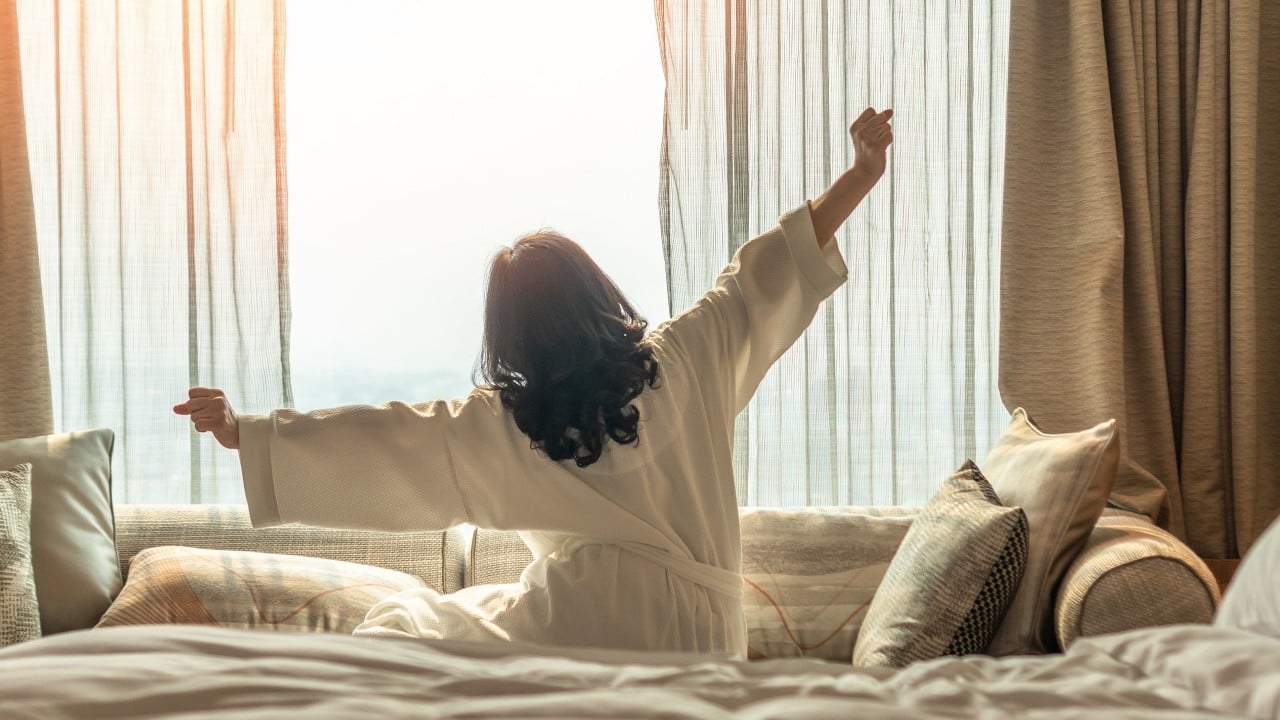
Inside Room 814, the woman wakes up naturally, without an alarm, without a cry, without a hand tugging at her sleeve. Sunlight bleeds through the edges of the blackout curtains, painting a thin gold line across the carpet. She stretches her legs against the cool cotton sheets, takes a slow, deep breath that reaches all the way to the bottom of her ribs, and reaches for her phone to switch off Do Not Disturb.
Outside that door, the world is waiting with all its noise, its deadlines, and its endless, beautiful demands. She swings her feet onto the floor, slips on her shoes, and walks back into her life—finally awake.