Silence.
That is what hits you first when you step off the gravel of the South Lawn and cross the threshold into the State Floor of the White House, a heavy, museum-grade quiet that smells faintly of beeswax, old wool, and seventy years of cold-war anxiety. Outside, the city hums with the frantic, metallic chatter of cable news producers and motorcade sirens. Inside, beneath the crystal chandeliers that have watched presidents age ten years in four, the air barely moves.
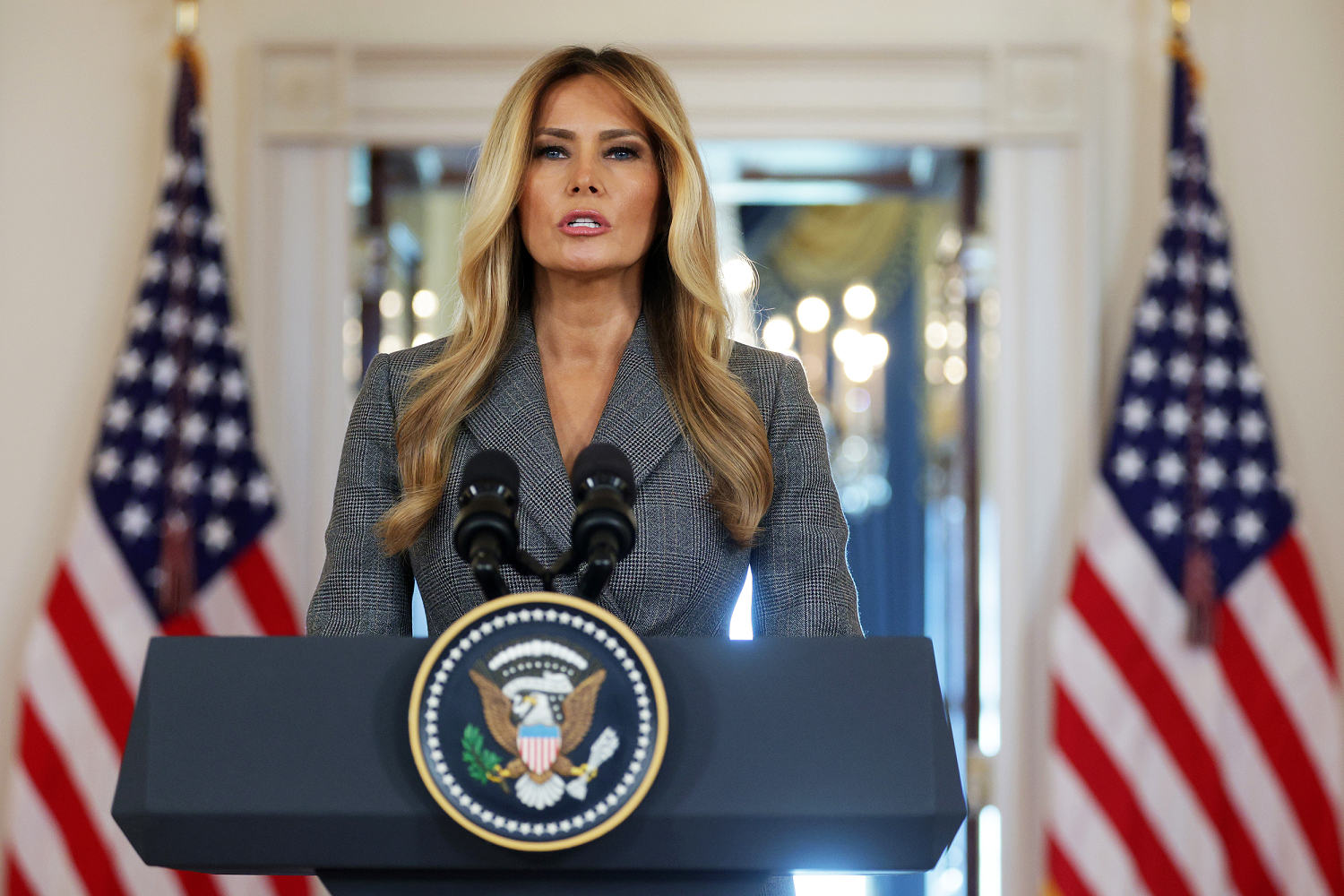
It was inside that stillness that Melania Trump gathered a room full of top officials and spoke a word that has become almost taboo in modern geopolitical circles.
Enduring.
Not a ceasefire. Not a tactical pause. Not a temporary freeze along a jagged trench line in the Donbas while both sides reload their artillery magazines. She asked for an enduring peace between Russia and Ukraine. And in a capital addicted to the quick hit of a breaking-news banner, the request landed with the strange, unsettling weight of an heirloom dropped onto a glass table.
To understand why those syllables matter—and why the people sitting around that table shifted in their gilded chairs—you have to leave the manicured hedges of Pennsylvania Avenue behind. You have to go where the maps stop being paper and start being mud.
The Arithmetic of a Half-Peace
Consider a hypothetical family living forty miles west of Kramatorsk. Let us call them the Kovalenkos—Olena, a former high school chemistry teacher, and her nine-year-old son, Taras. Neither of them exists in an official diplomatic briefing, yet millions of real people share their exact coordinates of exhaustion.
For Olena, peace is not an abstract noun debated by undersecretaries in tailored suits. Peace is the answer to a single, terrifyingly practical question: Do I buy winter boots for Taras in a size too big so he can wear them in a basement shelter next February, or do I buy sneakers for the schoolyard?
When Washington talks about a "negotiated settlement" or a "frozen conflict," Olena hears something entirely different. She hears a pause button. She knows what happens when diplomats sign a document designed merely to stop the bleeding until the next election cycle. A temporary truce is just a war holding its breath. You cannot plant an orchard during a ceasefire. You cannot rebuild a power grid when the engineers know the substations are still pre-programmed into a guidance computer three hundred miles away. You cannot tell a nine-year-old boy to unpack his suitcase when the truce expires in eighteen months.
I spent three winters reporting from borderlands where "peace" was written on crisp vellum in Geneva or Minsk while artillery still rattled the teacups on kitchen tables every Tuesday night. You learn quickly in those towns that half a peace is sometimes crueler than none at all, because it asks ordinary people to gamble their lives on the sincerity of men who have never slept in a flooded trench. You start measuring time not in months, but in the intervals between air-raid sirens. You learn the specific, hollow sound a city makes when everyone has left except the elderly and the stubborn.
That is the invisible ledger sitting in the center of the White House whenever top officials convene to discuss Eastern Europe. Every diplomatic compromise has a human invoice attached to it.
Why the Messenger Changes the Temperature of the Room
When a First Lady steps into the machinery of high-stakes foreign policy, Washington’s instincts are immediately cynical. The pundit class reaches for its usual deck of cards: optics, political positioning, soft-power choreography. We are trained to look at the East Wing as a stage for state dinners and literacy campaigns, while the West Wing handles the hardware—the Himars batteries, the sanction regimes, the intelligence briefings.
Yet history has a stubborn habit of ignoring our organizational charts.
Think back to the Cold War, when back-channel conversations and unexpected voices often broke deadlocks that the State Department had spent years cementing in place. Diplomacy, at its core, is just human psychology scaled up to the size of nations. When two adversaries have spent years screaming across a chasm through megaphones, the person who lowers their voice—or changes the setting entirely—forces everyone in the room to lean forward just to hear.
Melania Trump brings a distinct, almost jarring biographical perspective to a room full of career Washington strategists. She grew up in Sevnica, a small industrial town in what was then Yugoslavia, watching from across the border as the Iron Curtain rusted and eventually collapsed. She knows, in a way that someone raised in suburban Virginia or Manhattan simply cannot, that borders in Central and Eastern Europe are not permanent geological features. They are living scars. They move. They bleed. They swallow families whole when great powers treat small nations like bargaining chips on a green felt table.
When she hosted top officials at the White House and pressed the case for an enduring resolution to the Russia-Ukraine war, she was not reciting a defense contractor’s white paper. She was speaking the language of permanence to a town that rarely thinks past the next quarter.
Look closely at the mechanics of what happens in those closed-door sessions:
- The Shift from Tactical to Generational: Military planners think in campaigns—spring offensives, winter attrition, logistics corridors. By anchoring the conversation around enduring peace, the focus shifts from how to win the next ninety days to what the map looks like in twenty years.
- The Human Cost Audit: When officials are forced to articulate what "enduring" actually requires, they cannot hide behind casualty ratios or GDP contraction charts. They have to confront the millions of displaced Ukrainians scattered from Warsaw to Toronto, and the hundreds of thousands of young men on both sides who will never come home.
- The Accountability of Guarantees: An enduring peace cannot survive on a handshake. It demands enforceable security architectures, economic reconstruction that ties neighbors together rather than walling them off, and a diplomatic framework sturdy enough to outlast the leaders who sign it.
The Architecture of Things That Last
To understand the difference between a truce and an enduring peace, think about how you build a bridge across a river that floods every spring.
A truce is a pontoon bridge. You can throw it across the water in forty-eight hours. Tanks can roll over it; trucks can carry supplies across it; politicians can stand in the middle of it for a photo opportunity and declare the crossing open. It works brilliantly—until the snow melts in the mountains and the river rises six feet. Then the cables snap, the pontoons wash downstream, and the two banks are further apart than they were before you started.
An enduring peace is a suspension bridge sunk into bedrock. It takes agonizingly longer to engineer. You have to drill down through forty feet of silt and loose gravel just to find stone hard enough to hold the weight. The arguments over the blueprints are fierce, technical, and exhausting. Nobody gets a quick headline while you are pouring concrete underwater.
For more than a decade—stretching back to the annexation of Crimea in 2014 and exploding into full-scale catastrophe in February 2022—Europe has been living on pontoon bridges. The Minsk agreements were pontoons. The grain corridor deals were pontoons. Every time the water rose, the structure tore apart.
Why? Because the hardest questions were always deferred to "later." Sovereignty, security guarantees, NATO’s eastern flank, Russian imperial nostalgia, Ukrainian self-determination—these were treated as obstacles to be walked around rather than bedrock to be drilled into.
I will admit something that most foreign policy commentators hate saying out loud: nobody in Washington, Brussels, Kyiv, or Moscow has a clean, painless blueprint for how to drill into that bedrock today. Anyone who tells you the path to peace in Ukraine is simple is either selling you something or hasn't looked at a topographic map of Donetsk. The territory is soaked in blood and grievance. Trust between the warring capitals is below zero. The domestic politics on every side punish compromise as treason.
Confessing that difficulty does not mean surrendering to endless war. It means recognizing that amateur diplomacy—quick deals stitched together for a press conference—will unravel before the ink dries.
The Invisible Stakes in the Room
Let us return to that quiet room at the White House, where senior officials sat listening to the First Lady lay out her vision for a lasting settlement.
What were they actually weighing? Behind the polite nods and carefully worded readouts, every official in that room carries a set of competing anxieties. The national security advisors worry about deterrence—if aggression is rewarded with territory, what signal does that send to Beijing, Tehran, or Pyongyang? The diplomats worry about alliances—how do you keep European partners unified when energy prices and refugee fatigue test their patience? The economists look at the staggering bill for rebuilding Ukraine, a sum that the World Bank has already estimated in the hundreds of billions of dollars, knowing that private capital will never flow into a country if insurers believe missiles might rain down again in three years.
And beneath all of those spreadsheets sits the quietest, heaviest variable of all: fatigue.
War is a thief of attention. In the first months of the invasion, blue-and-yellow flags hung from suburban porches across America and Europe. Prime-time broadcasts opened every night with dispatches from Kyiv and Kharkiv. Three years later, the conflict has been pushed down the front page by domestic inflation, artificial intelligence, and fresh crises elsewhere on the globe. Yet in the trenches outside Pokrovsk, the mud is just as deep, the drones are just as lethal, and the mothers waiting by their phones in Lviv and Kursk are just as terrified.
When Melania Trump uses the platform of the White House to insist on an enduring peace, she is fighting against that global amnesia. She is refusing to let the war become background noise—an acceptable, permanent hum of tragedy that the West learns to live with while focusing on other priorities.
There is an old diplomatic truth that rarely makes it into textbooks: wars do not end when one side runs out of bullets. They end when both sides realize that the future they are destroying is worth more than the past they are trying to avenge.
Getting leaders to that realization requires pressure, leverage, and hard-nosed realism. Sanctions matter. Weapons deliveries matter. Intelligence sharing matters. None of those tools can be discarded while armies are still on the march. Yet hardware alone cannot write a peace treaty. At some point, someone has to walk into a quiet room and ask what the world is supposed to look like the morning after the guns go silent.
What Comes After the Chandeliers Dim
Eventually, the meeting at the White House ended. The heavy doors opened. Top officials stepped back out into the corridor, checking their phones, stepping back into the relentless current of Washington’s daily urgency. Statements were drafted. Carefully calibrated phrases were released to the press corps waiting near the briefing room.
Tomorrow, another crisis will demand the podium. Another briefing book will land on the desks of the West Wing.
Forty miles west of Kramatorsk, night falls early in late November. The wind comes flat and cold off the steppe, rattling the plastic sheeting taped over shattered window frames. Inside a small kitchen lit by a single battery-powered lantern, a boy lines up his boots beside the radiator, waiting to see whether tomorrow will be a day for schoolbooks or a day for the cellar.
Outside, the stars over Eastern Europe look exactly the same as they did a hundred years ago, indifferent to borders, treaties, and the speeches made beneath crystal chandeliers four thousand miles away. The only thing that changes what happens under them is whether the people in those quiet rooms have the courage to build something that actually lasts.